Introduction: A Legacy of Complexity in Indonesia’s Land Regime
Indonesia is widely regarded as having one of the most complex and diverse land-law systems in the world, shaped by a combination of statutory regulation and deeply rooted customary practices. The principal legal foundation of this system remains Law No. 5 of 1960 on Basic Agrarian Principles (UUPA), which, despite its foundational role, has remained largely unchanged since its enactment.
The UUPA was originally intended to unify Indonesia’s fragmented land regime under a single national framework. However, in practice, it has given rise to several structural challenges that continue to affect land governance and acquisition processes today. A key issue is the persistence of legal dualism, where formal statutory law operates alongside customary (adat) land systems. This coexistence has created ambiguity in ownership recognition, particularly in areas where land has not been formally registered. As a result, informal land evidence—such as girik, petok, and verponding—has historically functioned as a parallel system of claims, complicating efforts to establish clear and enforceable land rights.
Over the past few years, Indonesia has enacted reforms such as Government Regulation 18/2021, which aim to clarify and consolidate land ownership, streamline registration, and reduce disputes, particularly around customary land. These reforms are critical not only for domestic development but also for industrial investment, as Indonesia seeks to remain competitive in Southeast Asia. While countries like Vietnam and Malaysia have also advanced their land governance systems—offering singular ownership or freehold titles, respectively—Indonesia’s reforms are now positioning it to provide clearer, faster, and more secure land acquisition processes for investors and developers.
Indonesia’s Land Rights Structure: Registered Titles and Traditional Title Documents
In broad terms, Indonesia’s land rights structure can be divided into two principal categories:
1. Registered Title Document; and
2. Traditional Title Documents.
Understanding the distinction between these two document titles are essential, as the coexistence of both has historically been one of the main sources of complexity in land acquisition, particularly for investors and industrial park developers. At a high level, the distinction lies in the legal standing and registration status of the land title.
Registered Title
Registered Title refers to official and legally recognized land rights that have been properly registered with the Ministry of Agrarian Affairs and Spatial Planning / National Land Agency (ATR/BPN) and are supported by an issued certificate. These titles have clear legal standing under Indonesia’s agrarian framework and serve as the primary basis for ownership verification, transfer, financing, and dispute resolution.
Formal land rights typically include:
· SHM (Right of Ownership)
· HGB (Right to Build)
· HGU (Right to Cultivate)
· Hak Pakai (Right to Use)
· HPL (Right to Manage Land)
Because these rights are formally registered, they provide a higher degree of legal certainty, transferability, and enforceability, making them the preferred basis for commercial transactions and investment activities.
1. Right of Ownership Certificate / Freehold Title (SHM – Sertifikat Hak Milik)
Definition:
The Right of Ownership Certificate (SHM) is the strongest and most complete type of land right recognized under Indonesian agrarian law. The holder of an SHM has full rights over the use, management, transfer, and assignment of the land.
Key Characteristics
- Valid for lifetime and can be inherited
- No limitation on the period of use
- Can be used as collateral or loan security
- Cannot be owned by foreign citizens (WNA) or foreign legal entities
Legal Basis
- Article 20 of Law No. 5 of 1960 (UUPA)
“The right of ownership is a hereditary right, the strongest and most comprehensive right that a person can hold over land”
- Government Regulation No. 24 of 1997 on Land Registration
- ATR/BPN Ministerial Regulation No. 1 of 2010 on Land Service Standards
Who Can Hold It
- Indonesian citizens (WNI)
- Certain legal entities, such as cooperatives or religious foundations, subject to specific provisions underGovernment Regulation No. 38 of 1963
How SHM Can Be Obtained
- Purchase of land already holding SHM status
- Conversion from SHGB to SHM
- Inheritance
- Grant / donation
Advantages of SHM
- Considered the safest and strongest form of land ownership
- Holds the highest legal standing among land certificates
- Highest resale and investment value
2. Right to Build Certificate (SHGB / HGB – Sertifikat Hak Guna Bangunan)
Definition: SHGB is the right to construct and own buildings on state-owned land or land owned by another party for a specified period. It is commonly used by individuals, developers, and legal entities that wish to develop property without directly owning the land.
Key Characteristics
- Initial term: maximum 30 years
- Extendable for 20 years
- Renewable for an additional 30 years
- Limited in duration, unlike SHM,
- Can be sold, mortgaged, or inherited as long as the title remains valid
Legal Basis
- Article 35 of UUPA (Law No. 5 of 1960) “The right to build is the right to erect and own buildings on land not owned by the holder for a maximum period of 30 years.”
- Government Regulation No. 18 of 2021 on Management Rights, Land Rights, Flats, and Land Registration.
- ATR/BPN Ministerial Regulation No. 1 of 2010
Who Can Hold It
- Indonesian citizens
- Indonesian legal entities such as:
- Limited liability companies (PT)
- Cooperatives
- Foundations
- State-owned enterprises (BUMN/BUMD)
Foreign citizens may only access SHGB on a limited basis and subject to additional regulations.
When HGB Is Commonly Used
- Residential houses; shop houses / commercial units; apartments; industrial parks; warehouses and logistics facilities; large-scale commercial property development
- Property developers typically use SHGBs because of their flexibility and legal status for large-scale business activities.
Conversion to SHM
HGB may be upgraded into SHM provided that:
- The holder is an Indonesian citizen
- The land is not under security interest
- An application is submitted to the local land office
Important Note:
- If the HGB expires and is not extended, the land reverts to the state or to the underlying land title.
- The costs of renewal and extension are quite substantial and require a full set of documents.
3. Right to Cultivate Certificate (SHGU / HGU – Sertifikat Hak Guna Usaha)
Definition: SHGU is the right to cultivate land directly controlled by the state for:
- Agriculture
- Plantation
- Fisheries
- Livestock
This right is intended for large-scale productive agrarian activities, not residential or office development.
Key Characteristics
- Initial term: maximum 35 years
- Extendable for 25 years
- Renewable for an additional 35 years
- Limited in duration and must be used according to its designated purpose
- Can be transferred, inherited, or used as collateral
Legal Basis
- Article 28 of UUPA
- Government Regulation No. 18 of 2021
- ATR/BPN Ministerial Regulation No. 1 of 2010
Who Can Hold It
- Indonesian citizens
- Indonesian legal entities engaged in agrarian business, such as:
- Plantation companies
- Fisheries companies
- Livestock enterprises
- Agricultural cooperatives
Foreign citizens cannot directly obtain SHGU.
Examples of Use
- Palm oil plantation companies
- Smart farming projects
- Industrial-scale shrimp ponds
Obligations of SHGU Holder
- Must use the land according to its designated purpose
- Must pay land and building tax (PBB) and other levies
- May be revoked if not used according to function
4. Right to Use Certificate (Hak Pakai)
Definition: Hak Pakai is the right to use and/or derive benefits from land directly controlled by the state or owned by another party for a specified purpose and duration.
This does not grant full ownership, but rather a legally recognized right of use.
Key Characteristics
Can be granted over:
- State land
- HPL land
- Land owned by another party (with written contract agreement)
Duration:
- 30 years
- extension 20 years
- renewal 30 years
It cannot be upgraded to a Freehold Title as it is not freehold property
Legal Basis
- Articles 41–43 of UUPA
- Government Regulation No. 18 of 2021
- ATR/BPN Ministerial Regulation No. 1 of 2010
Who Can Hold It
- Indonesian citizens
- Foreign citizens
- Indonesian legal entities
- Foreign legal entities with representative offices
- Social institutions, consulates, and international organizations
This is the only land right that may be directly held by foreign citizens under Indonesian law.
Examples of Use
- Residential property for foreign nationals
- Foreign representative offices
- Schools, social foundations, orphanages
5. Right to Manage Land Certificate (HPL – Hak Pengelolaan)
Definition: Right to Manage Land (HPL) is a right granted by the state to legal entities or government institutions to manage and regulate the use of state land.
Important note:
HPL is not a direct ownership right, but rather a right to manage land. The land remains state-owned, but its management authority is delegated to the HPL holder.
Key Characteristics
The holder may:
- Manage and organize land use
- Lease the land
- Allocate portions to third parties through HGB or Hak Pakai
- Enter into commercial cooperation agreements
HPL itself does not have a fixed term provided, so long that the land is actively managed and used for a specific purpose (e.g. by a government agency or a state-owned enterprise).
Legal Basis
- Government Regulation No. 18 of 2021
- BPN Head Regulation No. 9 of 1999
- Article 2 and Article 4(1) of UUPA – The State, as the owner of land rights, grants management authority
Who Can Hold It
- Central and local government institutions
- BUMN / BUMD
- Special authorities
- Land Bank Agency
- Certain designated legal entities
Examples of Use
- Port areas managed by Pelindo → subsequently leased to logistics companies
- Airports managed by Angkasa Pura → leasing land to commercial tenants
- Industrial parks owned by state-owned enterprises → manufacturing companies lease land under a Right to Build (HGB) on land held under a Right to Use (HPL)
- Social housing (Rusunawa) on land held under a Right to Use (HPL) by local government
Advantages of HPL
- Provides flexibility for area-wide management
- Suitable for industrial parks and integrated zones
- Enables long-term commercial collaboration
Limitations
- Not an ownership title
- Cannot be freely transferred
- Use must comply with spatial planning and government approvals
From a practical perspective, land tenure structures in industrial developments can generally be categorized as follows:
- Industrial park developers typically hold one of these following options:
- HGB (Right to Build); or
- HPL (Right to Manage); or
- HGB over HPL (Right to Build over Right to Manage), where the underlying land is controlled by a government entity or state-owned enterprise
- Business operators / tenants within or outside industrial parks generally hold:
- HGB, either directly or derived from the developer’s land rights
- HGB over HPL
Traditional Title Document
In Indonesia, a significant portion of land—particularly in peri-urban and even urban areas—remains unregistered within the formal system of the Ministry of Agrarian Affairs and Spatial Planning / National Land Agency (ATR/BPN), a legacy that can be traced back to the colonial land administration framework. As a result, many parcels are still held under traditional land documents, rather than formally registered titles.
For companies seeking to acquire land, this creates an additional layer of complexity. In practice, land supported by traditional documents must first be formalized through registration with ATR/BPN, typically resulting in the issuance of a Freehold (SHM) certificate. Only thereafter can the land be converted into a Right to Build (HGB), which is the appropriate title for use by legal entities. This multi-step conversion process often contributes to delays in land acquisition, particularly for large-scale developments.
Traditional land documents are commonly identified in market practice as forms of customary or informal land ownership, particularly in rural and historically unregistered areas. While these terms are often used interchangeably, from a legal perspective, such documents should be understood primarily as evidence of historical possession, tax payment, or village-level land administration records, rather than conclusive proof of ownership comparable to registered certificates issued by ATR/BPN.
Indonesia recognises a wide range of legacy land documents, reflecting differences in historical administration and local land records. Among these, the most commonly encountered and still widely used documents today are Girik, Letter C (C Desa), and Petok D. These documents continue to serve as the initial basis for land claims and are frequently used in the process of first-time land registration.
Legal Basis
- Law No. 5 of 1960 on Basic Agrarian Principles (UUPA)
- Establishes that land rights must be registered to ensure legal certainty
- Government Regulation No. 24 of 1997 on Land Registration (jo. PP 18/2021)
- Serves as the principal basis for first-time land registration
- Article 24: proof of old rights may be established through:
- Written documentary evidence
- Witness testimony
- Physical possession
- ATR/BPN Regulations on PTSL and Sporadic Registration
- Regulates that land without formal certificates may still be registered based on:
- Evidence of physical possession
- Historical land documents
- Other juridical data
- Supreme Court Jurisprudence (consistent precedent)
- Establishes that Girik, Letter C, and Petok D are not proof of ownership
- Recognised as evidence of possession and historical control that may be assessed when issuing a certificate.
Clarifying the Legal Standing of Traditional Title Documents
- Girik
- A colonial-era land tax document (landrente)
- Indicates that an individual has historically paid tax over a parcel of land
- Doesnot constitute legal proof of ownership
- In agrarian practice, it may be accepted as an initial legal basis (alas hak) for first-time SHM registration
Legal standing: Administrative evidence of possession and tax history, not absolute proof of ownership
- Letter C (C Desa)
- A village-level land register recording the subject and object of land within the village territory
- Issued and maintained by the village administration, not by ATR/BPN
- Used to trace land history and hereditary control
- Does not provide strong legal proof of ownership on a standalone basis
Legal standing: Supporting evidence of land history and long-standing possession
- Petok D
- A legacy land tax document used prior to the modern land registration system
- Records the historical relationship between the landholder and the land parcel
- Similar to Girik, it does not establish formal ownership rights
- Commonly used as preliminary documentary evidence in first-time registration
Legal standing: Preliminary evidence of possession that must be supported by additional proof such as witness testimony, land history letters, and physical possession
In addition to Girik, Letter C, and Petok D, several other legacy land documents exist, largely originating from tax administration, village records, or colonial-era land systems, including:
- Petuk, Pipil, Kekitir, and Kohir– records of land tax payment, indicating historical control but not ownership
- Landrente and Verponding– colonial-era tax documents reflecting payment obligations to the state
- Petok D– proof of payment of tax on the land
- Erfpacht, Opstal, and Gebruik– colonial land rights related to use, cultivation, or building, which have since been converted or abolished under national land law
Key Legal Position: It is clear, that the legal standing for the traditional documents should not be interpreted as proof of ownership equivalent to SHM, HGB, or other registered titles. Their legal value lies in supporting the verification of possession and land history during the process of formal certification by ATR/BPN.
Structural Complexity in Indonesia’s Land Conversion and Legal Ambiguity
From the foregoing, it is evident that the coexistence of registered titles and traditional land documents has created a deeply complex land ownership landscape in Indonesia. The process of converting informal or historical land evidence into formally registered titles is often time-consuming and procedurally intricate, requiring multiple layers of verification, including documentary review, witness testimony, and confirmation of physical possession. For real estate and industrial park developers, this has translated into prolonged land acquisition timelines and heightened transaction uncertainty, particularly when assembling large, fragmented land parcels.
This complexity is further compounded by the legal ambiguity surrounding traditional documents. While instruments such as girik, petok, and Letter C do not constitute formal proof of ownership, they are still recognized as evidence of possession and land history, and may be considered in judicial proceedings. As a result, such documents have often been used to support competing claims in court, even where formal titles exist. In practice, this has also created exposure to document falsification and opportunistic claims, adding another layer of risk in land acquisition processes. These challenges are rooted in several structural characteristics of traditional land documentation:
- Lack of standardized legal recognition, creating ambiguity in determining legitimate ownership
- Overlapping and multiple claims over the same parcel of land
- Absence of centralized registration systems, particularly for village-level records
- Reliance on subjective verification, including witness testimony and informal land histories
- Fragmented ownership structures, especially due to inheritance without formal registration
- Vulnerability to document falsification, given weak verification mechanisms
- Judicial admissibility as supporting evidence, allowing disputes to persist even against formally registered titles
Regulatory Consolidation: Government Regulation No. 18 of 2021
It is within this context of structural complexity and legal ambiguity that the Government released a regulation in 2021, Government Regulation No. 18 of 2021 regarding Management Rights, Land Rights, Flats, and Land Registration (GR 18/2021) becomes particularly significant. The regulation represents a decisive policy intervention aimed at resolving the long-standing coexistence between formal land titles and informal land evidence.
One of its most critical provisions is the introduction of a time-bound requirement to formalize land rights. Under this framework, land supported by traditional or customary documentation must be converted into formally registered titles within a specified transition period.
This regulation introduced several key changes:
- Strengthening the framework for land rights, management, and registration
- Reinforcing the role of the state in land administration
- Introducing clearer rules on land utilization and tenure
Most critically, the regulation set a deadline for the recognition of informal or customary land evidence. According to Article 96 of GR 18/2021, it articulates:
(1) Written evidence of former customary land owned by individuals must be registered within a maximum period of 5 (five) years from the date of entry into force of this Government Regulation.
(2) Should the period referred to in paragraph (1) expire, the written evidence of former customary land shall be deemed invalid and may not be used as evidence of land rights, but only as a reference for the purposes of land registration.
As of February 2026, traditional land documents—such as girik, petok, verponding, and similar forms—are no longer be recognized as valid proof of land rights, and may only serve as historical references in the land registration process.
Any land supported solely by traditional or customary documents that has not been formally registered with the Ministry of Agrarian Affairs and Spatial Planning / National Land Agency (ATR/BPN) will, after February 2026, according to Article 95 of GR 18/2021, no longer be recognized as valid legal title. Such land will be treated as state-controlled land, subject to further determination under prevailing regulations.
However, landholder individuals may still apply for formal registration, through PTSL (Pendaftaran Tanah Sistematis Lengkap), a nationwide program by ATR/BPN to systematically register all land parcels in Indonesia, aimed at accelerating certification and strengthening legal certainty of land ownership. In this process, traditional documents may continue to be used as supporting evidence of possession and land history, subject to verification. In the lead-up to the 2026 deadline, this regulatory push has accelerated land formalization, with approximately 5 million land parcels registered and 1.8 million certificates issued in 2025 alone.
Implications for Land Acquisition
This reform marks a fundamental transition from a system historically influenced by possession-based claims toward a fully title-based land administration system. For investors and developers—particularly in real estate and industrial park development—the implications, once fully implemented, are significant. However, the effectiveness of this transition will require time for institutional and market adjustment, particularly in aligning administrative capacity, data integration, and on-the-ground verification processes.
In practical terms, this transition is expected to deliver several key improvements in the land acquisition process:
- Reduction in Legal Uncertainty: The elimination of informal land evidence directly reduces the risk of overlapping and competing claims.
- Improved Transaction Certainty: Land acquisition will increasingly rely on registered titles, enabling clearer verification and transfer processes.
- Acceleration of Land Consolidation: The standardization of land ownership documentation is expected to streamline the process of assembling large land parcels.
Looking Through A Lens in the Vietnamese Land Ownership Regulations
Different from Indonesia—which features multiple types of land rights, layered ownership structures, and the added complexity of customary land claims—Vietnam adopts a simpler and more centralized land regime. The system is built around a single concept: Land Use Rights (LUR), commonly evidenced through the Land Use Rights Certificate (LURC), also known as the “Red Book.”
Under Vietnam’s land law framework—most recently governed by the 2024 Land Law (No. 31/2024/QH15), replacing the 2013 Land Law—the State retains ultimate ownership of all land. As stipulated in the law, land belongs to the people, with the State acting as the sole administrator, responsible for allocating land and determining its permitted use.
Key Laws Governing Land Acquisition
The Vietnamese land regime is supported by a relatively streamlined set of regulations:
- 2024 Land Law (effective January 1, 2025) – establishes land use rights, tenure, and allocation mechanisms
- Law on Investment 2020 (as amended) – governs investment approvals, including project-linked land use rights
- Decree 43/2014/NĐ-CP – details implementation of land allocation and leasing
- Decree 148/2024/NĐ-CP – regulates issuance and transfer of Land Use Rights Certificates (LURCs)
Land Use Rights Framework for Investors
Investors in Vietnam cannot own land outright but instead obtain Land Use Rights (LURs), through a lease from the State. These rights are formalized through the issuance of a LURC, which serves as the primary legal instrument guaranteeing land use. Land in Vietnam is broadly categorized into:
- Agricultural land
- Non-agricultural land
- Unused land
For most foreign investors (FDI), the relevant category is non-agricultural land, particularly for:
- Industrial parks
- Manufacturing facilities
- Logistics and commercial operations
In terms of tenure:
- Foreign investors typically receive LURs for up to 50 years
- Extensions may be granted for another 50 years (subject to approval), or the government may take the land back if the party has failed to use the land under the terms and conditions of the LURC.
- Domestic entities may obtain indefinite use rights depending on land type
Four ways to lease land
For investors keen on leasing land in Vietnam, there are several ways to obtain land with a LURC, although the government enumerates different methods for locals and foreigners. There are four available methods that investors can choose from.
- Method 1:The first method is through allocation, where the state allocates a LURC via an administrative decision. Land users are required to pay land use fees to the government and this option is available to investors in residential housing projects and infrastructure projects in cemeteries.
- Method 2:The government leases the land to the land user where the user pays rent to the government. The rental may be paid in a lump sum or annually. This is in many ways like the customary system of renting.
- Method 3:The third option is by a lease or sub-lease agreement with the landlord in an industrial zone or park, industrial cluster, processing zone, high-tech zone, or an economic zone. The landlord is typically a commercial enterprise that has obtained land use rights under the above two mentioned options.
- Method 4:The fourth option is by an agreement on the transfer of assets that are attached to the land with an agreement on the transfer of land use rights, a land lease agreement, or a capital contribution with an existing land user. In such cases, the investor acquiring land use rights will become the land user of the acquired land area.
Land Use Rights and Transaction Flexibility
The scope of rights available to investors depends largely on the payment structure. An individual or business entity can either lease a piece of land and pay annual rent (called the “annual arrangement”) or provide the entire lease amount in one payment (called the “one-off arrangement”).
- Annual Payment Arrangement
- Limited rights
- Cannot freely transfer or sublease land
- Primarily for operational use
- One-Off Payment Arrangement
- Greater flexibility
- Allows transfer, sublease, mortgage, and capital contribution using LURs
- More aligned with investment and financing needs
Furthermore, the government allows the opportunity to contribute capital in the form of the LURC and assets to a joint-venture (JV).
Steps Required for Leasing Land
While leasing land in Vietnam is relatively structured, investors must follow a sequential regulatory process to secure land use rights. As an initial step, investors may obtain an “Approval in Principle” from the provincial People’s Committee, which provides an early indication of the project’s feasibility. While this approval is non-binding and does not guarantee final authorization, it serves as an important preliminary assessment before entering into any land-related commitments. Following this, the investor must complete the core establishment and investment approvals:
- Investment Registration Certificate (IRC)
- Enterprise Registration Certificate (ERC)
Once these approvals are secured, the investor can proceed to enter into a Land Lease Agreement with the relevant People’s Committee or authorized entity Finally, the investor must submit an application to the Ministry of Natural Resources and Environment (MONRE) at the local level to obtain the Land Use Rights Certificate (LURC),which formalizes the legal right to use the land.
Industrial Park Land Ownership Structure: No Layered Ownership
As seen in the above explanation, in practice, industrial park developers also obtain primary Land Use Rights from the State, typically through long-term leases. These developers then sublease the land to tenants, who receive the derivative from the LURs. Unlike Indonesia, Vietnam does not apply a layered land rights system (e.g., HGB over HPL). Instead, it operates under a single-tier structure, where:
- The State retains ownership
- Developers hold primary LURs for 50 years, and can be extended for another 50 years (depending on project, location, and approval).
- Tenants receive subleased LURs for the duration of their occupancy
From this, we can see that land acquisition for industrial park in Vietnam is generally more straightforward compared to Indonesia. This is primarily because:
- Single-tier ownership: Developers deal directly with the State for LURs, avoiding the complex layering of rights seen in Indonesia
- Clear legal framework: The Land Law clearly defines procedures, tenure, and permissible uses for leased land, reducing ambiguity.
- Minimal historical/customary claims: Unlike Indonesia, where traditional land documents, can complicate verification and provoke disputes, Vietnam’s State-administered LUR system mitigates these risks.
Looking Through a Lens in the Malaysian Land Ownership Regulations
In ASEAN, other than Singapore, Malaysia is also known for its clear and accessible ownership structure other than its peers. The Malaysian real estate market is highly attractive to both local and foreign investors. However, different types of property ownership vary in legal attributes, tenure periods, and market liquidity. The main types of property ownership in Malaysia include:
- Freehold – Perpetual ownership with no time
Freehold ownership means that the owner of a property or land holds the title indefinitely without the need for renewal. In general, it can be said that there are no government-imposed tenure limits and the owner has the freedom to sell, transfer, inherit, or mortgage the property without restriction.
However, certain freehold properties may still be subject to government-imposed restrictions such as state government approval, Malay Reserved Land, or Bumiputera-designated lots. This type of ownership is primarily regulated under the National Land Code 1965 (hereinafter referred to as “NLC”) and is widely regarded as the most valuable and investment-worthy property tenure in the Malaysian market.
Key Features:
- Stability of Ownership: Owners have full control over the land or property without the need to apply for renewal or pay additional fees to the government.
- Higher Market Value: With no time restrictions, freehold properties are generally more desirable than leasehold properties and tend to have greater appreciation
- Minimal Government Intervention: The government will not interfere with the sale or transfer of freehold land or property as long as urban planning regulations are followed,
Limitations of Freehold Ownership
- Restrictions on Certain Types of Land: Certain categories of land, such as Malay Reserved Land, remain exclusively available to Malay buyers, regardless of their freehold status.
- Restrictions on Foreign Buyers: Some State Governments impose a minimum purchase price requirement for foreign buyers acquiring freehold properties.
- Leasehold Ownership – Fixed Tenure with Renewal Requirements
Leasehold ownership refers to the right to use land or property for a specified period (typically 99 years, though some leases extend for 60 years or 30 years). When the lease expires, ownership will automatically revert to the state government unless the owner applies for a renewal. However, renewing a lease is not automatic and it depends on government policies, requires the payment of a premium, and is subjected to approval of the state government.
Standard Leasehold Terms:
- Peninsular Malaysia (West Malaysia): In West Malaysia, lease terms are generally 99 years, though some areas have shorter leases of 60, 50, or 30 years, depending on state policies and land designation.
- East Malaysia (Sabah & Sarawak): In East Malaysia (Sabah & Sarawak), leasehold tenure is typically 30 to 60 years, while 99-year leases are quite rare. A significant portion of land is designated under Native Customary Rights (NCR) land or Native Title Lands, which are reserved for Bumiputera communities. However, certain leasehold properties may still be available to non-Bumiputera buyers, subject to state government approval. Such lease terms can vary between 30 to 99 years depending on the land status and local policies.
Key Characteristics of Leasehold Ownership
- Limited Tenure: Leasehold properties come with a fixed expiration date, and as the lease period gets shorter, the property’s market value and appeal may decrease.
- Complex Renewal Process: Renewing a lease requires state government approval and involves paying a premium, with costs varying depending on the state’s policies.
- Financing and Loan Restrictions: Banks are generally more cautious about approving loans for leasehold properties with less than 50 years remaining, which can make financing more challenging for buyers.
Lease Renewal Process
According to s.197 and s.76 of the National Land Code 1965 (NLC), property owners can apply for a lease renewal from the state government and the state government will then specify the renewal conditions and fees required. If a lease expires without a renewal application, ownership of the land or property automatically reverts to the state government. To prevent this, property owners must proactively apply for lease renewal before the lease period ends to retain ownership.
Costs Involved in Lease Renewal
- Premium Payment: A one-time fee required for lease renewal, calculated based on the government-assessed market value of the land. The exact amount varies depending on the state and land use.
- Administrative Fees: Includes legal fees, government processing fees, and other related costs.
- Land Lease Rights – Usage Rights Without Ownership
Under Malaysian land law, Land Lease Rights do not provide ownership of the land. Instead, they grant the right to use the land for a specific period, subject to the terms of a lease agreement. Unlike leasehold properties, which are governed by the National Land Code 1965 (NLC), land leases are typically regulated under contract law and subject to state government approval.
Key Features of Land Lease Rights in Malaysia:
- No Ownership Rights: The tenant (lessee) is only granted the right to use the land, while the ownership remains with the landowner, which could be the state government or a private entity.
- Limited Land Use: Land leased under this arrangement is mainly for agriculture, industrial, or commercial purposes, such as plantations, factories, or petrol stations.
- State Government Oversight: Certain types of land leases, such as Temporary Occupation Licenses (TOL), require approval and renewal from the state government.
- Non-Transferable (Unless Stated in Contract): Most land lease agreements cannot be sold, subleased, or transferred without the landowner’s consent.
Steps Required to Acquire Industrial Land or Property
Acquisition of property by non-citizens and foreign companies in Malaysia is governed primarily by:
- The National Land Code (NLC, revised 2020, Act 828)
- Guidelines issued by the Economic Planning Unit (EPU)
- Relevant rules and regulations imposed by the State Authority
Investors seeking to acquire industrial land or property must comply with the following steps:
1. Acquisition Approval under the NLC:
Under Section 433E of the NLC, any non-citizen or foreign company intending to acquire property must submit a written application to the relevant State Authority to obtain approval.
- State Authority Approval: The approval may be subject to specific terms and conditions set by the State Authority and may require the payment of prescribed levy fees.
- This step is mandatory before any transfer of land title can take place.
2. Minimum Purchase Price & Permitted Property Types:
Each Malaysian state has its own regulations regarding:
- Minimum property purchase price that foreign buyers must meet.
- Types of properties that may be acquired by foreign entities, including industrial land, freehold or leasehold properties.
These thresholds vary by state and are intended to ensure alignment with local planning, economic policies, and Bumiputera interests.
4. Guidelines on Acquisition Issued by the EPU:
The Economic Planning Unit (EPU) provides additional guidance to regulate foreign investment in real estate, particularly to protect national interests:
- Direct acquisitions of real estate above a certain value require EPU approval prior to State Authority consent.
- Indirect acquisitions, such as acquiring control of a Malaysian company holding significant land assets, are also subject to approval if the land value exceeds thresholds.
- Conditions may include minimum Bumiputera equity requirements, capital thresholds, and compliance with broader economic policies.
5. Additional Considerations
- State Consent: Even after meeting NLC and EPU requirements, final State Authority consent is required before registration of title.
- Financial Implications: Approval may involve levy fees, premium payments, and administrative costs, which vary by state and land type.
- Strategic Structuring: Foreign investors often use Malaysian subsidiaries or joint ventures to comply with ownership, equity, and registration requirements.
Industrial Park Structure in Malaysia
From this, we can see that industrial park developers in Malaysia can typically acquire land in the form of freehold or leasehold titles directly from the State or private owners. Once secured, developers can develop and subdivide these land parcels for industrial use, and then lease individual plots or built units to tenants under contractual agreements that reflect the developer’s underlying title.
- Freehold Titles: Developers may acquire land freehold, providing indefinite ownership rights. This allows them to subdivide, sell, or lease plots without a fixed end date.
Example: Tiara Industrial Park 7 in Kajang, Selangor, a freehold industrial park spanning approximately 93 acres (about 37.6 hectares), offering individually freehold titled industrial plots suitable for light and medium industrial use. This project is developed and managed by Kueen Lai Group, a Malaysian property development company known for industrial and mixed‑use projects.
- Leasehold Titles: Land may also be held on leasehold tenure, whereby developers have the right to use the land for a fixed term (e.g., 60–99 years) and can then sublease plots to tenants. Under leasehold, the land reverts to the State or original owner at expiry, unless renewed.
In either title scenario:
- Developers do not transfer full land ownership to tenants merely by leasing, unless the developer grants subdivided freehold parcels.
- Tenants typically hold commercial leases or plot leases from the developer, which may include long‑term contractual rights suited to business operations.
Industrial Land Ownership in ASEAN: Comparing Indonesia, Vietnam, and Malaysia
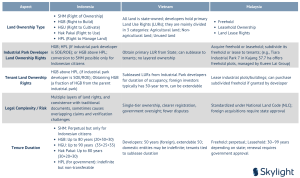
Indonesia, Vietnam, and Malaysia each present distinct approaches and challenges for industrial park development. In Indonesia, land ownership is complex and layered, while historical or informal documents still play a role. This creates legal and administrative complexity, making acquisition slow and negotiations with multiple claimants necessary, particularly for foreign investors who face ownership restrictions.
Vietnam, by contrast, operates a more centralized system where all land is state-owned and investors hold Land Use Rights (LURs) evidenced by the Red Book. This reduces legal ambiguity and historical disputes, but tenure is limited—usually 50 years for foreign entities—and investors are heavily dependent on government approvals.
Malaysia offers the clearest framework, with freehold and leasehold land under the National Land Code. Freehold ownership provides long-term security, and leaseholds are generally standardized, though state-specific regulations and foreign investment thresholds require careful compliance.
Overall, Indonesia offers high potential but high complexity, Vietnam provides structured but time-bound rights, and Malaysia delivers legal certainty and predictability, particularly for long-term investments.
Indonesia’s Land Reform & Regional Competitiveness
Land is one of the most critical factors for companies establishing production facilities, making clear and secure ownership essential for both domestic and foreign investors. In Indonesia, the enactment of Government Regulation 18/2021, along with the expiration of customary land ownership titles in February 2026, is expected to provide a more transparent, streamlined, and legally certain process for land acquisition. This reform aims to reduce disputes, simplify registration, and improve access for investors, real estate developers, and industrial park operators.
However, Indonesia is competing in a regional landscape where speed and certainty in land acquisition are key to attracting investment. Vietnam, with its system of singular land ownership, offers streamlined procedures that enable faster project implementation, while Malaysia’s freehold titles continue to provide an attractive and secure option for investors. Going forward, the ability of countries to enhance land governance and facilitate efficient acquisition processes will play a decisive role in determining where investment flows.
Sources
- Skylight Analytics Hub
- ABNR Law (n.d.)New omnibus law regulation makes significant changes to Indonesian land law regime. Available at: https://www.abnrlaw.com/news/new-omnibus-law-regulation-makes-significant-changes-to-indonesian-land-law-regime (Accessed: 12 March 2026).
- Mitra Jasa Hukum (n.d.)Kekuatan hukum girik, letter C, dan petok sebagai alas hak atas tanah untuk penerbitan SHM.Available at: https://mitrajasahukum.com/kekuatan-hukum-girik-letter-c-dan-petok-dsebagai-alas-hak-atas-tanah-untuk-penerbitan-shm/ (Accessed: 13 March 2026).
- Klik Legal (n.d.)Membeli tanah di luar kawasan industri: Apakah calon investor dapat membangun pabrik perakitannya? Available at: https://kliklegal.com/membeli-tanah-di-luar-kawasan-industri-apakah-calon-investor-dapat-membangun-pabrik-perakitannya/ (Accessed: 15 March 2026).
- ATR/BPN Sumbar (n.d.)Apa saja jenis sertipikat tanah. Available at: https://sumbar.atrbpn.go.id/informasi%20pertanahan/apa-saja-jenis-sertipikat-tanah (Accessed: 24 March 2026).
- Schinder Law Firm (n.d.)The complexity of land acquisition in Indonesia: Bridging traditional land documentation and legal certainty. Available at: https://schinderlawfirm.com/blog/the-complexity-of-land-acquisition-in-indonesia-bridging-traditional-land-documentation-and-legal-certainty/ (Accessed: 24 March 2026).
- Rumah123 (n.d.)Bukti kepemilikan tanah selain sertifikat. Available at: https://www.rumah123.com/panduan-properti/bukti-kepemilikan-tanah-selain-sertifikat/ (Accessed: 24 March 2026).
- Aesia Kemenkeu (n.d.)4 jenis hak atas tanah yang berlaku di Indonesia. Available at: https://aesia.kemenkeu.go.id/berita-properti/properti/4-jenis-hak-atas-tanah-yang-berlaku-di-indonesia-101.html(Accessed: 24 March 2026).
- Kompas (2026)Surat tanah lama tak berlaku mulai 2 Februari 2026: Ini dampak dan… Available at: https://www.kompas.com/jawa-barat/read/2026/01/27/133000688/surat-tanah-lama-tak-berlaku-mulai-2-februari-2026-ini-dampak-dan?page=all#google_vignette (Accessed: 24 March 2026).
- Kompas (2025)Apa itu verponding: Jenis surat tanah yang tak berlaku 2026. Available at: https://www.kompas.com/jawa-timur/read/2025/12/18/155500688/apa-itu-verponding-jenis-surat-tanah-yang-tak-berlaku-2026-#google_vignette (Accessed: 28 March 2026).
- Kompas Properti (2025)Tak berlaku 2026: Kenali girik, letter C, dan verponding. Available at: https://properti.kompas.com/read/2025/07/01/142918621/tak-berlaku-2026-kenali-girik-letter-c-dan-verponding#google_vignette (Accessed: 28 March 2026).
- Baker McKenzie (n.d.)Global corporate real estate guide: Malaysia – Real estate law. Available at: https://resourcehub.bakermckenzie.com/en/resources/global-corporate-real-estate-guide/asia-pacific/malaysia/topics/real-estate-law (Accessed: 28 March 2026).
- Vietnam Briefing (n.d.)Land rights in Vietnam: What they are and how you can acquire land. Available at: https://www.vietnam-briefing.com/news/land-rights-vietnam-what-they-are-and-how-you-can-acquire-land.html/#:~:text=In%20Vietnam,%20land%20is%20collectively%20owned%20by,land%20use%20rights%20permitted%20within%20the%20law (Accessed: 28 March 2026).
- Vietnam Briefing (n.d.)Vietnam amends business registration rules. Available at: https://www.vietnam-briefing.com/news/vietnam-amends-business-registration-rules.html/ (Accessed: 30 March 2026).
- Ant Lawyers (n.d.)Real estate ownership in Vietnam. Available at: https://antlawyers.vn/library/real-estate-ownership-in-vietnam-10.html#:~:text=In%20general,%20it%20is%20not%20permitted%20to,of%20Vietnam%20thereby%20operates%20as%20the%20administrator (Accessed: 30 March 2026).
- Live and Invest Overseas (n.d.)Real estate Vietnam. Available at: https://www.liveandinvestoverseas.com/country-hub/vietnam/real-estate-vietnam/ (Accessed: 30 March 2026).
- Narotama FH (2011)Indonesia and Vietnam land law. Available at: https://fh.narotama.ac.id/2011/08/indonesia-and-vietnam-land-law.html#:~:text=Land%20law%20in%20Vietnam%20is,*%20Non%2DAgriculture%20land%20category (Accessed: 30 March 2026).
- Viettonkin Consulting (n.d.)Buying land in Vietnam. Available at: https://viettonkinconsulting.com/legal-and-compliance/buying-land-in-vietnam/ (Accessed: 24 February 2026).
- HHQ (n.d.)Acquisition of property by non-citizen/foreign companies in Malaysia. Available at: https://hhq.com.my/posts/acquisition-of-property-by-non-citizen-foreign-companies-in-malaysia/#:~:text=Under%20Section%202%20of%20the,fees%20as%20may%20be%20prescribed (Accessed: 24 February 2026).
- Terra Group (n.d.)Freehold vs leasehold in Shah Alam industrial parks: Which is better? Available at: https://terragroup.my/blogs/freehold-vs-leasehold-in-shah-alam-industrial-parks-which-is-better (Accessed: 24 February 2026).
- iProperty (n.d.)Foreigners buying property in Malaysia: Complete guide. Available at: https://www.iproperty.com.my/guides/foreigners-buying-property-malaysia-complete-guide-12332 (Accessed: 24 February 2026).
- NZ Chambers (n.d.)Overview of Malaysia’s legal framework for acquisition of real estate by foreign company. Available at: https://nzchambers.com/overview-of-malaysias-legal-framework-for-acquisition-of-real-estate-by-foreign-company/ (Accessed: 24 February 2026).
Disclaimer
The content on this platform (“Platform”) is proprietary to Skylight, protected under copyright and intellectual property laws, and cannot be reproduced or used without written authorization. The insights shared are for informational purposes only, do not constitute professional advice, and may not reflect the latest industry developments. Skylight and its contributors disclaim all liability for actions taken based on the content and do not guarantee specific outcomes from past insights or case studies. Use of the Platform does not establish any contractual or advisory relationship with Skylight. By accessing this Platform, you agree to these terms. © 2026 Skylight Strategic Indonesia. All rights reserved.