EXECUTIVE BRIEF: Sports Promotion and Higher Value-Added Development of Indonesia’s Textile Industry
Executive Summary
Indonesia makes a lot of clothing, but keeps too little of the value. The country has real garment manufacturing scale and a strong export position in finished apparel. Yet it remains heavily dependent on imported inputs — and the reason goes deeper than policy or habit. Domestic upstream and intermediate producers often do not yet match what garment manufacturers actually need: the right price, consistent quality, precise specifications, functional performance, and reliable delivery. The result is a structural gap at the intermediate stages — materials, fabric development, dyeing and finishing, functional treatments, testing, and product specification — where imports fill what local supply cannot. In short, Indonesia produces the garment but captures a thin slice of the margin, know-how, and decision-making behind it.
The rise of sportswear and active lifestyles changes the opportunity. A growing domestic market — projected to expand from roughly IDR 38.5 trillion in 2025 to IDR 58.6 trillion by 2030 — gives Indonesia a practical platform to build the higher-value functions it currently lacks. Sportswear demands integrated capability: fabric structure, functional finishing, performance testing, and product proposals all working together. That makes it an ideal training ground for suppliers to move up the value chain.
The strategic goal is not to replace Indonesia’s labor-intensive OEM base. It is to add higher-value functions around that base — R&D, fabric development, testing, and proposal-based manufacturing — so that more value stays in the country from each garment produced. Indonesia’s climate and Muslim culture add a further advantage, opening differentiated niches in functional, modest, and halal-traceable sportswear for domestic and regional markets.
Core thesis: Indonesia already has scale. What it lacks is domestic capability in the functions that drive value capture. Sportswear is the best near-term platform to build them.
Key Takeaways
- Indonesia is strong in garments but weak in between. Finished apparel exports well, but intermediate stages — fabric formation, dyeing, finishing, and functional processing — remain heavily import-dependent.
- The core problem is a supply-demand mismatch, not just a volume gap. Garment manufacturers source abroad because domestic upstream supply often does not meet their requirements on price, quality, specifications, functional performance, consistency, and delivery. More local production alone will not fix this.
- Upgrading means competitiveness, not just capacity. Industrial policy should focus on making intermediate-stage producers competitive enough that downstream buyers choose them on merit — not on restricting access to imports.
- Sportswear is a practical platform to close the gap. It demands integrated capability — functional fabrics, performance testing, precise specs, and product proposals — and the growing domestic market gives local suppliers a real proving ground.
- Differentiation is available now. Climate, function, and modest/halal positioning give Indonesia defensible niches at home and across ASEAN, the Middle East, and South Asia.
- Upgrade, not displace. Add higher-value functions around existing OEM manufacturing.
Pillar 1: Scale Already Exist
Indonesia has a broad manufacturing base spanning synthetic fibers, polyester, knitting and weaving, dyeing and finishing, and garments. The textile and apparel sector (TPT) employs around four million people and anchors a significant export position.
But capacity use reveals an imbalance. In July 2025, garment capacity utilization stood at 72.67%, while the textile sector reached only 51.71%. The downstream, labor-intensive end runs hotter than the upstream, capital-intensive one. The foundation is in place — the challenge is what sits on top of it.
Pillar 2: The Problem Is a Mismatch, Not Just a Volume Gap
Indonesia’s garment manufacturers rely heavily on imported fabric. For “other fabrics” used by apparel makers (KBLI 1411), roughly 207 million kg out of 261 million kg total consumption was imported in 2023 — an import share near 79%. The intermediate stages that determine performance and margin are largely sourced abroad.
This dependence is structural, not accidental. Policies such as KITE Pembebasan, which exempt import duties and taxes on materials used for export production, let garment exporters procure overseas fabric efficiently. That is good for export competitiveness but reinforces reliance on imported inputs.
The real policy objective is not to block imported fabric. It is to build domestic fabric competitiveness strong enough that local materials get selected on merit — even when imports are easy to procure.
Where does the value sit? In the functions Indonesia underperforms today:
- Fabric engineering and structure
- Dyeing and finishing
- Functional treatments (moisture management, cooling, stretch, UV protection)
- Testing and certification
- Prototyping and product development
- Material and specification proposals to brands
Global brand requirements show how demanding this is. As of fiscal 2026, Nike worked with 205 strategic Tier 2 material suppliers and emphasized long-term relationships built on proven quality, mass-production reliability, delivery, and development capability. Acquiring capacity is not enough. Suppliers must build a track record before they can replace established sources.
Pillar 3: Sportswear Is a Practical Upgrading Platform
Sportswear is no longer just athletic gear. It has become everyday wear, leisurewear, and fashion — and the market is growing steadily. That demand is useful for more than sales. It is a supplier-learning engine.
As a demand engine, domestic sports brands act as anchor customers. They provide the first source of product-development demand for local material and fabric makers, and real consumer and athlete feedback to improve materials, structures, and finishing.
As a learning platform, school and community sports matter most. This segment does not require elite performance — it prioritizes affordability, durability, washability, breathability, quick-drying, and comfort. Supplying it in large, stable volumes lets manufacturers climb a clear curve: from basic apparel, to functional apparel, to premium and performance wear. Each step builds not just production capacity but domestic capability in product planning and material development.
In this model, the domestic sports market becomes the place where local brands and fabric makers jointly plan products, prototype fabrics, launch them, and feed results back into improvement. That is how suppliers earn the credibility needed to export across ASEAN or join global brand supply chains.
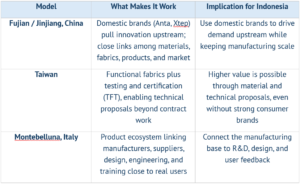
What the Overseas Cases Tell Us
Pillar 4: Differentiate Through Climate, Function, and Modest/Halal Positioning
Indonesia does not have to compete only on cost or generic capability. Its environment and culture open distinctive niches.
Functional fabrics suited to a hot, humid climate — lightweight, quick-drying, breathable, thermal-comfort — are a natural development focus with direct relevance to ASEAN, the Middle East, and South Asia.
Modest and halal sportswear is a market Indonesia is uniquely positioned to own. Halal considerations reach beyond finished products into dyes, adhesives, processing agents, and animal-derived inputs. If traceability is built as a genuine supplier capability — not just regulatory compliance — it becomes a competitive advantage for proposals in Muslim markets regionally.
Developed, prototyped, sold, and refined at home, these products turn Indonesia’s climate and culture into a product-development edge rather than a constraint.
Strategic Priorities
1. Use the domestic sports market as a supplier-development platform.
Position domestic sports brands as anchor customers that generate first demand for local material and fabric development. Start with school and community sports for stable volume and learning.
2. Build Product Development & Textile Innovation Function.
Establish shared R&D and testing capability connecting material producers, fabric makers, garment companies, brands, universities, and testing institutions. Build on existing assets — for example, BDI Surabaya’s CLO3D digital design training — and position them as a product-development platform, not just education.
3. Close the Mismatch at The Intermediate Stages — not just Expand Volume.
The goal is not to produce more domestic fabric. It is to make domestic intermediate-stage producers — in fabric formation, dyeing, finishing, functional treatment, and testing — competitive enough that garment manufacturers choose them on merit. That means closing the gap on price, quality, technical specifications, functional performance, consistency, and delivery time. Measure progress not by fiber tonnage or production volume, but by how often downstream buyers select domestic supply over imports.
4. Develop differentiated niches in functional, modest, and halal sportswear.
Treat climate-suited performance fabrics and halal traceability as product-development markets with built-in regional export potential.
Across all four priorities, one principle holds: add higher-value functions around existing OEM manufacturing — not replace it. OEM production remains a vital base for employment and exports. The aim is to retain more technology, margin, and decision-making per garment, not to move away from Indonesia’s current strengths.
Skylight Opionion
Indonesia’s sports and textile industries should be developed together, through a deliberate cross-sector approach. Demand and user feedback generated by sports promotion can flow back to brands, fabric makers, garment companies, and research institutions — turning a social policy into an engine for industrial capability.
The commercial logic is clear. Scale already exists. But the deeper problem is not simply that Indonesia imports too much fabric — it is that domestic upstream and intermediate supply often does not yet meet what downstream garment manufacturers actually require in price, quality, specifications, functional performance, and delivery. Closing that mismatch, not just expanding output volume, is the real industrial challenge. Sportswear is the most practical near-term platform to do it — forcing integrated capability across fabric, finishing, testing, and product development in a market that rewards competitiveness. And climate, function, and modest/halal positioning give Indonesia niches it can credibly own and grow across the region.
The realistic path forward is not to rebuild the industry, but to build the right functions around it — R&D, fabric development, product planning, design, testing, and quality control. If it could be done well, Indonesia will widen its jobs, widen its export base, and make far more value at home from every garment it produces.
Latest Update
- U.S. and Chinese AI Investment Expands as Batam Emerges as a Regional Data Center and Connectivity Hub
- Rapid growth in AI demand is accelerating investment in data centers and AI infrastructure across Asia Pacific, with U.S. hyperscalers, AI companies, and Chinese technology firms among the major investors. Direct data center investment in Asia Pacific reached a record US$11.6 billion in 2025, with development increasingly shifting toward Southeast Asia, where power, land, and infrastructure can support large-scale AI workloads. Indonesia is seeing particularly strong momentum in Batam. Firmus Technologies, together with NVIDIA and DayOne, announced plans for a 360 MW NVIDIA DSX AI Factory campus, while Coordinating Minister Airlangga Hartarto later disclosed that NVIDIA is considering approximately US$4.5 billion in data center investment in Batam. Chinese data center operator Range IDC is also developing a high-density AI data center on the island.
- Batam is simultaneously strengthening the infrastructure needed to support its ambitions as a regional digital hub. The Nongsa–Changi subsea cable connecting Batam directly with Singapore, alongside Nongsa Digital Park, expanding fiber connectivity, and new power capacity, is improving the island’s international connectivity and ability to support large-scale digital infrastructure. Beyond attracting foreign investment, Indonesia is also emphasizing “Sovereign AI” by developing domestic computing infrastructure, AI capabilities, and digital talent. Telkom subsidiary NeutraDC is preparing phased development of up to 1 GW of AI data center capacity across Batam, Greater Jakarta, Java, and Manado.
- Indonesia’s approach therefore combines global investment with the development of domestic digital capabilities. Rather than limiting U.S. or Chinese participation, the strategy seeks to use global capital and technology to accelerate infrastructure development while strengthening Indonesia’s own computing capacity, connectivity, energy infrastructure, technology capabilities, and talent. The key challenge will be whether Batam can evolve into a regional data and AI infrastructure hub while Indonesia captures a greater share of the value created by the digital economy and reduces structural dependence on foreign-controlled AI infrastructure.
- Indonesia’s Coffee Market Grows Around 10% Annually as Local Chains Expand and Nestlé Enters the Low-Cost Segment
- Indonesia’s coffee market continues to expand, supported by rising daily consumption, particularly among younger consumers, and the growing role of cafés as places to socialize and work. Since the pandemic, the market has grown at around 10% annually, reaching approximately US$12.07 billion in 2025, up 10.8% year-on-year. Around 75% of consumption takes place out of home, indicating that growth is increasingly driven by consumers purchasing prepared beverages rather than household consumption alone.
- Local coffee chains established mainly since the late 2010s have become major drivers of this expansion. Kopi Kenangan now operates around 1,300 outlets domestically, while Janji Jiwa has more than 900 and Tomoro Coffee more than 650. These brands have broadened the consumer base through affordable pricing, often starting at around IDR20,000 per cup, alongside takeaway formats, digital ordering, and smaller outlets. Growth is also reaching lower-price segments: Nestlé Professional launched its Kedai NESCAFÉ coffee stall concept in January 2025, offering drinks from around IDR5,000, and had expanded to more than 500 stalls across over 80 cities by August 2025. Meanwhile, Fore Coffee reached 363 outlets in Indonesia in the first half of 2026, with revenue increasing 52% year-on-year to IDR1 trillion.
- Indonesia’s coffee market is therefore becoming increasingly segmented, spanning international premium brands, affordable domestic chains, and low-cost roadside and mobile vendors. Nestlé’s move into the out-of-home stall segment is particularly notable, representing a shift by a major packaged beverage company toward direct consumer engagement. As coffee becomes increasingly embedded in everyday lifestyles, expansion into secondary cities and lower-price segments could provide another avenue for market growth.
- Indonesia Moves to Strengthen Textile and Garment Industry through Regulatory and Import Policy Reforms
- President Prabowo Subianto on September 22 instructed relevant ministries to strengthen Indonesia’s textile and textile products (TPT) industry through measures covering raw material procurement, import controls, taxation, employment arrangements, and corporate restructuring. The sector contributes around 0.97% of GDP, employs approximately 4 million workers, and generates around US$12 billion in annual exports. The government has emphasized that textiles should not be treated as a “sunset industry,” highlighting opportunities for reinvestment and capacity expansion.
- A key challenge is the imbalance across the textile supply chain. Indonesia remains a net importer of upstream and intermediate textile materials, importing around US$8.4 billion compared with approximately US$3.1 billion in exports. Meanwhile, the downstream garment sector remains strongly export-oriented, with around US$8.7 billion in exports against only about US$690 million in imports. The government is therefore reviewing regulations affecting access to imported production inputs while strengthening controls on bulk imports, including used clothing and “ball press” imports, which it says are disrupting domestic garment producers.
- The emerging policy direction combines greater access to production inputs with stronger controls on finished products that compete directly with domestic manufacturers. Other measures under consideration include greater flexibility in fixed-term employment contracts (PKWT), a review of VAT treatment for export-oriented textile and garment companies, and greater involvement from Danantara in companies undergoing financial restructuring. While several measures still require detailed regulations, the broader objective is to maintain domestic production capacity, support reinvestment, and improve the competitiveness of one of Indonesia’s largest labor-intensive industries.
- Indonesia Moves to Incorporate 100 GW Solar Program into RUPTL while Building Domestic Manufacturing Capacity
- The Indonesian government plans to formally incorporate its 100 GW solar power development program into PLN’s Electricity Supply Business Plan (RUPTL), requiring a substantial expansion of the existing 2025–2034 electricity plan. The current RUPTL targets 69.5 GW of new generation and storage capacity by 2034, including only 17.1 GW of solar, while the government expects around 70% of future power development to come from new and renewable energy sources. Launched on August 25, the 100 GW program targets 17 GW in its first phase, with 14 projects totaling approximately 5.2 GW already in various stages of development.
- The program will combine utility-scale, rooftop and floating solar with battery energy storage systems (BESS), while supporting objectives such as replacing diesel generation, electrifying underserved villages and supplying industrial areas. Implementation will require coordinated investment in generation, transmission, storage, land and financing, with around 24,000 hectares of potential land identified on Java alone. The scale of deployment also creates an opportunity to strengthen Indonesia’s domestic solar manufacturing base. In Kendal, PT Trina Mas Agra Indonesia (TMAI) has begun operating a solar cell and module facility with around 1 GW of annual capacity, planned to expand to 3 GW.
- However, Indonesia’s solar manufacturing ecosystem remains concentrated mainly in cell and module production, while upstream stages such as polysilicon, ingot and wafer production remain limited. The key challenge will therefore be whether the scale of domestic solar demand can attract further investment and gradually deepen the local supply chain rather than relying primarily on imported components. The 100 GW program could consequently become not only a major renewable energy initiative, but also a catalyst for developing Indonesia’s broader solar manufacturing and industrial ecosystem.
- FrieslandCampina and Ultrajaya Agree on Strategic Partnership, Combining Major Dairy Platforms in Indonesia
- Royal FrieslandCampina and PT Ultrajaya Milk Industry & Trading Company (ULTJ) have agreed to establish a strategic partnership under which Ultrajaya will acquire 100% of PT Frisian Flag Indonesia (FFI), valued at approximately IDR 14.6 trillion. In exchange, FrieslandCampina is expected to receive newly issued Ultrajaya shares and hold approximately 28.95–30.81% of the company, becoming its new controlling shareholder. FFI will subsequently become part of the Ultrajaya Group, bringing together two established platforms in Indonesia’s dairy industry.
- The combination creates complementary product, manufacturing and distribution capabilities. Ultrajaya has a strong position in UHT milk through Ultra Milk and a broader ready-to-drink beverage portfolio, while FFI brings brands such as Frisian Flag and Omela across liquid milk, condensed milk, milk powder and nutritional products. With manufacturing facilities across West Java, the companies could potentially improve production allocation, procurement, logistics and distribution efficiency, while also creating opportunities for broader product coverage and cross-selling. FFI also contributes its newly established Cikarang dairy plant, which opened in 2024 following an investment of approximately IDR 3.8 trillion and has significant processing capacity.
- The transaction therefore extends beyond brand consolidation, potentially creating a broader dairy manufacturing and supply-chain platform in Indonesia. Ultrajaya has identified manufacturing flexibility, supply-chain efficiency and stronger distribution as key potential benefits, although completion remains subject to shareholder and regulatory approvals, with an Extraordinary General Meeting scheduled for 27 October 2026. If completed, the partnership would represent a significant consolidation in Indonesia’s dairy industry and a deeper integration between a leading local consumer-goods producer and a global dairy company.
- Ant International Deepens Investment in DOKU as Indonesian Payment Platform Becomes “DOKU by Antom”
- Indonesian digital payment company DOKU announced on 24 September that Antom, the merchant payment and digitalization arm of Ant International, has deepened its strategic investment in the company. The move builds on their partnership announced in February 2026, with DOKU now rebranded as “DOKU by Antom.” DOKU will continue operating under its existing Indonesian corporate identity and licenses, while DOKU co-founder Himelda Renuat becomes CEO of DOKU and Head of Antom Indonesia, strengthening coordination between the two businesses.
- The partnership connects DOKU’s local merchant relationships, licenses and payment infrastructure with Antom’s global merchant acquiring network and Ant International’s broader payment ecosystem, including Alipay+. Collaboration with 2C2P, Antom’s Southeast Asian payment gateway subsidiary, is also expected to support Indonesian merchants seeking access to regional payment infrastructure and overseas businesses entering Indonesia. The companies plan to expand beyond conventional payment processing into areas such as multi-currency services, cross-border transactions, and potentially merchant lending and treasury-management solutions.
- The development reflects a broader approach to international expansion in Indonesia, where global technology and payment companies can deepen their presence by partnering with established domestic platforms rather than building entirely new networks. For DOKU, the partnership provides access to broader regional and global markets and technology, while Ant International gains a stronger position in Indonesia through an established locally licensed operator. Financial terms of the additional investment were not disclosed.
- KAI to Import 23 Used Japanese KRL Trainsets to Address Greater Jakarta Fleet Shortage
- State-owned railway operator PT Kereta Api Indonesia (KAI) plans to import 23 used electric commuter trainsets from Japan to address a growing rolling stock shortage on the Greater Jakarta (Jabodetabek) Commuter Line network. The procurement includes seven 12-car trainsets and sixteen eight-car trainsets, with the plan approved by Commission VI of the House of Representatives on September 23. Different train lengths are required because some stations are not yet equipped to accommodate 12-car formations. Meanwhile, passenger numbers increased by more than 11% year-on-year in the first half of 2026, with the network now carrying around 1.1 million passengers per day and reaching up to 1.3 million on busy days.
- The pressure is compounded by an aging fleet. Some Japanese-built commuter trains are already more than 40 years old and increasingly require retirement due to aging components, spare-part availability and metal fatigue. KAI estimates that at least 87 trainsets will need to be replaced by 2031, while 2026 alone could see a shortage of up to 22 trainsets due to delayed new fleet deliveries and the retirement of 13 aging trainsets. Peak-hour density can reach approximately 480 passengers per carriage, particularly on the Rangkasbitung, Bogor and Bekasi lines, highlighting the immediate capacity challenge.
- The imported trains are therefore being positioned as a transitional solution rather than a replacement for domestic production. PT INKA is working to increase its manufacturing capacity to around 15–16 trainsets per year, but this cannot immediately meet KAI’s fleet requirements. Used Japanese trains could reportedly be delivered within one to two months after approval, compared with one to two years for newly manufactured trains, and are expected to operate for approximately 10 years. The broader challenge is to bridge the short-term capacity gap while domestic manufacturing scales up enough to support the long-term renewal of Indonesia’s commuter rail fleet.
End of Document
REFERENCES
- Skylight Analytics Hub
- Euromonitor International — “Sportswear in Indonesia.”
- ANTARA News — “Ministry Expects Steady Growth in Indonesia’s Sportswear Market.”
- BKPK, Ministry of Health — “Hasil Utama Survei Kesehatan Indonesia (SKI) 2023.”Ministry of Health — “Obesitas Berkaitan dengan Kualitas Hidup.”
- BPS Statistics Indonesia — “Population by Age Group and Sex.”
- Kementerian Pemuda dan Olahraga Republik Indonesia — “Laporan Indeks Pembangunan Olahraga 2024.”
- BPK RI — Permenpora No. 7 Tahun 2026 — Regulation on sports development and participation.
- BPK RI — Permenpora No. 9 Tahun 2026 — Regulation on the sports industry.
- Kementerian Perindustrian Republik Indonesia — “Kemenperin Perkuat Ekosistem Industri Pendukung Gaya Hidup Aktif dan Sehat,” 2026.
- Kementerian Perindustrian Republik Indonesia — “Sambut Tahun Ajaran Baru, Kemenperin Kampanyekan Pakai Peralatan Sekolah Lokal,” 2026.
- Kementerian Perindustrian Republik Indonesia — “Kemenperin Pertemukan IKM Produk Olahraga dengan Ekosistem Ritel Nasional,” 2026.
- PT MAP Aktif Adiperkasa Tbk — “MAP Active Public Expose 2026.”
- Indonesia.go.id — “Menembus Batas Pasar Produk Tekstil.”
- Kementerian Koordinator Bidang Perekonomian Republik Indonesia — “Pemerintah Dorong Penyusunan Grand Design Penguatan Industri Tekstil dan Pakaian Jadi Berdaya Saing Global,” 2025.
- Kementerian Koordinator Bidang Perekonomian Republik Indonesia — “Industri Tekstil dan Produk Tekstil Tetap Strategis, Pemerintah Dorong Penguatan Daya Saing dan Investasi,” 2026.
- Badan Pusat Statistik (BPS) — “Statistik Industri Manufaktur Bahan Baku 2023.”
- Direktorat Jenderal Bea dan Cukai — “FAQ Fasilitas KITE Pembebasan.”
- PT Pan Brothers Tbk — “Pan Brothers 2023 Press Release.”
- Indorama Corporation — “Polyester.”
- Indorama Corporation — “Indorama Synthetics Commissions 100% Spun Polyester Yarn Plant.”
- U.S. Securities and Exchange Commission — NIKE, Inc. — NIKE, Inc. Annual Report / Form 10-K for the fiscal year ended May 31, 2026.
- NIKE, Inc. — “Supplier Relationships.”
- CLO Virtual Fashion — “CLO Virtual Fashion Expands in Indonesia.”
- Balai Diklat Industri Surabaya — “BDI Surabaya Perkuat Kompetensi Digital Fashion melalui Pelatihan Practice Project CLO3D,” 2026.
- Politeknik STTT Bandung — “STTT X Eiger.”
- DinarStandard — “State of the Global Islamic Economy Report 2025/26.”
- Salaam Gateway — “SGIE 2025/26 Special Coverage.”
- Kementerian Perindustrian Republik Indonesia — “Industri Fesyen Muslim Nasional Mampu Bersaing di Pasar Global.”
- BPJPH — “Wajib Halal Mulai 18 Oktober 2026.”
- BPJPH — “BPJPH Pastikan Implementasi Wajib Halal Oktober 2026.”
- BPJPH — “Kepala BPJPH Perkuat Industri Tekstil Nasional dengan Sertifikasi Halal.”
- BPJPH — “Sertifikat Halal Perkuat Daya Saing Industri Tekstil Nasional,” 2026.
- Ministry of Industry and Information Technology of China — “Textile Industry Digital Transformation Implementation Plan.”
- General Administration of Sport of China — “Fujian Sports Industry: From Sports Footwear and Apparel Manufacturing to ‘Manufacturing + Services’.”
- Jinjiang Municipal Government — “Jinjiang Textile and Footwear Industry Cluster.”
- Fujian Provincial Department of Commerce — “Modern Textiles, Footwear & Apparel.”
- Fujian Provincial Department of Commerce — “Footwear & Apparel Whole Industrial Chain Innovation Ecosystem Construction Project.”
- Taiwan Textile Federation — “Taiwan Functional Textiles.”
- Taiwan Textile Federation — “Taiwan Functional Textiles Certification.”
- Taipei Innovative Textile Application Show (TITAS) — Product Catalogue.
- Taiwan Industrial Development Administration — “Everest Textile Functional Fabrics and Smart Manufacturing.”
- NAIP News — “Smart Textile and Sports Technology.”
- Italia.it — Veneto fashion and the Montebelluna Sportsystem district.
- Fondazione Sportsystem — “The Asolo–Montebelluna Sportsystem District.”
- Intesa Sanpaolo — “Sportsystem Economic Observatory 2026.”
- Treviso Belluno System / Fondazione Sportsystem — “Osservatorio Economico Sportsystem,” 2026.
- OpportunItaly — “Sportsystem Montebelluna.”
- SDKI Analytics — “Polyester Staple Fiber Market.”
- Business Research Insights — “Polyester Filament Yarn Market.”
- Zhejiang Hengyuan Chemical Fiber Group — “Difference between POY and PSF.”
- Textile Exchange — “Materials Market Report 2025.”
- World Bank WITS / UN Comtrade — 2021 — Trade data for HS 540233.
- World Bank WITS / UN Comtrade — 2022 — Trade data for HS 540233.
- World Bank WITS / UN Comtrade — Indonesia 2023 — Indonesia trade data for HS 540233.
- World Bank WITS / UN Comtrade — Indonesia 2024 — Indonesia trade data for HS 540233.
- ICIS — “Asia Petrochemicals Gain on Crude Surge and Tight Supply.”
- S&P Global Commodity Insights — “Hormuz Crisis and Circular Chemicals amid Feedstock Woes.”
- https://www.nna.jp/news/2969856 — NNA ASIA
- https://www.nna.jp/news/2970568 — NNA ASIA
- https://www.nna.jp/news/2970597 — NNA ASIA
- https://firmus.co/newsroom/firmus-to-build-170-000-gpu-ai-factor-y-campus-with-nvidia-for-global-ai-natives — Firmus
- https://teknologi.bisnis.com/read/20260923/84/2006695/airlangga-sebut-nvidia-mau-investasi-data-center-rp801-triliun — BISNIS TEKNO
- https://portal.komdigi.go.id/kanal-publik/berita-kini/10415 —KOMDIGI
- https://bpbatam.go.id/kepala-bp-batam-nongsa-changi-cable-perkuat-batam-sebagai-gerbang-ekonomi-digital-indonesia — BP BATAM
- https://www.cbre.co.jp/en/insights/reports/2026-asia-pacific-data-centre-trends-and-outlook — CBRE
- https://www.nna.jp/news/2963825 —NNA ASIA
- https://www.nestle.co.id/media/pressreleases/allpressreleases/nestle-hadirkan-kedai-nescafe — NESTLE
- https://fore.coffee/fore-demonstrates-operating-leverage-store-expansion-continues-margins-strengthen-esg-remains-the-foundation — Fore
- https://ekon.go.id/publikasi/detail/7107/industri-tekstil-dan-produk-tekstil-tetap-strategis-pemerintah-dorong-penguatan-daya-saing-dan-investasi — KEMENTRIAN KOORDINATOR BIDANG PEREKONOMIAN REPUBLIK INDONESIA
- https://setkab.go.id/en/president-prabowo-pushes-measures-to-strengthen-textile-industry — CABINET SECRETARIAT OF THE REPUBLIC INDONESIA
- https://www.nna.jp/news/2969934 — NNA ASIA
- https://en.antaranews.com/news/360481/indonesias-largest-solar-panel-factory-opened-in-central-java — ANTARA
- https://en.antaranews.com/news/417337/indonesia-prepares-24000-hectares-in-java-for-100-gw-solar-project — ANTARA
- https://www.antaranews.com/berita/5540844/esdm-dongkrak-penyerapan-panel-surya-domestik-lewat-100-gw-plts — ANTARA
- https://setkab.go.id/presiden-prabowo-luncurkan-program-plts-100-gwp-targetkan-pembangunan-dalam-tiga-tahun — SEKRETARIAT KABINET REPUBLIK INDONESIA
- https://www.metrotvnews.com/read/KXyCWzO5-bahlil-pastikan-ruptl-bakal-direvisi-untuk-akomodasi-program-100-gw-plts — METROTV
- https://www.esdm.go.id/id/media-center/arsip-berita/menteri-esdm-umumkan-ruptl-pln-2025-2034-serap-lebih-dari-17-juta-tenaga-kerja-baru — ESDM
- https://www.nna.jp/news/2969961 — NNA ASIA
- https://www.frieslandcampina.com/news/frieslandcampina-makes-record-investment-new-frisian-flag-indonesia-dairy-plant-opened — Friesland Campina
- https://market.bisnis.com/read/20260919/192/2005451/bos-ultrajaya-ultj-ungkap-tujuan-akuisisi-frisian-flag-rp146-triliun — Bisnis
- https://www.agriholland.nl/nieuws/276070/ — Agri Holland
- https://vakbladvoedingsindustrie.nl/en/article/frieslandcampina-strengthens-position-in-indonesia — VOEDINGS INDUSTRIE
- https://www.idxchannel.com/market-news/induk-frisian-flag-bakal-jadi-pengendali-baru-ultrajaya-ultj-begini-prospeknya — IDX
- https://www.bloombergtechnoz.com/detail-news/122059/frieslandcampina-ambil-alih-kendali-ultrajaya-milk-ultj —Bloomberg
- https://www.nna.jp/news/2969052 — NNA ASIA
- https://www.doku.com/blog/doku-names-himelda-renuat-ceo-as-ant-internationals-antom-deepens-strategic-investment-in-indonesias-payments-leader — DOKU
- https://www.doku.com/en-us/blog/doku-enters-strategic-partnership-with-ant-international-to-accelerate-digital-payments-and-fintech-innovation-in-indonesia — DOKU
- https://www.doku.com/blog/locally-trusted-globally-connected-dokus-next-step — DOKU
- https://www.antaranews.com/berita/5754875/kai-impor-kereta-bekas-jepang-untuk-transisi-produksi-dalam-negeri — ANTARA
- https://www.thejakartapost.com/business/2023/04/07/govt-shuts-door-for-kci-to-import-japanese-trains — The Jakarta Post
- https://kumparan.com/kumparannews/dpr-setujui-kai-impor-krl-bekas-28F1jYh0GaB — kumparanNEWS
- https://www.kci.id/id/informasi-publik/berita/tingkatkan-keandalan-sarana-kai-commuter-tandatangani-nota-kesepahaman-kerja-sama-dengan-jrtm-jepang — KAI Commuter
- https://www.nna.jp/news/2970521 — NNA ASIA