EXECUTIVE BRIEF: Indonesia’s Emerging Role in ASEAN’s AI Ecosystem
Executive Summary
Rather than competing as a single nation like the United States or China, ASEAN has the potential to build a regional AI ecosystem by leveraging the diverse strengths of its member states. Among them, Indonesia is well positioned to play a significant role, supported by the region’s largest population, a rapidly expanding digital economy, growing demand for AI services, increasing investment in AI infrastructure, and ongoing efforts to develop AI talent. AI presents opportunities not only to enhance industrial competitiveness but also to improve public services and reduce regional disparities across Indonesia’s vast archipelago.
Key Takeaways
- AI competition is shifting from individual technologies to the entire AI value chain. Competitive advantage increasingly depends on semiconductors, GPUs, data centers, digital infrastructure, talent, energy, and AI governance rather than AI models alone.
- ASEAN is developing a complementary AI ecosystem rather than competing as a single AI superpower. Member states are leveraging their respective strengths in AI research, infrastructure, semiconductor capabilities, talent development, and industrial adoption.
- Indonesia’s comparative advantage lies in its large domestic market, expanding AI infrastructure, and growing AI talent. Rather than competing directly in frontier AI research, Indonesia is well positioned to strengthen ASEAN’s AI ecosystem through AI infrastructure, digital transformation, and human capital development.
- Batam and Java are expected to play complementary roles in Indonesia’s AI strategy. Batam is emerging as a strategic AI infrastructure hub supporting regional computing demand, while Java is expected to become the center of AI adoption across manufacturing, business activities, and public services.
- Beyond industrial competitiveness, AI has the potential to improve healthcare, education, and public administration while helping reduce regional disparities across Indonesia’s archipelago. Realizing these benefits will require accelerating digitalization across both the public and private sectors, supported by reliable digital infrastructure, data governance, cybersecurity, and AI talent development.
Global AI Trends
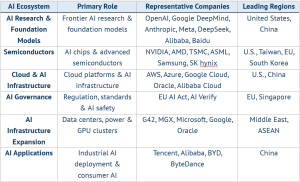
Artificial intelligence has become a strategic technology shaping economic competitiveness and national security. As AI competition expands beyond foundation models to the broader AI value chain—including semiconductors, computing infrastructure, talent, energy, and governance—countries are increasingly leveraging their comparative advantages to build AI ecosystems rather than competing in every segment. This trend is particularly relevant to ASEAN, where regional collaboration offers greater potential than competition among individual member states.
The AI Value Chain is divided into several interconnected parts:
ASEAN’s AI Landscape
As global AI competition accelerates, ASEAN is increasingly positioning AI as a key driver of its digital economy. According to the OECD, AI could increase ASEAN’s GDP by 10–18% by 2030, prompting governments across the region to incorporate AI into their national development strategies. Venture capital investment in AI-related startups has also grown rapidly, rising from approximately US$113 million in 2015 to around US$3.8 billion in 2024.
However, ASEAN countries are pursuing distinct AI strategies based on their comparative advantages. Singapore focuses on AI research, foundation models, and AI governance. Malaysia is positioning Johor as a regional AI infrastructure hub by attracting large-scale investments in data centers and cloud services while leveraging its globally competitive semiconductor assembly, packaging, and testing (OSAT) industry. Vietnam is strengthening AI talent and semiconductor design capabilities, while Thailand prioritizes AI adoption across manufacturing, healthcare, and tourism.
Rather than competing as a single AI superpower, ASEAN has the opportunity to build a complementary regional AI ecosystem, with each member state specializing in different segments of the AI value chain according to its strengths.
An important feature of this regional ecosystem is the rapid expansion of AI-ready data center investments. According to the OECD, investment commitments in AI-ready data centers across ASEAN now exceed US$50 billion, with Singapore, Malaysia, and Thailand receiving the majority of projects. As Singapore faces constraints in land and power availability, large-scale AI infrastructure is increasingly expanding into Johor in Malaysia and Batam in Indonesia, highlighting the emergence of a cross-border AI infrastructure ecosystem within ASEAN.
AI Strategies Across ASEAN
AI strategies vary by region, making AI a complex technology that has developed its own distinct ecosystem.
- Singapore’s AI Strategy — AI as a foundational technology underpinning national competitiveness. Through the National AI Strategy 2.0, it prioritizes investment in AI research, foundation models, AI governance and high-performance computing infrastructure. Initiatives such as SEA-LION and AI Verify reinforce its ambition to become ASEAN’s AI innovation hub. However, constraints in land and electricity supply make regional cooperation increasingly important for large-scale AI data center development.
- Malaysia’s AI Strategy — Focuses on developing AI infrastructure by attracting foreign investment. Johor has emerged as a major destination for hyperscale data centers backed by companies such as Google, Microsoft and Oracle, complementing Singapore’s digital ecosystem. Through the National AI Office (NAIO), Malaysia is also strengthening AI policy, governance and talent development while reinforcing its semiconductor industry.
- Vietnam’s AI Strategy — AI talent and research capabilities are primary competitive advantages. Under its National AI Strategy 2030, the country is investing in AI research facilities, high-performance computing infrastructure and partnerships with NVIDIA. Supported by a strong engineering workforce and software industry, Vietnam aims to establish itself as ASEAN’s AI talent and technology development hub.
- Thailand’s AI Strategy — Prioritizes AI adoption across existing industries rather than frontier AI research. Through its National AI Strategy and Action Plan, it promotes AI applications in manufacturing, healthcare, agriculture and tourism while strengthening AI governance and regulatory frameworks. Its objective is to improve industrial competitiveness through widespread AI deployment.
- Philippines’ AI Strategy — Focuses on AI as a tool to upgrade its digital economy and business process outsourcing (BPO) industry. Through the National AI Strategy Roadmap, it promotes AI research, workforce development and AI governance, while investing in reskilling programs to prepare workers for AI-driven transformation.
Indonesia’s AI Strategy
Indonesia views artificial intelligence as a strategic technology for strengthening long-term economic growth and industrial competitiveness. Under the National Strategy for Artificial Intelligence 2020–2045, the government promotes AI adoption across priority sectors—including healthcare, education, public administration, food security, and smart cities—while investing in AI talent, digital infrastructure, research, and AI governance. These initiatives support Indonesia’s broader vision of achieving Golden Indonesia 2045 through digital transformation and innovation.
With a population of approximately 280 million and one of Southeast Asia’s fastest-growing digital economies, Indonesia is experiencing rapidly growing demand for cloud computing and AI services. This has accelerated investment in data centers and digital infrastructure, particularly around Greater Jakarta and emerging hubs such as Batam.
The government is also strengthening the country’s AI ecosystem through human capital development. Microsoft has announced a US$1.7 billion investment in Indonesia, including plans to train approximately 840,000 people in AI skills. In addition, Arm and Danantara have launched initiatives to develop semiconductor talent, supporting Indonesia’s long-term AI capabilities and digital industrial development.
Recently Indonesia signed on as one of 29 founding members of the World AI Cooperation Organization (WAICO), a Shanghai-headquartered body set up to strengthen international cooperation and governance around artificial intelligence. Indonesia requested a key position within the WAICO Secretariat, signaling its ambition to play a larger role in global AI governance, and held talks with Huawei and ByteDance on AI investment, digital infrastructure, talent development, cybersecurity, and technology transfer — including encouraging ByteDance to establish an AI research center in the country and explore collaboration on large language models (LLMs) and generative AI. Indonesia also engaged leading Chinese robotics firms Unitree Robotics and Deep Robotics on cooperation in AI, robotics, and advanced manufacturing.
Strategic Role of Batam
Batam has become one of the most strategically important locations in Indonesia’s AI ambitions. Located approximately 20 km from Singapore, Batam has long attracted foreign investment as a Free Trade Zone (FTZ) with well-developed industrial infrastructure, international submarine cable connections and logistics facilities. These advantages have increasingly attracted investment in data centers and digital infrastructure.
A landmark example is the AI Factory project announced in 2026 by Firmus Technologies in partnership with NVIDIA. The project will develop a 360 MW AI campus that is expected to deploy up to 170,000 NVIDIA AI accelerators in phases, making it one of the largest AI computing facilities planned in Southeast Asia. Beyond serving Indonesia’s domestic market, the project demonstrates Batam’s potential to provide AI computing capacity across ASEAN.
Batam’s emergence reflects its complementary relationship with Singapore. While Singapore specializes in AI research, foundation models, financial services and AI governance, its limited land and electricity supply constrain further expansion of AI computing infrastructure. Batam, by contrast, offers the space and industrial capacity needed for large-scale AI infrastructure. Together, Singapore and Batam are increasingly forming a complementary AI ecosystem rather than competing directly.
Potential Application of AI in Indonesia
Artificial intelligence has the potential to transform not only Indonesia’s industrial competitiveness but also the quality and accessibility of public services. International experience demonstrates that AI is increasingly being adopted across healthcare, education, public administration, manufacturing, and logistics. For Indonesia, these applications are particularly relevant given its large population and geography as the world’s largest archipelagic nation.
- Healthcare — Singapore has adopted AI-assisted diagnostics, medical image analysis, and telemedicine to improve healthcare delivery and optimize hospital operations. Similar technologies could help Indonesia expand access to specialist healthcare across remote islands, reduce regional disparities, and lessen the need for patients to travel long distances or seek treatment abroad.
- Education — South Korea has introduced AI-powered digital learning platforms that provide personalized education based on individual learning needs. Similar technologies could improve access to quality education across Indonesia’s archipelago while reducing educational disparities between urban and rural areas.
- Public Administration — Estonia has integrated AI into digital government services to improve administrative efficiency and citizen access to public services. Indonesia could similarly leverage AI to streamline public administration and deliver more efficient government services across geographically dispersed regions.
- Manufacturing and Logistics — Manufacturing economies such as Japan and Germany are increasingly using AI for predictive maintenance, quality inspection, and production optimization, while AI is also improving logistics and supply chain management. These technologies could strengthen Indonesia’s manufacturing competitiveness and improve connectivity between islands through more efficient logistics and transportation networks.
These examples illustrate that AI is becoming an enabling technology across multiple sectors rather than remaining limited to the digital economy. For Indonesia, the challenge is no longer whether to adopt AI, but how to deploy it effectively to maximize economic growth, improve public services, and reduce regional disparities.
Skylight Opinion
AI competition is increasingly driven by ecosystems rather than individual countries. Rather than pursuing a fully self-sufficient AI industry, Indonesia can achieve greater long-term competitiveness by leveraging its comparative advantages within ASEAN’s emerging AI ecosystem.
In the near term, Batam is well positioned to serve as Indonesia’s gateway for AI infrastructure investment, complementing Singapore’s strengths in AI research, governance, and financial services. At the same time, Java is expected to become the center of AI adoption, where AI technologies can be integrated into manufacturing, business operations, and public services. Developing AI infrastructure in Batam while accelerating AI adoption across Java would allow Indonesia to strengthen both the supply and demand sides of its AI ecosystem.
Beyond strengthening industrial competitiveness, AI has the potential to improve the quality and accessibility of public services across Indonesia. As the world’s largest archipelagic nation, Indonesia continues to face challenges in delivering healthcare, education, and public administration evenly across its more than 17,000 islands. AI-enabled services—including telemedicine, AI-assisted diagnostics, digital learning platforms, and AI-supported public administration—could improve access to high-quality services while helping reduce regional disparities. As ASEAN’s AI ecosystem continues to develop, closer regional collaboration could further expand these opportunities by improving cross-border knowledge sharing, innovation, and service delivery.
To fully realize these benefits, however, Indonesia must continue accelerating digital transformation across both the public and private sectors. Many public and private sector processes in Indonesia still rely on paper-based or fragmented systems. Accelerating digitalization will therefore be a prerequisite for realizing the full potential of AI. At the same time, ensuring data quality, interoperability, cybersecurity, privacy protection, and responsible AI governance will become increasingly important as AI adoption expands.
AI should also be deployed to augment rather than replace Indonesia’s workforce. Continued investment in AI literacy, reskilling, upskilling, and innovation will enable workers to adopt AI as a productivity-enhancing tool while creating new high-value industries and employment opportunities.
Ultimately, Indonesia’s long-term objective should be to evolve from an economy that primarily adopts AI to one that increasingly develops AI-enabled industries, services, and innovation. By aligning this transition with ASEAN’s broader AI ecosystem, Indonesia can strengthen its own competitiveness while contributing to a more integrated, inclusive, and sustainable digital future for the region.
Latest Update
- Changan Launches Deepal SO5 in Indonesia, Evaluates Future Local Assembly
- Changan Automobile has officially launched the Deepal S05 in Indonesia, offering both Battery Electric Vehicle (BEV) and Range-Extended Electric Vehicle (REEV) variants. The REEV model combines an electric powertrain with a gasoline-powered range extender, enabling a driving range of more than 1,000 km, while addressing range anxiety and supporting broader EV adoption.
- The Deepal S05 will initially be sold as a Completely Built-Up (CBU) model imported from Thailand, with both the BEV and REEV variants supplied from Changan’s Thai production facility. The company stated that it is evaluating the possibility of introducing CKD (Complete Knocked Down) assembly in Indonesia in the future, with any decision depending on market demand, discussions with its headquarters, and the available production capacity at its local assembly facility.
- Changan has already established local CKD operations in partnership with Indomobil Group, with the Deepal S07 and Changan Lumin currently assembled at PT National Assemblers in Purwakarta, West Java. Rather than investing in a new manufacturing plant, the company is leveraging its existing production network while assessing the commercial viability of localizing the S05. This phased approach reflects Changan’s strategy of expanding its manufacturing footprint in Indonesia while minimizing investment risk.
- LiuGong Breaks Ground on Heavy Equipment Manufacturing Plant in West Java
- Chinese construction machinery manufacturer LiuGong has broken ground in Karawang, West Java, marking a major step in its localization strategy in Indonesia. The facility is scheduled to begin operations in the first half of 2027 and is expected to become Indonesia’s first manufacturing plant dedicated to electric heavy equipment, supporting the country’s industrial modernization and green transition. Phase I is planned to include production lines for electric excavators and electric wheel loaders with annual capacity of 5,000 units, using smart manufacturing technologies. The plant is intended to become its Asia-Pacific production hub, with exports expected to extend gradually to Europe and North America.
- Since 2023, the company has trained more than 900 Indonesian students, in line with LiuGong’s plans to establish an Indonesia Product Application R&D Center and collaborate with Universitas Gadjah Mada (UGM) to promote technology transfer and develop local engineering talent.
- LiuGong’s move into Indonesia appears to be driven by a mix of market access, localization, export strategy, and green-industry positioning. First, Indonesia is one of Southeast Asia’s largest markets for heavy equipment because of sustained demand from mining, infrastructure, and industrial development, making it a logical base for a manufacturer that wants to be closer to end users and reduce delivery times. Industry coverage also notes that LiuGong has already been active in Indonesia’s mining segment, including deliveries of battery-electric mining trucks, electric excavators, and wheel loaders, suggesting the company is building on an existing commercial footprint rather than entering cold.
- Siloam Hospitals Invest IDR 1 Trillion (US$55.32 million) to Expand Robotic Surgery
- Siloam Hospitals Group plans to invest approximately IDR 1 trillion (US$55.32 million) over the next few years to expand its robotic-assisted surgery program across Indonesia. The investment will support the procurement of additional surgical robots, expansion of robotic surgery services, and training of specialist surgeons, reflecting the group’s strategy to strengthen advanced healthcare capabilities.
- Siloam aims to increase the number of robotic-assisted procedures in specialties such as urology, digestive surgery, gynecology, thoracic surgery, and oncology, where minimally invasive surgery can improve precision, shorten hospital stays, and reduce post-operative complications as the first private hospital in Indonesia to introduce the da Vinci Xi robotic surgical system in 2025.
- Siloam was the first private hospital in Indonesia to introduce the da Vinci Xi robotic surgical system in 2025 and now operates seven robotic systems across Jakarta, Surabaya, Bali, and Makassar. By expanding robotic surgery capacity and developing local surgical expertise, Siloam aims to reduce the need for Indonesians to seek complex medical treatment overseas while improving access to high-quality healthcare services domestically.
- DCI Indonesia Maintains Strong Growth in First Half of 2026
- PT DCI Indonesia Tbk (DCII), Indonesia’s leading data center operator, reported strong financial results for the first half of 2026, reflecting continued demand for data center services driven by cloud computing, AI, and digital transformation. The company recorded revenue of IDR 1.78 trillion (US$ 98.46 million), up from IDR 1.33 trillion (US$73.57 million) in the same period last year, while net profit increased to IDR 732.5 billion (US$40.52 million) from IDR 616.9 billion (US$34.12 million).
- The company’s growth continued to be supported primarily by its colocation business, which serves hyperscale cloud providers, financial institutions, and enterprise customers. DCI has benefited from rising demand for digital infrastructure as Indonesia experiences rapid expansion in AI applications, cloud services, and data localization requirements.
- Looking ahead, DCI is continuing to expand its data center capacity to meet growing domestic and regional demand. As Indonesia positions itself as a regional digital and AI hub, the company is expected to remain one of the country’s key digital infrastructure providers, supported by increasing investments from global cloud and AI companies.
- Indonesia Plans 93 Hydrogen Ecosystem Projects to Accelerate Energy Transition
- During the Global Hydrogen Ecosystem Summit & Exhibition (GHES) 2026 in Jakarta, the Ministry of Energy and Mineral Resources announced that Indonesia is currently developing 93 hydrogen ecosystem projects with a combined investment value of approximately IDR 32 trillion (around USD 2 billion) part of the government’s strategy to accelerate the energy transition, reduce dependence on fossil fuels, and establish a national hydrogen ecosystem.
- The projects support the government’s dedieselization program, which aims to replace diesel-fired power generation, particularly in remote and island regions, with cleaner energy solutions. Key projects include a renewable energy-based hydrogen project in Sumba targeted for operation by 2028, a solar-powered hydrogen storage project on Rengit Island with state utility PLN, and Pertamina’s geothermal-powered green hydrogen facility at the Ulubelu Geothermal Field in Lampung.
- The government also launched the Hydrogen Diesel Dual Fuel (H2 DDF) Bus Pilot Program in cooperation with state-owned DAMRI, demonstrating the use of hydrogen-diesel blended fuel in public transportation. Officials expect some of the 93 projects to begin commercial operations as early as 2027, supporting Indonesia’s long-term goals of strengthening energy security, reducing fuel imports, and developing a low-carbon hydrogen economy.
- INPEX Launches Construction of US$20.9 Billion Abadi LNG Project
- INPEX Corporation has officially launched construction of the long-delayed Abadi LNG Project in Indonesia’s Masela Block, marking the start of one of Southeast Asia’s largest energy developments. With a total investment of approximately US$20.9 billion, the project is expected to commence production around 2030.
- The project reaches this milestone after decades of delays driven by several stacked factors: the government’s 2010 demand to shift from a floating LNG design to an onshore facility, which forced a major redesign and repeated revisions to the plan of development; Shell’s 2023 withdrawal from the block, tied to low gas prices, which triggered a shareholding reorganization; the later addition of a carbon capture and storage (CCS) component; pandemic-related disruption; and a series of permitting and bureaucratic hurdles that required government “debottlenecking” efforts to clear.
- The project will include an onshore LNG plant with an annual production capacity of 9.5 million tonnes, a natural gas pipeline supplying 150 million cubic feet per day to the domestic market, and condensate production of up to 35,000 barrels per day. At least 60% of the project’s gas output will be allocated to the domestic market, supporting Indonesia’s industrial development and electricity generation.
- Operated by INPEX (65%) in partnership with Pertamina (20%) and Petronas (15%), the Abadi LNG Project will also become Indonesia’s first LNG project to incorporate carbon capture and storage (CCS) from the start of commercial operations, enhancing its environmental performance while maintaining long-term competitiveness. The project is expected to strengthen Indonesia’s position as a major LNG exporter and contribute to energy security across the Indo-Pacific region.
- NAVICUS Launches Indonesia Market Entry Support Business for Japanese Companies
- NAVICUS, a Japanese marketing and social media consulting company, has launched a new business to support Japanese companies entering the Indonesian market. The initiative is being carried out in partnership with AAI Co., Ltd., PT Awina Sinergi International, and Indonesian marketing firm Sakative, providing a one-stop service covering market entry strategy, local partner development, legal and administrative procedures, and marketing execution. The four companies signed a cooperation agreement in Jakarta on 17 July 2026.
- Indonesia was selected as the first target market due to its population of approximately 290 million, expanding middle class, stable economic growth, and widespread adoption of social media and e-commerce. NAVICUS noted that Indonesian consumers—particularly younger generations—frequently discover and purchase products through digital platforms, making SNS marketing and influencer campaigns effective tools for Japanese brands. The company also highlighted the strong affinity Indonesian consumers have for Japanese products and culture.
- Under the partnership, NAVICUS will lead marketing strategy and promotional planning, AAI will support market research and business strategy, PT Awina Sinergi International will provide local business development, government relations, and partner matching, while Sakative will execute local digital marketing, media relations, and influencer campaigns. The integrated support service aims to simplify market entry for Japanese companies by offering comprehensive assistance from strategy development to on-the-ground business operations.
- Alamport Launches Industrial Reclaimed Water Service Business in Indonesia
- Alamport Inc., together with NiX JAPAN Group and Indonesian water infrastructure company PT Adika Tirta Daya, has established a joint venture, PT Alam NiX Tirtadaya, to provide Water as a Service (WaaS) solutions for industrial and commercial customers in Indonesia. The new company will offer reclaimed water treatment services, supporting sustainable water management while reducing the upfront investment required for water treatment facilities.
- Under the WaaS model, PT Alam NiX Tirtadaya will be responsible for the design, construction, financing, operation, and maintenance of water treatment facilities, allowing customers to access reclaimed water without making significant capital investments. The service is expected to help manufacturers and industrial parks reduce freshwater consumption, improve compliance with environmental regulations, and achieve ESG and sustainability objectives amid rising industrial water demand in Indonesia.
- The project marks Alamport’s expansion from renewable energy into sustainable water infrastructure. By combining Japanese water treatment expertise with local operational capabilities, the joint venture aims to support Indonesia’s industrial sector through efficient water resource management and contribute to the country’s broader efforts to strengthen environmental sustainability and circular resource utilization.
End of Document
REFERENCES
- Skylight Analytics Hub
- https://www.nikkei.com/article/DGXZQOGM3013B0Q6A630C2000000/
- https://www.nikkei.com/article/DGXZQOGM247H90U6A220C2000000/
- https://news.microsoft.com/apac/2024/04/30/microsoft-announces-us1-7-billion-investment-to-advance-indonesias-cloud-and-ai-ambitions/?utm_
- https://en.vietnamplus.vn/indonesia-aims-to-turn-batam-into-ai-hub-in-southeast-asia-post347450.vnp?utm_
- https://www.itmedia.co.jp/news/articles/2607/03/news077.html
- https://finance.biggo.jp/news/a1f4e34c-fecf-4afd-a6fd-ffed8be65617
- https://www.nbr.org/publication/charting-aseans-path-to-ai-governance-uneven-yet-gaining-ground/?utm_
- https://www.sciencedirect.com/science/article/abs/pii/S2211883725000097?utm_
- https://digitalinasia.com/southeast-asia-ai-data-centre-boom/?utm_
- https://hai.stanford.edu/ai-index/2026-ai-index-report?utm_
- https://www.oecd.org/en/publications/digital-trade-review-of-the-association-of-southeast-asian-nations_abd6f44a-en/full-report/transitioning-asean-towards-the-ai-era_158513b0.html?utm_
- https://www.oecd.org/en/publications/competition-in-artificial-intelligence-infrastructure_623d1874-en/full-report/component-5.html#chapter-d1e357-4e267c76bc
- https://oecd.ai/en/dashboards/policy-initiatives/thailand-national-ai-strategy-and-action-plan-2022-2027-1728?utm_
- https://www.sciencedirect.com/science/article/abs/pii/S2211883725000097?utm_
- https://sociallab.ai/global-ai-strategy-landscapes/?utm_
- https://ai.gov.my/about-naio?utm_
- https://www.ft.com/content/14d77d11-847e-4950-ab67-67a02e5324db?utm_
- https://www.mddi.gov.sg/newsroom/update-to-singapore-s-national-ai-strategy–refreshed-priorities-to-harness-ai-for-the-public-good-factsheet/?utm
- https://nvidianews.nvidia.com/news/nvidia-to-open-vietnam-r-d-center-to-bolster-ai-development?utm_
- https://en.baochinhphu.vn/national-strategy-on-rd-and-application-of-artificial-intelligence-11140663.htm?utm_
- https://www.etda.or.th/th/pr-news/aigc_Driving-Trust_AI_Governance.aspx?feed=cb66f430-5546-4dd8-b279-3827e88d154b&utm_
- https://www.unesco.org/ethics-ai/en/philippines?utm_
- https://www.unesco.org/en/articles/leading-ai-ethics-unesco-and-kominfo-launch-ai-readiness-assessment-methodology-indonesia?utm_
- https://gorricetalaw.com/philippines-powered-by-ai-the-philippines-national-ai-strategy-roadmap-2-0/?utm_
- https://www.researchgate.net/publication/400395915_Assessment_of_Indonesia%27s_Readiness_for_AI_Adoption_Challenges_and_Prospects?utm_
- https://dayonedc.com/?utm_
- https://firmus.co/newsroom/firmus-to-build-170-000-gpu-ai-factor-y-campus-with-nvidia-for-global-ai-natives?utm_
- https://bpbatam.go.id/bp-batam-sambut-baik-ekspansi-firmus-technologies-perkuat-posisi-batam-sebagai-hub-infrastruktur-ai-regional/?utm_
- https://english.moe.go.kr/boardCnts/viewRenewal.do?boardID=265&boardSeq=102075&lev=0&m=0201&opType=N&page=1&s=english&searchType=null&statusYN=W&utm_source
- https://www.unescap.org/sites/default/d8files/event-documents/AI-Training-for-ASEAN-Policymakers.pdf?utm_
- https://publicsectornetwork.com/insight/case-study-ai-implementation-in-the-government-of-estonia
- https://pmc.ncbi.nlm.nih.gov/articles/PMC12209719/?utm_
- https://kumparan.com/kumparanoto/changan-deepal-s05-masih-cbu-thailand-mulai-dikirim-agustus-2026-27jmNql1krl/full?utm_
- https://www.idntimes.com/automotive/car/deepal-s05-masih-cbu-thailand-changan-buka-peluang-dirakit-lokal-00-7cdnt-3nxfd0?utm_
- https://www.segmenty.com/GenerateNewsStaticJsps/Deepal_S05_to_remain_CBU__Changan_assesses_local_production.html?utm_
- https://voi.id/ja/mobil/585834?utm_
- https://www.nna.jp/news/2948487
- https://english.news.cn/20260723/7c2a2f8edf7249cb93fc831f24116d3f/c.html
- https://www.plantandequipment.com/news/earthmoving/liugong-to-build-317-million-heavy-equipment-plant-in-indonesia?utm_
- https://www.nna.jp/news/2949044
- https://english.www.gov.cn/news/202607/17/content_WS6a59a226c6d00ca5f9a0c432.html?utm
- https://en.antaranews.com/news/422973/ri-to-participate-in-chinas-initiative-ai-cooperation-waico?utm
- https://www.nna.jp/news/2947338
- https://www.healthcareitnews.com/news/asia/first-da-vinci-xi-rollout-indonesia?utm
- https://observerid.com/siloam-celebrates-one-year-of-pioneering-robotic-surgery-in-indonesia/?utm
- https://www.nna.jp/news/2947561
- https://www.marketscreener.com/news/pt-dci-indonesia-tbk-reports-earnings-results-for-the-half-year-ended-june-30-2026-ce7f51d9de8bf024?utm
- https://www.nna.jp/news/2949011
- https://jakartaglobe.id/business/indonesia-launches-hydrogen-corridor-unveils-first-hydrogen-bus-pilot?utm
- https://en.vietnamplus.vn/indonesia-advances-93-hydrogen-projects-worth-2-bln-usd-post348729.vnp?utm
- https://en.antaranews.com/news/403926/indonesia-offers-green-hydrogen-projects-at-ghes-2026-to-lure-capital?utm
- https://english.news.cn/asiapacific/20260722/60b529bbca2c416e86c7d81029e5b173/c.html
- https://www.nna.jp/news/2948591
- https://www.inpex.com/business/project/abadi.html?utm
- https://aogdigital.com/news/541280-inpex-starts-construction-of-indonesias-abadi-lng-project?utm
- https://ashu-aseanstatistics.com/news/307547-15484818730
- https://www.nna.jp/news/2948540
- https://www.navicus.jp/press-release/1685/
- https://alamport.net/2026/07/23/antd/
- https://www.nna.jp/news/2948670
- https://nix-japan.co.jp/news/260722