EXECUTIVE BRIEF: Indonesia Wage Growth, Productivity, and ASEAN Competitiveness
Indonesia is stepping into a new phase of labor market development. With minimum wages rising by average 5–7% for 2026, the government continues to prioritize household welfare and domestic purchasing power — a necessary step for an economy led strongly by consumption. The labor force now stands at more than 153 million people, with unemployment contained below 5%, placing Indonesia among the largest and most dynamic employment markets in ASEAN. Yet beneath these positive indicators lies a fundamental question about the future direction of national competitiveness.
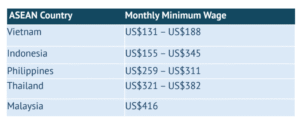
On paper, Indonesia’s wage levels remain middle-of-the-pack in Southeast Asia — below Malaysia and far behind Singapore, but comparable to peers such as Vietnam, Thailand, and the Philippines. Cost competitiveness, therefore, is not yet disappearing. The real contest is shifting to a different area: the efficiency and value generated by each worker.
From Labour Quantity to Labour Quality
For decades, Indonesia’s comparative advantage has been grounded in abundant and affordable labour. Industrial activity — particularly in consumer goods, garments, and electronics assembly — grew on that foundation.
But the ground has shifted. ASEAN economies are rapidly transforming:
- Automation is reshaping factories
- Green manufacturing demands new technical skills
- Digitalization is becoming a baseline for mass adoption
In this transition, productivity and quality becomes the true determinant of competitiveness. Global investors are becoming more selective as they rebalance supply chains, weighing not just wages but policy consistency, infrastructure quality, ease of doing business and long-term investment certainty. Wages alone do not determine competitiveness, but to productivity and quality. Meanwhile over the past years in Indonesia:
- Minimum wages increased 5%–10% / year
- Labor Productivity improved by only 5%–2% / year
This widening mismatch between wage growth and productivity creates mounting structural pressure for industries. Potential impacts include:
- Margin squeeze in labor-intensive sectors such as textiles, garments, and footwear, where profitability averages only ~5% and cost absorption capacity is limited.
- Job cuts, as companies remain in recovery mode while facing weak domestic demand, high operating costs, illegal imports, and reliance on imported raw materials.
- Acceleration of automation to reduce labor dependency, potentially limiting future job creation in sectors historically reliant on large workforces.
- Relocation risks within ASEAN, especially toward faster-productivity-growing competitors such as Vietnam and Thailand
Comparing Labor Competitiveness with ASEAN & Beyond
Labor productivity per worker is a key indicator in economic analysis, as it describes the economic value generated by each worker within a specific period. From a macroeconomic perspective, growth supported by productivity improvements is generally considered more sustainable than growth that relies solely on an increase in the number of workers. As global investors re-route supply chains, the winning destinations are those offering skilled, adaptive workforces — not just low wages.
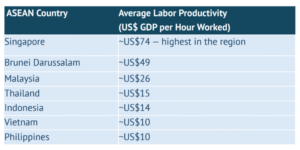
The data highlights that Indonesia ranks fifth in Southeast Asia, trailing significantly behind productivity leaders like Singapore, Brunei Darussalam, and Malaysia. While Indonesia remains ahead of Vietnam and the Philippines, the gap is narrow — and Vietnam’s rapid productivity acceleration presents a competitive threat.
From a broader economic view, Indonesia’s GDP per worker remains around US$23,870, slightly below the ASEAN average of US$24,270 per worker. Meanwhile, workers in OECD countries can generate up to nearly US$100,000 annually, and those in other upper- middle-income economies produce roughly US$40,000–US$50,000 per year.
In short: Indonesia’s workforce is large — but each worker needs to produce more. Sustained competitiveness will depend on how quickly productivity can rise to match wage growth and industrial ambitions.
Structural Challenges in Improving Workforce Productivity
- Skills mismatch — Education outcomes do not match industry needs, resulting in graduates lacking practical and technical skills.
- Limited vocational readiness — Vocational and technical schools often lack up-to- date equipment and strong industry
- High informality — A large share of workers operates outside the formal sector, restricting access to structured training and career advancement.
- Regional disparities — Wide gaps in infrastructure and industrial development create uneven productivity between Java and other region.
- Low digital and technology adoption — Many businesses, especially SMEs, still operate with low automation and limited digital skills.
- Industrial capability gaps — Key priority sectors face shortages of specialized technical talent necessary for higher-value production.
Skylight’s Opinion: Productivity as a Silent Investment
While Indonesia focuses on physical infrastructure and downstreaming, labor productivity remains a “silent investment” — less visible but critical for long-term growth. A skilled, competitive workforce is the foundation for industrial upgrading and economic resilience. Achieving this requires collaboration among policymakers, businesses, and workers.
Actionable Recommendations:
Government Priorities
- Strengthen vocational education aligned with industrial needs, ensuring a pipeline of job-ready skilled
- Enhance education quality from primary to university, prioritizing Science, Technology, Engineer, Math (STEM), digital literacy, and problem-solving competencies.
- Facilitate labor mobility across regions and sectors through affordable housing and improved infrastructure readiness within that area.
- Expand industry–academia collaboration to align curricula with emerging technologies and future workforce requirements.
Industry & Industrial Park Developer Responsibilities
- Invest in continuous employee training and capability development, supporting productivity upgrades and career progression.
- Expand inclusive workforce participation — particularly women and youth — to unlock untapped labor potential and strengthen labor force resilience.
- Build industrial-park–based talent ecosystems, where park developers lead community training centers, specialized vocational programs, and direct partnerships with tenant industries to accelerate skill
Worker / Individual Responsibilities
- Commit to continuous self-development through vocational training, digital skills, and new production techniques to remain competitive in a fast-changing labor market.
- Strengthen soft skills — communication, teamwork, discipline, and adaptability — which are increasingly decisive for productivity and career advancement.
- Embrace lifelong learning and openness to new roles, technologies, and work environments, including relocation to higher-opportunity industrial regions.
- Maintain personal health, safety awareness, and work discipline, contributing to higher reliability and efffciency within
Latest Update
- Vinfast Completed Construction of EV Factory in Subang
- VinFast — Vietnam’s leading EV manufacturer — has officially confirmed Indonesia as one of its primary production hubs in Southeast Asia (outside Vietnam), marked by the inauguration of its manufacturing facility in Subang on December 15,
- The project was completed within 17 months and sits on a total land area of 170 In Phase 1, only 9–10 hectares are being developed, supporting an initial production capacity of up to 50,000 vehicles per year with a capital injection of US$300 million, and a total estimated of 900 workers.
- At the inauguration ceremony, VinFast states its long-term commitment to Indonesia, announcing a US$1 billion total investment plan to fully develop the site and ramp up capacity to 350,000 vehicles annually upon the completion of subsequent phases.
- Pupuk Indonesia Builds Indonesia’s First NPK Nitrate Factory
- State-owned fertilizer company, PT Pupuk Indonesia, through its two subsidiaries, PT Pupuk Kujang Cikampek and PT Rekayasa Industri (Rekind), is building Indonesia’s first ammonium nitrate-based NPK Nitrate factory.
- The groundbreaking ceremony, held at the Kujang Cikampek Industrial Park, a State-Owned Industrial Park with a total area of 110 hectares located in West Java, marks an important milestone in strengthening the independence of the national fertilizer supply, to support food self-sufficiency.
- Built on 5 hectares of land, the factory has the potential to save the country’s foreign exchange through import substitution equivalent to IDR700 billion– IDR1 trillion per year (US$44 million – US$64 million).
- With a target to be operational in the 3rd quarter of 2027, this factory will have a production capacity of 100,000 metric tons per year.
- Daesang’s Growth Strategy: Targeting BEFF to Strengthen Indonesia Presence
- Daesang Holdings, a South Korean food industry giant, has been making significant strides in Indonesia, leveraging the country as a key hub for its regional and global expansion.
- With a presence dating back to 1973 through PT Miwon Indonesia, Daesang has navigated its growth in Indonesia’s halal food market, producing halal- certified products and dominating categories like dried seaweed and breadcrumbs under its Mamasuka brand. The company aims to grow its Indonesia-based revenue to 4 trillion won (~$1 billion) by 2030, using the country as a springboard to enter other halal markets in Southeast Asia and the Middle East.
- Recently, Daesang has been rumored to be eyeing PT Estika Tata Tiara Tbk (BEEF), an integrated livestock and meat processing company, as a potential acquisition BEEF’s strong position in Indonesia’s protein market, its involvement in the government-backed Free Nutritious Meals Program(MBG), and its aggressive expansion into dairy, cold storage, and live cattle trading make it an attractive prospect.
- Market players believe Daesang’s interest is driven by BEEF’s instant market access, long-term revenue potential through MBG, and its attractive valuation. While no official statements have been made, the potential acquisition aligns with Daesang’s strategy of building a robust halal-certified protein platform and expanding its footprint in Indonesia’s growing food industry.
- Indonesia Plans to Stop EV Incentive in 2026
- Indonesia’s EV industry faces a critical juncture as the government plans to end key incentives in 2026, including sales tax exemptions, VAT reductions, and 0% import duties for These measures, previously aimed at boosting adoption and attracting investment, will be redirected to support the national car program.
- While the policy shift aligns with efforts to localize EV production and increase domestic content requirements (TKDN) to 60% by 2027, it has raised concerns among industry players. Experts warn that removing incentives could stall EV demand, slow the development of battery and component industries, and jeopardize potential economic benefits of up to IDR 544 trillion (~US$34 billion) annually by 2060.
- With nine global automakers, including BYD and Geely already committed to local production, the government aims to strengthen the EV supply chain, but risks losing momentum in adoption and investment. To balance this transition, experts recommend extending incentives temporarily, promoting green financing, and rationalizing fuel subsidies to sustain growth and support Indonesia’s energy transition goals.
- Korean Firms Team Up to Develop Petrochemical Plant in Indonesia
- South Korean chemical companies KG Chemical and Dong-Suh Chemical have signed a memorandum of understanding (MoU) to jointly invest in a new chemical materials production facility in Indonesia. The agreement, finalized on December 15, 2025, in Gwacheon, South Korea, outlines plans for a 50-50 joint venture to produce Polynaphthalene Sulfonate Formaldehyde Condensate (PNS), a key chemical material widely used in construction and industrial applications.
- The project involves an estimated investment of $20 million, targeting an annual production capacity of approximately 30,000 tonnes of The joint venture is expected to be established in early 2026, with construction of the production facility scheduled to begin in the first half of the year. The facility will integrate the production process from naphthalene oil to PNS, ensuring efficiency and cost-effectiveness.
- This collaboration reflects the growing interest of South Korean firms in Indonesia’s industrial sector, leveraging the country’s strategic location and resources to expand their global Further details on the investment terms and production plans will be finalized through ongoing discussions between the two companies.
- Amazon Services No Longer Collects Indonesian Digital Taxes
- Indonesia’s tax authority has officially appointed OpenAI Operating Company, LLC as a Value-Added Tax (VAT) collector on digital trade, replacing Amazon Services Europe as the previous collector. This move reflects the government’s continued expansion of tax regulation for cross-border digital transactions and growing adoption of AI-based services.
- In addition to OpenAI OpCo, the government has also appointed the International Bureau of Fiscal Documentation, a leading provider of cross tax border from Netherlands and Bespin Global, a leading global cloud computing solutions company from South Korea as digital VAT With the latest additions, Indonesia has now designated 254 companies to collect digital taxes.
- Several criteria for E-Commerce VAT collectors include having a transaction value with Goods and/or Services Users in Indonesia exceeding IDR 600 million (US$37,500) in 1 year or IDR 50 million (US$3,125) in 1 month. Then, the number of traffic or accesses in Indonesia exceeds 12 thousand in 1 year or 1,000 in 1 month.
- According to the Directorate General of Taxes, digital tax revenue has reached 55 trillion (US$2.7 billion) as of November 30, 2025, signaling the sector’s strong contribution to state income.
- The appointment of digital tax collectors from the AI industry reinforces that the digital economy increasingly generates tangible benefits to the public sector—particularly in strengthening government revenue streams.
Latest Update – Japanese Market Movements
- Hankyu Hanshin Properties Acquires Deli Park Mall in Medan – Hankyu Hanshin Properties will acquire Deli Park Mall in Medan, North Sumatra, in January 2026, marking its third major commercial property in Indonesia after Central Park Mall and Central Park Mall 2 in Jakarta. Strategically located near Medan Station and key transport links, the mall is part of the Podomoro City Deli Medan mixed- use development, which includes offices, universities, and residential units. With Medan’s growing middle- and upper-income population, the facility is expected to capture demand from diverse users and remain a growth market. Hankyu Hanshin aims to enhance the mall’s asset value and strengthen its leasing business in ASEAN.
- Rent Co., Ltd. Restructures Indonesian Operations – Rent , Ltd. has acquired full control of its Indonesian subsidiaries, previously co-owned with Marubeni Group, and renamed PT Max Rent Indonesia to PT Rent Indonesia Asia. The restructuring, effective November 2025, increases Rent Co.’s ownership to 93%, enabling more agile decision-making. The company continues to focus on construction and industrial machinery rentals, leveraging its resources to expand operations in Indonesia and Vietnam. This move aligns with Rent Co.’s strategy to contribute to ASEAN’s economic growth through its rental business.
- Japan Promotes Transit-Oriented Development (TOD) in Jakarta – The Urban Renaissance Agency (UR) and Japan’s Ministry of Land, Infrastructure, Transport and Tourism hosted a TOD Forum in Jakarta on December 23, 2025, to promote sustainable urban The event highlighted Japanese TOD concepts, addressing urban challenges like traffic congestion and environmental issues. A scale model of Jakarta’s Dukuh Atas pedestrian deck project was showcased, emphasizing Japan-Indonesia collaboration in urban planning. The forum strengthened public-private partnerships and reaffirmed Japan’s commitment to supporting Indonesia’s urban development initiatives.
- Human Holdings Expands Japanese-Style Daycare in Jakarta – Human Star Child, part of Human Holdings Group, has opened its second daycare center in Jakarta, following the success of its first Located in the upscale Pakubuwono area, the center offers Japanese-style childcare services, focusing on safety, nutrition, and cognitive development. With full enrollment at its first center, the expansion addresses Indonesia’s growing demand for high-quality childcare amid increasing dual-income households. The initiative reflects Human Holdings’ commitment to providing secure childcare solutions for both expatriate and local families.
- Japanese Restaurant Chain “Hikiniku to Kome” Enters Jakarta – ORES COMPANY will open its first “Hikiniku to Kome” restaurant in Jakarta in February 2026, in partnership with Indonesia’s Boga Located in South Jakarta’s Pondok Ibadah Mall 5 building, the restaurant will cater to Indonesia’s young and vibrant population. Boga Group staff underwent training in Japan to ensure high service quality. With existing outlets in Japan and other Asian cities, ORES COMPANY aims to carefully expand its presence in Indonesia, focusing on customer satisfaction and operational excellence.
-end-
REFERENCES
- Skylight Analytics Hub
- https://www.cnnindonesia.com/ekonomi/20251225063416-92-1310513/daftar-lengkap-ump- 2026-di-36-provinsi-jakarta-tertinggi#goog_rewarded
- https://en.antaranews.com/news/396601/indonesias-productivity-gap-threatens-long-term- economic-growth
- https://databoks.katadata.co.id/en/agroindustry/statistics/66e18f8d40dd8/indonesias-labor- productivity-ranked-5th-in-asean-in-2023#:~:text=A%20Small,(September%206%2C%202024).
- https://talenthub.glints.com/en-sg/blog/minimum-wage-in-southeast-asia-countries-what- employers-should-know
- https://en.antaranews.com/news/396601/indonesias-productivity-gap-threatens-long-term- economic-growth
- https://databoks.katadata.co.id/en/agroindustry/statistics/66e18f8d40dd8/indonesias-labor- productivity-ranked-5th-in-asean-in-2023
- https://en.tempo.co/read/1966159/indonesian-workforce-productivity-lags-behind-southeast- asian-peers
- https://jakartaglobe.id/business/vinfast-taps-indonesia-as-southeast-asia-production-hub-with- new-subang-plant
- https://kikc.co.id/
- https://ekonomi.bisnis.com/read/20251224/99/1939378/pupuk-indonesia-bangun-pabrik-npk- nitrat-pertama-di-indonesia#goog_rewarded
- https://www.cnbcindonesia.com/market/20251229092417-17-697819/raksasa-korea-daesang- holdings-mau-caplok-emiten-ri-ini
- https://www.idnfinancials.com/id/beef/pt-estika-tata-tiara- tbk#:~:text=PT%20Estika%20Tata%20Tiara%20Tbk,daging%2C%20dan%20juga%20produk%20 olahannya.
- https://www.bloombergtechnoz.com/detail-news/94115/insentif-ev-mau-distop-2026-kerugian- ekonomi-diramal-rp544-t
- https://www.suara.com/bisnis/2025/12/29/134651/insentif-kendaraan-listrik-dihentikan- untung-atau-buntung
- https://www.petromindo.com/news/article/korean-firms-team-up-to-develop-petrochemical- plant-in-indonesia
- https://jakartaglobe.id/business/indonesia-appoints-openai-opco-as-digital-vat-collector
- https://finance.detik.com/berita-ekonomi-bisnis/d-8284143/amazon-services-tak-lagi-jadi- pemungut-pajak-digital-ri-ini-alasannya
- https://us.ibfd.org/about-us
- https://event.cloudcomputing.id/berita/bespin-global-resmi-masuk-pasar-cloud-indonesia https://www.hhp.co.jp/news/2025/12/000857.html
- https://ashu-aseanstatistics.com/news/307167-52443619830
- https://www.rent.co.jp/news/2025_12_17/ https://www.nna.jp/news/2876311
- https://www.athuman.com/news/2025/25282/ https://www.nna.jp/news/2865977