EXECUTIVE BRIEF: Branding and Value Addition For Indonesia’s Fisheries Resources
Executive Summary
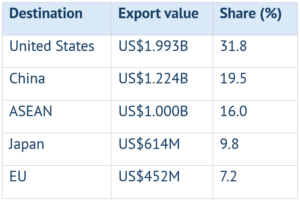
Indonesia sells one of the world’s richest fisheries endowments largely at commodity prices. In 2025, fisheries exports reached US$6.27 billion, led by shrimp, tuna and skipjack, squid, crab, and seaweed, shipped to the United States, China, ASEAN, Japan, and the EU. The volume is impressive. The value captured per kilogram is not.
The gap is the opportunity. Products from the same species command very different prices depending on origin, quality, production method, freshness, sustainability, and regional identity. Indonesia’s archipelago of roughly 17,000 islands produces exactly this kind of variety — in species, waters, fishing and farming methods, processing traditions, and food cultures. Today that diversity is treated as a logistics headache. It should be treated as a branding asset.
The strategic shift is from selling volume to capturing premium. That means converting regional characteristics into branded value that buyers recognize and pay more for — then protecting that value against imitation, origin fraud, and quality drift.
International experience is clear on one point: there is no single winning model. Norway built a national origin brand through government–industry partnership. Maine Lobster works as a collective regional brand. New Zealand’s Ōra King Salmon is private-sector premiumization. Japan’s Echizen-gani shows how public institutions can protect and amplify value that producers already created. Indonesia should match the model to the product, region, and market — not impose one template nationwide.
The foundations exist. Products including Bandeng Asap Sidoarjo and Sidat Marmorata Poso already hold Geographical Indication (GI) status, and systems like STELINA support origin and quality verification. What remains is execution: linking origin and identity with quality control, certification, traceability, logistics, and market development — and treating fisheries branding as an industrial strategy, not a marketing exercise.
The Decision Context
Indonesia’s production base is large and diversified across capture, aquaculture, and seaweed.
Fisheries Production (2024)
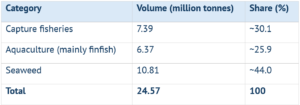
Export grew 5.2% year on year in 2025, with shrimp alone approaching a third of the total.
Main export products (2025)
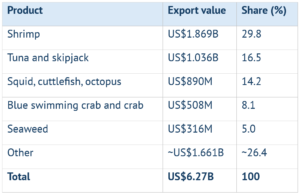
Market access is already broad, giving Indonesia a commercial platform for premium products.
Major export markets (2025)
The resource depth is exceptional: an estimated 8,500 fish species — roughly 37% of the global total — plus more than 900 seaweed species, spread across open ocean, coral reefs, mangroves, brackish waters, rivers, and lakes. Quality systems are keeping pace too; Indonesia’s Ministry of Marine Affairs and Fisheries (KKP)’s 2024 report recorded a 95.25% achievement rate on marine and fisheries quality and food-safety compliance.
The takeaway for decision-makers: the volume, market reach, and quality infrastructure are in place. The missing piece is a strategy that turns regional difference into recognized, premium value.
What the International Models Teach
Four proven models point to specific actions. Read them as strategic options, not case studies.
Norway — national brand through public–private partnership. The government-owned Norwegian Seafood Council runs “Seafood from Norway,” funded by industry levies, and pairs marketing with strict origin rules (traceability required; tighter standards for products like Skrei). Norway also created demand — building the Japanese salmon-sushi market from scratch over decades.
Indonesian action: combine coordinated national marketing with enforceable origin standards, and target demand creation in specific markets rather than only competing in existing ones.
Maine Lobster — collective regional brand. Fishers, wholesalers, and processors jointly fund and govern the brand through license-based assessments, achieving marketing scale no small producer could reach alone.
Indonesian action: use producer organizations to pool marketing and manage shared standards in regions dominated by small-scale producers.
Ōra King Salmon — private-sector premiumization. New Zealand King Salmon built distinct product traits through selective breeding, grading, traceability, freshness-managed logistics, and chef relationships — proving value addition does not require more processing.
Indonesian action: enable companies to integrate R&D, production, quality, logistics, and marketing into single premium brands, especially in aquaculture.
Echizen-gani — institutions protecting producer-built value. Producers created the reputation; GI registration protected the name; a tiered quality mark (“Kiwami”) added a premium layer; tax and tourism programs extended value across the local economy.
Indonesian action: position government to protect, organize, and amplify existing producer value — not to invent brands — and link products to regional tourism and events.
Four Strategic Priorities
Priority 1: Build and differentiate value through GI
Regulation No. 26/2025 frames GI as a competitiveness and value-addition tool, not just intellectual property (IP) protection. As of July 2025, 11 marine and fisheries-related products held GI status, with 38 processed products and 18 commodities identified as candidates.
Selected registered GIs
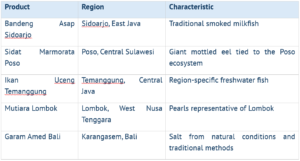
These show two routes to value: a “processing and culture” model (Bandeng Asap Sidoarjo, Garam Amed — value in technique and tradition) and a “production and quality” model (pole-and-line tuna, premium shrimp — value in fishing method, freshness, and sustainability). Both matter, and value addition is not the same as more processing. After GI registration, Garam Amed reportedly gained higher prices and new channels including hotels and restaurants.
Roles: producers and organizations define regional identity; companies commercialize it; research institutions validate distinctive characteristics; government registers and protects.
Priority 2: Protect the brand through quality, certification, and traceability
A valuable brand attracts free riders. Protection requires two things at once: authenticity of origin and consistency of quality. Stopping fake origin means little if genuine products vary wildly in quality.
Three mechanisms must work together:
- GI protects names and origin.
- Quality and standardization systems — supported by programs like GQSP Indonesia (with the United Nations Industrial Development Organization (UNIDO), Indonesia’s Ministry of Marine Affairs and Fisheries (KKP), and the National Standardization Agency of Indonesia (BSN)), currently focused on shrimp, milkfish, and seaweed — maintain consistency.
- STELINA, the national fish traceability and logistics system, verifies origin and production history, with consumer-facing QR codes as a future communication tool.
Define brand-use conditions upfront: species, origin, method, size, handling, storage, freshness, and grade. Producers comply when stricter standards deliver premiums, stable channels, or higher-value market access.
Roles: producer-led brand-management bodies set specifications; larger companies integrate small producers into compliant supply chains; government provides the legal and verification backbone.
Priority 3: Convert quality into demand through logistics and marketing
Two failures kill premium value: losing quality in transit, and failing to make buyers understand the difference.
Cold chains are quality management, not just logistics. Across a dispersed archipelago, post-harvest handling, chilled and frozen storage, and refrigerated transport must run unbroken from origin to Jakarta, Surabaya, and export markets — or the premium disappears before the buyer sees it.
Marketing must create demand, not just describe it. Norway’s salmon-sushi playbook is the model: work with chefs, restaurants, hotels, retailers, and importers to develop formats, uses, and price points. Position on origin, method, freshness, sustainability, and food culture — never on price alone.
Use the large domestic market — high-income consumers and premium channels in Jakarta, Surabaya, and Bali — as a proving ground before scaling internationally. Match logistics to geography: cold-chain investment where cities and export gateways are accessible; local tourism-linked value capture (restaurants, accommodation, events) where transport costs are high but visitor demand is strong.
Roles: companies and producers lead market development; government funds enabling cold-chain and export infrastructure.
Priority 4: Create new value through R&D
Where GI protects existing value, R&D creates new value — and aquaculture offers the most room. Indonesia’s varied waters support developing species, strains, feed, and production systems tuned to local conditions, shaping taste, texture, fat content, size, and consistency.
Ōra King proves the payoff comes from integration: breeding plus production, grading, freshness, logistics, and marketing under one strategy. Apply this to shrimp, grouper, milkfish, tilapia, and seaweed.
Roles: universities and research institutions study waters, species, disease, and feed; companies translate findings into commercial systems and pull smaller operators into higher-value chains through seedstock, feed, SOPs, and guaranteed purchase; government need not run the R&D itself.
Skylight’s View
Indonesia’s fisheries strength is not just abundance — it is diversity: distinct waters, species, methods, and food cultures that most competitors cannot match. Right now that diversity is sold at commodity prices. Branded correctly, it becomes premium.
The strategic imperative is straightforward: stop measuring success by tonnes and export totals, and start measuring it by value captured per resource. Given import pressure and external balance concerns, producing and exporting more is not the answer. Extracting more value from each fish, each region, and each brand is.
No single model fits a country this varied. Some products will be led by companies, others by producer organizations, GI communities, or public–private partnerships. Government’s job is not to pick brands but to build the foundations — GI, quality standards, traceability through STELINA, and enabling infrastructure — that let many branding approaches succeed.
The choice ahead is not whether Indonesia can produce more seafood. It clearly can. The choice is whether it will convert the richest marine diversity on earth into brands the world pays a premium for — starting now, while the export platform and institutional groundwork are already in hand.
Latest Update
- BYD Produces Nearly 10,000 Vehicles Locally in August in Indonesia’s Electrified Vehicle Market Expands
- Chinese electric vehicle manufacturer BYD has rapidly increased local production in Indonesia following the start of operations at its new manufacturing facility in Subang, West Java. BYD produced 9,736 vehicles in Indonesia in August, up sharply from 198 units in April and 1,560 units in May. Cumulative domestic production reached approximately 24,900 units between April and August.
- The Subang plant has an annual production capacity of up to 150,000 vehicles and is currently operating at close to 10,000 units per month as production is gradually ramped up. BYD has also stopped importing completely built-up (CBU) vehicles for new supply and is shifting toward domestic production, marking a transition from its initial market-entry phase to localized manufacturing.
- The expansion comes alongside rapid growth in Indonesia’s electrified vehicle market. Sales of electrified vehicles, including battery electric vehicles (BEVs), hybrid electric vehicles (HEVs), and plug-in hybrid vehicles (PHEVs), reached approximately 27,000 units in August, the highest monthly level recorded so far in 2026.
- The combination of rising EV demand and expanding domestic production indicates that Indonesia’s electric vehicle industry is entering a new stage, with competition increasingly moving from imported vehicle sales toward local manufacturing. This could increase demand for batteries, electronic components, charging infrastructure, automotive parts, factory automation, and other supporting industries.
- China’s Anjoy Foods Forms Indonesian Joint Venture with Salim-Linked Partner for Frozen Food Production
- Chinese frozen food manufacturer Anjoy Foods Group plans to establish a joint venture in Indonesia with Mutual Strategy Limited, a company linked to Indonesia’s Salim business family. The partners have committed a combined minimum of US$74.25 million, with investment to be made in several stages according to project progress.
- The Indonesian operations will produce and sell frozen surimi-based products, frozen sausages, frozen noodle and rice products, as well as shelf-stable sausage and surimi snack products. Anjoy will contribute product development, manufacturing technology, quality management and standardized operations, while its local partner will provide access to raw materials, supply chains, retail channels and local operating capabilities.
- The partnership is expected to establish an integrated system covering product development, manufacturing, supply chain management and sales for Indonesia and surrounding markets.
- The investment reflects growing interest from Chinese food manufacturers in establishing local production bases in Indonesia rather than relying solely on exports. Indonesia’s large consumer market, expanding modern retail sector and growing demand for convenient and processed foods are supporting its role as a production and sales base for regional food companies.
- Beiersdorf Invests €52.8 Million (~$USD 60.5 Million) to Expand Malang Factory, Raising Capacity by Nearly 50%
- German consumer goods company Beiersdorf has completed an expansion of its production facility in Malang, East Java, with an investment of €52.8 million, equivalent to approximately IDR 1 trillion. The project will increase the factory’s annual production capacity by nearly 50% and strengthen Indonesia’s role within Beiersdorf’s manufacturing network.
- The Malang facility manufactures products under major brands including NIVEA and Hansaplast. The plant currently supplies more than 90% of the company’s domestic demand in Indonesia while also serving additional regional markets.
- The expansion includes new manufacturing technologies such as fully automated high-speed filling and packaging lines, automated raw-material dosing, real-time production efficiency monitoring, energy monitoring systems and integrated building management systems.
- The investment reflects the growing importance of Indonesia not only as a large consumer market but also as a manufacturing base for Southeast Asia. Continued demand could generate opportunities for packaging, raw materials, automation, logistics and other supporting industries.
- Indonesia Accelerates Development of Rebana as New Industrial and Logistics Hub
- Indonesia is accelerating the development of the Rebana Area in northeastern West Java as a new industrial, logistics and economic growth corridor. The region is centered around strategic infrastructure including Patimban International Port and Kertajati International Airport and is intended to complement the existing industrial concentration around Greater Jakarta.
- Rebana currently has 13 designated industrial areas, of which eight are already operating. Investment realization reached around Rp36 trillion in 2025 and a further Rp21.59 trillion by the second quarter of 2026, representing approximately 30% of total investment in West Java.
- Development plans cover manufacturing and logistics as well as aviation, tourism, education and urban development. Particular emphasis is being placed on sustainable industrialization, including renewable energy, circular economy initiatives, decarbonization and environmentally conscious industrial estates.
- With Patimban Port, industrial estates and improved transport infrastructure gradually being integrated, Rebana has the potential to emerge as a major new manufacturing and logistics corridor in West Java.
- Indonesia Seeks Investment in Ethanol Plants Ahead of E20 Fuel Introduction
- The Indonesian government is accelerating efforts to attract private investment in new bioethanol production facilities as it prepares to expand the use of ethanol-blended gasoline. The government is targeting a gradual increase from E5 in 2026 to E10 in 2027 and eventually E20, or gasoline containing 20% bioethanol, as early as 2028.
- A major challenge is the limited domestic supply of fuel-grade ethanol. Current available production capacity is estimated at only around 70,500 kiloliters per year, while demand will increase as higher blending levels are introduced. The government is therefore encouraging private companies to build new plants and expand domestic feedstock production.
- Potential raw materials include sugarcane and molasses, cassava, corn and sorghum, as well as agricultural and biomass residues. The government is preparing separate market price references for ethanol based on different feedstocks to encourage investment across producing regions.
- Expanding domestic bioethanol production is intended to reduce Indonesia’s dependence on imported gasoline while creating new downstream demand for agricultural commodities. The program could generate opportunities across ethanol processing, agricultural development, biomass utilization, storage and distribution infrastructure.
- Megalestari Epack Plans New Digital Flexible Packaging Facility in Surabaya in 2027
- Indonesian flexible packaging manufacturer PT Megalestari Epack Sentosaraya Tbk (EPAC) plans to establish a new production facility in Surabaya in 2027 as part of a restructuring and expansion of its packaging business. The new facility will specialize in digitally printed flexible packaging.
- EPAC currently operates conventional rotogravure printing and digital printing. The company plans to discontinue its conventional production facility by the end of December 2026 after the segment weighed on consolidated profitability.
- Following the restructuring, flexible packaging operations will focus on digital production in Tangerang and the planned Surabaya site. Digital printing enables greater flexibility for short- and medium-volume orders, faster turnaround times and customized packaging, allowing the company to serve a broader range of customers, including smaller consumer brands.
- The expansion reflects broader changes in Indonesia’s consumer packaging industry, where food, beverage and other consumer brands are increasing demand for smaller production runs, customized designs and faster product launches.
- Indonesia and Ireland Launch Strategic Dialogue to Strengthen Trade and Investment Cooperation
- Indonesia and Ireland have launched a new strategic dialogue aimed at strengthening bilateral trade and investment cooperation. The first dialogue was held in Jakarta on September 4 and brought together government representatives, business associations and private-sector organizations from both countries.
- Priority areas identified during the dialogue include digital technology and artificial intelligence, renewable energy and clean technology, sustainable finance, agri-food and nutrition, pharmaceuticals and healthcare services, as well as aviation and related services.
- Bilateral trade reached US$228.6 million in 2025, while trade during January–July 2026 totaled US$145.5 million. Although the overall scale remains relatively modest, both governments see room to diversify trade and expand investment and private-sector participation.
- The dialogue also comes as Ireland holds the Presidency of the Council of the European Union from July to December 2026 and Indonesia prepares for closer economic integration with the EU through the Indonesia–EU Comprehensive Economic Partnership Agreement (IEU-CEPA).
- Indonesia Expands Recognition of Overseas Halal Certification Ahead of Mandatory Halal Rules
- Indonesia is expanding its framework for recognizing halal certificates issued overseas as it prepares for the next phase of mandatory halal certification in October 2026. The Halal Product Assurance Organizing Agency (BPJPH) is strengthening cooperation with foreign halal certification bodies while establishing clearer procedures for imported products entering the Indonesian market.
- Under the recognition system, overseas halal institutions that meet Indonesian requirements can enter into Recognition Agreements with BPJPH. Certificates issued by recognized institutions can then be used within Indonesia’s foreign halal certificate registration system, reducing the need for businesses to undergo repetitive certification procedures in both the exporting country and Indonesia.
- As of July 2026, 45 foreign halal institutions across 16 European countries had been accredited and concluded recognition agreements with BPJPH. Additional agreements have also been concluded with certification bodies in countries including China, the Philippines, Mexico and the United States.
- The broader recognition framework is intended to tighten halal requirements while reducing disruption to international trade. A wider network of recognized certification bodies could lower compliance costs, shorten market-entry procedures and make it easier for overseas manufacturers to access Indonesia’s halal consumer market.
- XLSMART Targets 5G Coverage in 101 Cities by End-2026
- Indonesian telecommunications operator XLSMART plans to expand its 5G network to 101 cities and regencies by the end of 2026, raising its previous target of 88 areas. The company currently serves around 73 million subscribers nationwide.
- The expansion has been supported by additional spectrum secured in the 700 MHz and 2.6 GHz bands. XLSMART received approval to activate the new frequencies in early August and has since accelerated the deployment of 5G infrastructure.
- Unlike earlier 5G deployments that were often concentrated in selected high-traffic locations, XLSMART is adopting a “blanket coverage” approach, aiming to provide continuous 5G connectivity across designated urban areas.
- XLSMART has also increased its 2026 capital expenditure guidance from around Rp15 trillion to Rp20 trillion to support network modernization, spectrum utilization and the expansion of next-generation services.
- Wider 5G coverage could support not only consumer mobile services but also cloud services, Internet of Things (IoT), AI-enabled applications and digital solutions for businesses.
- Lotte Supports Sustainable Cocoa Production in Sulawesi Through Local Nursery Center
- Japanese confectionery company Lotte has donated a cocoa nursery center in Polewali Mandar Regency, West Sulawesi, through its chocolate brand dari K. The facility has an annual production capacity of approximately 15,000 cocoa seedlings, with the company aiming to expand cumulative seedling production to as many as 60,000 trees by 2030.
- The project is intended to address declining productivity caused by the aging of cocoa trees in Sulawesi. Many farms supplying dari K currently have trees that are 30–40 years old, while access to high-quality seedlings remains limited.
- In addition to supplying seedlings, the nursery will serve as a training center for local farmers, providing cultivation guidance and supporting the development of younger generations of cocoa producers. Ownership of the facility has been transferred to local partner PT Untuk Indonesia Hijau.
- The initiative reflects Lotte’s broader strategy of strengthening its cocoa supply chain from the production stage. Improving access to productive seedlings, cultivation techniques and fermentation know-how could contribute to more stable supplies of higher-quality Indonesian cocoa and increase the value of locally produced agricultural commodities.
End of Document
REFERENCES
- Skylight Analytics Hub
- https://www.dgip.go.id/menu-utama/indikasi-geografis/listing
- https://www.kingsalmon.co.nz/our-operations
- https://orakingsalmon.co.nz/traceability
- https://orakingsalmon.co.nz/our-salmon
- https://www.aquaculture.org.nz/greenshell-mussel-powder
- https://www.fao.org/geographical-indications/our-approach/en
- https://en.seafood.no/about-norwegian-seafood-council/barekraft/about-us2
- https://en.seafood.no/marketing/The_Seafood_from_Norway-trademark/General-Guidelines-and-Terms-and-Conditions-for-the-use-of-the-Seafood-from-Norway-trademark
- https://en.seafood.no/news-and-media/news-archive/norwegian-salmon-continues-to-lead-global-sushi-category-40-years-on-from-its-introduction-to-japan
- https://en.seafood.no/marketing/NSCs-Joint-Marketing-Program
- https://seasia.alaskaseafood.org/about-us
- https://www.wipo.int/en/web/geographical-indications/faq_geographicalindications
- https://www.maff.go.jp/j/shokusan/gi_act/register/0069/index.html
- https://www.maff.go.jp/j/pr/aff/2501/spe1_01.html
- https://www.kkp.go.id/storage/AkuntabilitasKinerja/2441/document-akuntabilitas-kinerja-67dbca8145e712025.02.28%20LKJ%20KKP%20TAHUN%202024%20Final.pdf
- https://kkp.go.id/news/news-detail/ekspor-perikanan-tembus-usd-627-miliar-di-2025-kkp-komoditas-indonesia-makin-bernilai-di-pasar-global-krB5.html
- https://kkp.go.id/news/news-detail/produk-perikanan-indonesia-makin-bernilai-di-pasar-internasional-WQjJ.html
- https://kkp.go.id/djpdskp/regulasi-indikasi-geografis-untuk-jaga-reputasi-produk-perikanan-pergaraman-nasional-nRpl/detail.html
- https://jdih.kkp.go.id/Homedev/DetailPeraturan/6934
- https://jdih.kkp.go.id/peraturan/naskah/2025permenkp026_kt.pdf
- https://www.kkp.go.id/news/news-detail/strategi-kkp-bikin-produk-perikanan-berdaya-saing-global-K8Ar.html
- https://hub.unido.org/news/gqsp-indonesia-phase-2-launched
- https://www.gqspindonesia.org/en/about-us
- https://kkp.go.id/djpdskp/indikasi-geografis-produk-kelautan-dan-perikanan-meningkatkan-daya-saing-dan-keberlanjutan-ekonomi-lokal-Y77K/detail.html
- https://indonesiantuna.com/
- https://stelina.kkp.go.id/public/informasi/indonesia-confirms-worlds-first-gdst-compliant-national-traceabilitysystem
- https://penerbit.brin.go.id/press/catalog/book/2445
- https://legislature.maine.gov/statutes/12/title12sec6455-A.html
- https://lobsterfrommaine.com/the-collaborative
- ANTARA – BYD Catat Penjualan 40.700 Unit EV hingga Agustus 2026
- ANTARA – BYD Setop Impor Mobil ke Indonesia, Beralih Penuh ke Produksi Lokal
- Databoks – Top 10 Best-Selling Car Brands in Indonesia in August 2026
- Detikoto – Terungkap Pabrik BYD di Subang Sudah Produksi Mobil Sejak April 2026
- NNA ASIA
- ANJOY FOODS GROUP – HKEX Filing
- ANJOY FOODS GROUP
- 上海証券報
- ASEAN 産業データ&レポート
- Beiersdorf – LinkedIn
- ANTARA – Beiersdorf Harap Ekspansi Pabrik di Malang Perluas Lapangan Kerja
- RRI – Ekspansi Pabrik Beiersdorf Perkuat Produksi Lokal di Malang
- Liputan6 – Beiersdorf Indonesia Investasi Rp1 Triliun
- ASEAN 産業データ&レポート
- NNA ASIA
- Lotte – News
- Kakao Indonesia Cemerlang – dari K
- Kemenko Perekonomian – Peluang Investasi untuk Percepatan Pembangunan Kawasan Rebana
- JICA – Indonesia Press Release
- Invest in West Java – Is China Shaping Indonesia’s Emerging Rebana?
- NNA ASIA
- NNA ASIA
- Kementerian ESDM – Implementasi Program E20
- ANTARA – Mandatori BBM E20 Bergantung pada Kesiapan Bahan Baku
- DetikFinance – Bensin Campur Etanol 20% Ditargetkan Jalan 2028
- EPACK – Products
- IDX Channel – EPAC Ekspansi ke Surabaya
- NNA ASIA
- NNA ASIA
- ANTARA – Letter of Intent Indonesia-Irlandia
- Kemenko Perekonomian – Dialog Strategis Indonesia-Irlandia
- NNA ASIA
- BPJPH – Pemastian Produk Halal Impor
- DetikINET – XLSMART Perluas Layanan 5G
- XLSMART – Rayakan Satu Tahun Perjalanan XLSMART
- Gadgetren – 5G hingga 101 Kota di 2026
- NNA ASIA