EXECUTIVE BRIEF: The Rise of Semiconductors in ASEAN — Can the Region Build a Full Ecosystem?
Executive Summary
The global semiconductor industry is projected to reach US$1 trillion by 2029. As geopolitical tensions reshape supply chains from efficiency-focused to security-focused models, ASEAN has emerged as a critical “neutral” alternative. This brief analyzes the region’s readiness to capture this shift and outlines specific implications for Indonesia.
Key Takeaways:
- Strategic Window: Multinational corporations are accelerating “China Plus One” strategies, positioning ASEAN as a stable, cost-competitive manufacturing hub.
- Uneven Regional Growth: While Singapore (upstream/Intellectual Property) and Malaysia (packaging/testing) lead, emerging players like Vietnam and Thailand are rapidly scaling midstream capabilities.
- Indonesia’s Opportunity: Indonesia is in the early stages but possesses potentials through its large industrial estate capacity and growing demand from the EV/IoT sectors.
- Action Required: To compete, Indonesia must focus on practical, zone-level improvements—upgrading infrastructure to semiconductor standards and streamlining investment regulations—rather than waiting for complex regional policy harmonization.
Understanding the Semiconductor Industry
Semiconductors are the essential materials that enable modern electronics. Found at the heart of everything from smartphones and computers to cars and advanced industrial systems, semiconductors help control the flow of electricity so devices can process, store, and transmit information. They are often described as the “brains” of electronic devices, making complex tasks possible at incredible speeds.
The Semiconductor Value Chain: An Overview
The industry spans three main stages, each with distinct activities and expertise:
- Upstream (Chip Design & R&D):
Companies develop chip blueprints, optimize architecture for speed and efficiency, and create intellectual property (IP) for future product designs.
- Midstream (Manufacturing & Fabrication):
Highly specialized facilities, known as fabrication plants or “fabs,” use advanced processes to turn raw materials into semiconductor wafers.
- Downstream (Assembly, Testing & Packaging – ATP):
Finished wafers are cut into individual chips, tested for performance and reliability, then packaged for use in electronic devices.
The Global Context: From Efficiency to Security
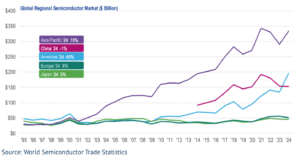
The race for semiconductor dominance is redefining global economic competition. Chips are now the central nervous system of AI, electric vehicles (EVs), cloud computing, and digital infrastructure. Major economies are deploying massive capital to secure their supply chains:
- United States: Committed over US$52 billion via the CHIPS and Science Acts.
- China: Doubling down on “Made in China 2025” for self-reliance.
- EU, Japan, & Korea: Deploying large-scale incentives and stricter export This realignment opens a strategic window for ASEAN. As firms diversify to reduce concentration risk, Southeast Asia is rising as a geopolitically neutral alternative. The question remains: Can ASEAN convert this moment into a long-term advantage by building a fully integrated regional ecosystem?
Competitive Landscape: ASEAN vs. Global Giants
To understand ASEAN’s trajectory, we must benchmark it against established global hubs:
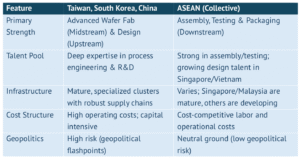
Strategic Insight: ASEAN cannot immediately compete with Taiwan or Korea on advanced node fabrication. Its competitive edge lies in neutrality, cost-efficiency, and downstream excellence, with a gradual climb toward midstream manufacturing.
Understanding ASEAN’s Value Chain Position
ASEAN is upgrading from a back-end manufacturing center to a more integrated ecosystem.
- Upstream (Design & R&D): Anchored by Singapore, with emerging pockets in Vietnam. This phase involves architecture development and IP creation.
- Midstream (Fabrication): The most capital-intensive segment. While not a dominant fab center yet, the region is attracting investments in legacy nodes and power chips for automotive use.
- Downstream (ATP): ASEAN’s Malaysia and Vietnam are global leaders in packaging, testing, and preparation for integration.
Sustainability: The Green Chip Opportunity
Sustainability is shifting from a corporate responsibility metric to a competitive requirement. Global chipmakers face pressure to decarbonize supply chains.
- Green Manufacturing: ASEAN has the opportunity to build new facilities that are “born green,” utilizing renewable energy sources and advanced water recycling systems—a significant differentiator against older, less efficient legacy fabs in other regions.
- ESG Alignment: Countries that align industrial zones with global ESG standards (e.g., renewable power grids, waste management compliance) will win contracts from top-tier multinationals like Apple and NVIDIA who have strict supplier carbon mandates.
Country Progress: ASEAN’s Emerging Semiconductor Nodes
- Singapore — The Innovation Anchor
Singapore acts as the region’s upstream brain. Home to GlobalFoundries and Micron, the sector accounts for ~6% of GDP. It provides the necessary IP protection, regulatory stability, and R&D capabilities that anchor the wider regional ecosystem.
- Malaysia — The Established Powerhouse
Malaysia controls 13% of the global testing and packaging market. The “Silicon Valley of the East” in Penang is moving up the value chain under the National Semiconductor Strategy (NSS), focusing on wafer fabrication and advanced manufacturing. Recent initiatives include major expansions in Sarawak, as an emerging innovation hub for AI and chip technology as part of NSS initiative, supported by Sama Jaya High-Tech Park, as well as strategic private-sector collaborations (e.g., Edelteq, Analog Devices).
- Vietnam — The Aggressive Challenger
Vietnam is rapidly building a foundation for growth, targeting USD 16.64 billion in revenue by 2033. Vietnam’s strengths lie in ATP, with increasing movement into Integrated Circuit (IC) design, R&D, and domestic talent development.
Strong government incentives and partnerships with the US, Japan, and South Korea accelerate growth. Targets to open its first localized semiconductor plant in 2026, as its path to create a semiconductor ecosystem, Vietnam is positioned to become a cost-efficient manufacturing and innovation hub, supporting regional ATP consolidation and emerging design capabilities.
- Thailand — The Automotive Hub
Driven by its “Detroit of Asia” legacy, Thailand is pivoting to power semiconductors. Growing collaborations with Japanese and Taiwanese firms for electronics manufacturing services (EMS). Development of Eastern Economic Corridor (EEC) – Thailand’s major SEZ–as a high-tech manufacturing hub,integrating semiconductor components into automotive and smart manufacturing.
- Indonesia — The Industrial Contender
Indonesia is accelerating efforts to build foundational capabilities. While constrained by talent shortages, the country is leveraging its massive industrial land banks and domestic market scale. Recent progress include:
- Government push to develop Integrated Circuit (IC) design talent via university and polytechnic programs.
- Exploration of semiconductor in industrial zones around West Java and Riau Island, especially Batam.
- Partnerships with Japan, South Korea, and the US for skills development and initial facility planning.
- Rising demand from EV, battery, and IoT manufacturing
- However, Indonesia remains constrained by limited upstream capability, talent shortages, and high capital
Key Challenges for the Region
- Talent Shortage: Specialized engineering talent is scarce outside Singapore and Malaysia.
- Infrastructure Gaps: Cleanrooms, stable power, and ultra-pure water supplies vary significantly by country.
- Fragmented Policy: Lack of unified standards increases compliance complexity for investors.
- IP Dependence: The region remains reliant on foreign technology and lacks advanced-node design IP.
Skylight’s Opinion: A Practical Roadmap for Indonesia
While regional cooperation is valuable, Indonesia cannot wait for ASEAN-wide policy harmonization. To capture the semiconductor opportunity, Indonesia must focus on practical, domestic execution.
- Prepare Industrial Zones for High-Tech Investment. Indonesia does not need to designate specific “winning” zones; instead, it should create a framework where any industrial estate can compete to be semiconductor-ready.
- Infrastructure Upgrades: Industrial Parks must guarantee high-quality power stability (zero downtime), access to ultra-pure water, and hazardous waste management systems that meet global semiconductor standards.
- Logistics & Customs: Establish “Green Lanes” for semiconductor imports/exports to ensure rapid movement of time-sensitive materials, bypassing standard red tape.
- Leverage the EV & IoT Indonesia should not try to compete head-on with Malaysia in general logic chips. Instead, it can focus on Power Management Integrated Circuits (PMICs)— specialized chips that control and distribute electrical power efficiently within devices such as EVs and IoT systems. PMICs are crucial for maximizing battery life, ensuring safety, and supporting the high-performance demands of modern electronics. By developing capacity in PMICs and legacy nodes, Indonesia can serve its rapidly expanding domestic markets in automotive and IoT, creating a robust internal ecosystem and reducing over-reliance on exports alone.
- Indonesia’s position as a manufacturing base for a broad set of automotive industry leaders—including major Japanese automakers as well as new entrants like Hyundai and Chinese manufacturers—offers a distinct By aligning semiconductor development with the needs of this diverse and growing automotive sector, Indonesia can attract targeted investments in semiconductor manufacturing across a range of applications, from traditional vehicles to EVs and IoT-enabled systems.
- Streamline Investment Simplify the “entry cost” for foreign firms. This includes offering clear, long-term tax incentives for capital-intensive equipment imports and easing work permits for foreign technical experts who are needed to train the local workforce in the short term.
- Build Talent through Vocational Partnerships. Address the skills gap from the bottom up. Partner with polytechnics to create specialized 1-2 year certification programs for cleanroom technicians and equipment maintenance staff. This is a faster route to employability than 4- year design degrees and directly addresses the operational needs of potential investors.
Latest Update
- US & German Consortium Build Semiconductor Industry in Riau Island
- The consortium of US and German companies, including PT Quantum Luminous Indonesia, PT Terra Mineral Nusantara, and Tynergy Group, is spearheading a $26.73 billion investment to establish semiconductor manufacturing, silica sand downstreaming, and high-tech glass production facilities on Galang Island, Riau Islands. This initiative is part of the Wiraraja Green Renewable Energy and Smart-Eco Industrial Park (GESEIP), a National Strategic Project. Construction is set to begin in early 2026, with the consortium leveraging the park’s strategic location and free trade zone benefits.
- The project has been in development since the 2022 G20 Bali Summit, with further commitments made at the 2023 Hannover Messe in Germany. A formal Cooperation Agreement was signed in November 2023 between Tynergy Group and PT Galang Bumi Industri, the park’s operator. The consortium is expediting licensing and permitting processes to meet the construction timeline, emphasizing the project’s potential to strengthen Indonesia’s role in the global semiconductor supply chain.
- The facilities will focus on advanced technologies, including semiconductor wafer production and silica processing for solar panels. The initiative also aims to create local employment, foster technology transfer, and enhance Indonesia’s competitiveness in high-tech US based Tynergy Group, known for its sustainable energy and innovative technologies, is a key player in this venture, collaborating with global partners to ensure the project’s success.
- AEON Open First Store in East Java
- AEON Indonesia has expanded its footprint in East Java with the opening of its 13th supermarket at Pakuwon Mall Surabaya, marking its first store in the city. This strategic move aligns with AEON’s long-term plan to strengthen its presence in Indonesia’s regional The store, located in one of the largest and most prestigious malls in Surabaya, features a 6,000-square- meter sales floor, making it one of the largest food supermarkets in the country. It offers a wide range of products, including 18,000 Stock Keeping Units of food and daily necessities, and introduces dry-aged beef and expanded sambal selections to cater to local tastes.
- The store also includes 700 eat-in seats, the largest among AEON’s Indonesian outlets, and a dedicated “Food Street” area featuring Japanese- inspired dishes with local twists, such as spicy fusion menus. AEON’s commitment to quality is evident in its offerings of premium imported goods like Tasmanian beef and Norwegian salmon, alongside local The store’s design and product lineup aim to meet the evolving preferences of Surabaya’s urban consumers, who value convenience, quality, and variety.
- This expansion is part of AEON’s broader strategy to open 30 new stores by 2030, with five planned for next The company has shifted its focus to partnering with local developers for store locations, as seen in its recent openings in Bandung and Semarang. AEON has also leveraged its app-based membership program to enhance customer engagement, achieving 28,000 members at the Surabaya store before its official opening. This digital initiative, combined with promotional offers, underscores AEON’s efforts to adapt to Indonesia’s dynamic retail landscape.
- Mitsubishi Corp. Build 2 Logistics Center Located in Jakarta
- Mitsubishi will invest over 10 billion yen (US$64.2 million) to develop two logistics centers in Indonesia, acquired vacant land previously Japanese- owned in two industrial parks near Jakarta, with construction starting May 2026 and completion targeted for May 2027. The facilities will support Indonesia’s expanding e-commerce and EV sectors.
- Mitsubishi will lead the design, construction, and tenant selection for the 2 single-story warehouses, totaling 110,000 sqm.
- Since 2023, Mitsubishi has joined hands with non-Japanese partners to take minority stakes in three warehouse projects in This time around, Mitsubishi will be investing over 90% of the capital for the new logistics centers.
- Rising construction costs and declining rents in the Tokyo area are prompting Japanese firms to seek higher-growth opportunities in regional logistics
- Indonesia’s warehouse market is expected to expand by 50%, from USD 85 billion in 2023 to USD 4.25 billion by 2028. The country boasts the largest e-commerce transaction volume in ASEAN, and investment in EV-related manufacturing plants, including those by BYD, is accelerating.
- PT Pindad Sets Plan to Build Facility for National Car Production
- PT Pindad, Indonesia’s SOE operating in the field of defense equipment manufacturing and commercial products is preparing to build a national car factory in Subang, targeting a production capacity of 500,000 units per year, starting with 100,000 units in 2028. The government aims to price the national car below IDR300 million (USD$18,100) to attract middle-class consumers.
- The target is highly ambitious—approaching the scale of Daihatsu, Indonesia’s largest Japanese automaker, which produces around 530,000 units annually.
- This move aligns with the newly signed MoU between the Ministry of National Development Planning/Bappenas, the Industrial Estate Association (HKI), and PT Pindad to strengthen the planning of priority industrial estates in the 2025–2029 National Medium-Term Development Plan (RPJMN).
- The three parties agreed to develop Eco Industrial Park, strengthen the domestic automotive supply chain, and advance high-standard manufacturing technology.
- Chinese PET Factory to be Build in Krakatau Industrial Estate
- Krakatau Steel Group, through its subsidiary PT Krakatau Sarana Infrastruktur (KSI), signed the finalization of the sale of 26 hectares of land to Wankai Advanced Materials Indonesia, a Chinese PET resin manufacturer, and at the same time held a groundbreaking ceremony on the land located in the Krakatau Industrial Estate, in Cilegon, Banten.
- This land will be used for the construction of a PET resin factory with a capacity of 750,000 tons per year and an investment value of US$284 million. This factory will strengthen the supply chain for food and beverage packaging and other downstream industries.
- This agreement marks China’s first investment in the Krakatau Steel industrial area, which was previously dominated by investors from Korea and The PET resin plant is targeted to begin construction soon, with an estimated construction period of 1.5 years before entering the commercial operation phase.
- Golden Elephant To Attract More Chemical Industries to Indonesia
- PT AKR Corporindo through its subsidiary PT Berkah Kawasan Manyar Sejahtera, has handed over an additional 20 hectares of industrial land to PT GEABH Joint Technology in JIIPE SEZ, Gresik, East Java.
- PT GEABH Joint Technology is a subsidiary of Sichuan Golden Elephant Chemical, a Chinese company that produces chemical raw materials and fertilizers using natural gas as its main raw Its portfolio includes melamine, nitro-compound fertilizers, ammonium nitrate, nitric acid, water- soluble fertilizers, hydrogen peroxide (including electronic grade), and acetic acid.
- The handover of the land is a continuation of Golden Elephant’s previous acquisition of 20 hectares of land in April 2025 for its first production. The additional land will be used for the development of environmentally friendly chemical facilities.
- Golden Elephant plans to build new plants producing melamine, nitric acid, and ammonium nitrate, and is assessing the feasibility of additional ammonia and synthetic urea facilities leveraging Indonesia’s natural gas resources. A specific construction timeline has not yet been announced.
- Golden Elephant is expected to become one of the anchor tenants in JIIPE SEZ that will attract more chemical and downstream industries to the region.
- Indonesia Impose Export Duties on Gold and Coal
- Indonesia has enacted a new regulation under Finance Ministry Regulation Number 80 of 2025, imposing export duties on gold to support domestic mineral downstreaming and stabilize local commodity prices. Effective December 23, 2025, the tariffs range from 5% to 15%, depending on the global gold reference price. For prices between $2,800 and $3,200 per troy ounce, duties are set at 7.5% to 12.5%, while prices above $3,200 incur 10% to 15%. The policy applies to various gold forms, including dore, granules, ingots, and minted bars. Analysts view the measure as a step to curb indirect subsidies for exporters and address domestic supply shortages, ensuring the sustainability of Indonesia’s gold sector amidst global demand.
- Besides gold, Indonesia will impose coal export duties starting in 2026, ending the long-standing exemption for the commodity. Finance Minister emphasized that the move aims to increase state revenue, as coal’s contribution has been relatively small compared to other mining The government believes the policy will not harm Indonesia’s global competitiveness, as it only slightly reduces profit margins while remaining economically viable. Experts, however, suggest implementing the duty when coal prices stabilize, ideally above $160 per ton, as current prices are low. Additionally, the Directorate General of Taxes plans to integrate data from the Ministry of Energy and Mineral Resources to optimize tax collection.
- Robinhood Expands to ASEAN Market with Two Acquisitions in Indonesia
- S&P 500 US-based trading and investment platform Robinhood is entering the Indonesian market after securing two new acquisition agreements with Indonesian brokerage PT Buana Capital Sekuritas and licensed digital financial asset trader PT Pedagang Aset Kripto. The financial terms of the deals are undisclosed.
- Both acquisitions are pending approval from the Indonesian Financial Services Authority (OJK) as well as other regulatory authorities, with both deals expected to close in the first half of
- Once the deals have been completed, Robinhood will continue to serve Buana Capital’s brokerage customers with financial products. It then also plans to roll out its own brokerage and crypto trading solutions to connect Indonesian customers to US equities, crypto currencies, and more at
- These deals will accelerate the company’s expansion across Southeast Asia, with Indonesia viewed as a high-potential market—home to tens of millions of young, tech-savvy capital-market and crypto investors—and a strategic entry point that signals Robinhood’s intent to establish a stronger regional presence.
Latest Update – Japanese Market Movements
Danantara and MUFG Host Investor Relations Event – In a move to attract foreign capital, Indonesia’s state-backed investment fund, Danantara, held its first investor relations event in Tokyo, in partnership with Mitsubishi UFJ Financial Group (MUFG). Established in February, Danantara oversees a portfolio of major Indonesian state-owned enterprises. The event featured six of these companies, including oil and gas Pertamina, electricity provider PLN, Bank Mandiri, and mining holding company MIND ID. They presented their business strategies to approximately 30 Japanese institutional investors, with opportunities for one-on-one meetings. MUFG highlighted that the event aligns with investors’ growing interest in portfolio diversification amid geopolitical uncertainty and meets the Indonesian government’s strong desire to attract investment from Japan.
RevComm Establishes Development Hub for AI Voice Analytics – RevComm Inc. is enhancing its presence in the Indonesian market by establishing a development hub at its local subsidiary, PT RevComm APAC Indonesia. Having launched its voice analytics AI solution, “MiiTel,” in Indonesia in October 2021, the company has seen steady growth and adoption by government institutions and local businesses. While the subsidiary previously focused on sales, it will now employ software engineers to localize services, such as “MiiTel Phone Mobile for Hotels,” and adapt AI-related functions for the Indonesian language and telecommunications standards. This move is a rare instance of a Japanese startup establishing a development base in Indonesia, aiming to improve the user experience and create new service offerings.
Nikkon Holdings Completes New Warehouse in Karawang – Nikkon Holdings has expanded its logistics capabilities in Indonesia with the completion of a new warehouse in West Java, constructed by its subsidiary, PT Nippon Konpo Indonesia. This two-story, 18,142-square-meter facility is the fifth warehouse for its Bukit Sales Office, located in Kota Bukit Indah Industrial Park. It is designed for operational efficiency and safety, equipped with vertical conveyors, a high-capacity elevator, and a layout that minimizes forklift use to reduce physical strain on workers. The warehouse also features energy- efficient LED lighting and other modern specifications to support safe and sustainable logistics operations.
Andersen Group Opens Flagship Bakery in Jakarta – Hiroshima-based bakery company, the Andersen Group, has opened the flagship store for its Japanese-style “Say Bread Bakery & Cafe” brand in Jakarta. This marks the first store where the group is directly involved in operations, offering a premium selection of around 60 items. The store is located in South Jakarta and is fully supervised by Japanese staff, from product development to store design. This initiative builds on a decade-long relationship with the Indomaret Group, Indonesia’s major convenience store operator. The joint venture aims to introduce a premium-oriented bread culture to Indonesians, moving beyond the affordable options currently widespread in convenience stores.
Yamamoto Trading Establishes Sales Subsidiary – Yamamoto Trading, a distributor of chemical products like pigments and dyes, announced the establishment of a new sales subsidiary in Jakarta. The decision was driven by the active expansion of its major customers into the Indonesian market, making a local presence essential for sustainable growth. The new entity, tentatively named PT Yamamoto Trading Indonesia, is planned to be established in April 2026 with a capital of 8.0 billion IDR. By leveraging local human resources, the company aims to respond effectively to industry trends and secure new sources of revenue in the growing Indonesian market.
Mitsui & Co. Partners with MMP to Strengthen Nickel Supply Chain – Mitsui & Co. has entered into a strategic partnership with PT Mitra Murni Perkasa (MMP), a subsidiary of MMS Group Indonesia, to enhance the marketing of high-quality nickel matte and explore investment opportunities. The memorandum of understanding aims to bolster Indonesia’s position in the global EV battery ecosystem and support the country’s downstream industrialization policy. Under the agreement, Mitsui & Co. will focus on developing the Japanese market, while MMP will contribute its expertise in operating integrated smelting facilities. This collaboration is designed to create added value within the supply chain for high-quality nickel, a critical component for electric vehicle batteries.
-end-
REFERENCES
- Skylight Analytics Hub
- https://hanoitimes.vn/vietnam-to-open-first-semiconductor-plant-in-2026-prime- minister.900401.html
- https://fulcrum.sg/thailands-new-semiconductor-strategy-ambitious-but-challenging/
- https://www.eria.org/news-and-views/asean-s-strategic-leap–building-resilience-in-the- semiconductor-supply-chain
- https://asean-bac.org/news-and-press-releases/how-vietnam-malaysia-and-singapore-are- shaping-asean-s-semiconductor-supply-chain-potential
- https://vir.com.vn/asean-economies-move-up-the-global-chip-value-chain-142410.html https://www.semi.org/sea/blogs/October-2025
- https://fulcrum.sg/aseans-regional-ambitions-for-the-semiconductor-industry/ https://www.hinrichfoundation.com/research/wp/tech/mapping-asean-semiconductor-moment https://asiatimes.com/2025/11/critical-industries-critical-risks-in-asean-supply-chains/
- https://horizontechnology.com/news/the-semiconductor-fabrication- race/#:~:text=A%20Global%20Web:%20Current%20State,is%20owned%20by%20multinational% 20firms.
- https://medium.com/@dualinsightshub/understanding-the-semiconductor-industry-a-deep- dive-into-its-ecosystem-and-value-chain-f42b2c36d55f
- https://industri.kontan.co.id/news/perusahaan-as-dan-jerman-siap-bangun-industri- semikonduktor-di-batam-awal-2026
- https://money.kompas.com/read/2025/12/02/170451326/konsorsium-asjerman-siap-bangun- kawasan-semikonduktor-rp-444-triliun-di-pulau#google_vignette
- https://money.kompas.com/read/2025/12/18/190217326/aeon-resmikan-supermarket-di- surabaya-ada-beragam-promo?page=all
- https://swa.co.id/read/467447/aeon-resmikan-gerai-supermarket-ke-13-di-pakuwon-mall- surabaya
- https://amp.kontan.co.id/news/ekspansi-ke-jawa-timur-aeon-supermarket-resmi-buka-di- pakuwon-mall-surabaya
- https://asia.nikkei.com/spotlight/supply-chain/mitsubishi-corp.-to-build-2-logistics-centers-in- indonesia
- https://otomotif.kompas.com/read/2025/12/10/162100015/pindad-siapkan-pabrik-mobil- nasional-di-subang-produksi-500.000-unit
- https://otomotif.katadata.co.id/mobil/pindad-bakal-bangun-pabrik-di-subang-buat-produksi- mobil-nasional-22136
- https://www.cnnindonesia.com/otomotif/20251210114057-587-1304958/pabrik-mobil- nasional-pindad-ditarget-mampu-produksi-500-ribu-setahun
- https://investortrust.id/business/88023/krakatau-steel-group-finalisasi-penjualan-26-ha-lahan- untuk-pabrik-pet-resin-ke-wankai-indonesia
- https://market.bisnis.com/read/20251205/192/1934436/akr-corporindo-akra-serahkan-20-ha- lahan-di-kawasan-industri-jiipe-ke-golden-elephant
- https://www.dunia-energi.com/pengamat-bea-ekspor-emas-cegah-subsidi-tak-langsung-bagi- eksportir/
- https://ekonomi.bisnis.com/read/20251201/259/1933061/bea-keluar-batu-bara-mulai- dikenakan-2026-djp-incar-data-minerba-esdm
- https://www.cnbcindonesia.com/market/20251201085107-17-689874/djp-panggil-1800- pengusaha-tambang-minta-lunasi-tunggakan-pajak
- https://katadata.co.id/finansial/bursa/69376e96c3ab3/harga-saham-robinhood-melesat-usai- umumkan-masuk-pasar-indonesia
- https://www.fintechfutures.com/m-a/robinhood-expands-southeast-asian-presence-with-two- acquisitions-in-indonesia
- https://www.nikkei.com/article/DGXZQOUB040VO0U5A201C2000000/?n_cid= dsapp_share_android
- https://ashu-aseanstatistics.com/news/309757-02472618730
- https://www.revcomm.com/ja/news/pressrelease/20251209/ https://contents.xj-
- storage.jp/xcontents/AS06210/a47c3896/3805/41d6/b832/39f1ee0ff00d/202511 28182505713s.pdf
- https://www.nna.jp/news/2871391
- https://www.nikkei.com/nkd/disclosure/tdnr/20251212519227/
- http://ekonomi.bisnis.com/read/20251211/44/1936204/mmp-dan-mitsui-teken-kesepakatan- kerja-sama-pengembangan-pasar-nikel-di-jepang