
By Fahmi Shahab, Industrial Park
As global competition for manufacturing heats up, how can governments strategically position themselves to attract investment and fuel long-term growth?
In the face of intensifying global competition for investment, countries are deploying increasingly sophisticated strategies to attract capital—particularly in the manufacturing and processing sectors. Among the most effective policy instruments are Industrial Parks and Special Economic Zones, both of which are widely leveraged across nations to position themselves as attractive destinations for investors.
These zones have emerged as critical levers in national economic development strategies, serving as catalysts for industrial growth, job creation, and regional competitiveness.
Successful models often reflect a deliberate integration of world-class infrastructure and utility services with targeted incentives and streamlined regulatory frameworks—forming an investment ecosystem designed to reduce barriers, lower costs, and accelerate business establishment.
In Indonesia, Industrial Parks have developed earlier, dating back to the 1970s, initially driven by state-owned enterprises (SOEs), followed by private sector development in the 1990s. In contrast, Special Economic Zones (SEZs) were only introduced in 2009. However, the incentives and facilities provided by the government for SEZs are significantly more attractive than those for traditional Industrial Parks. As a result, several Industrial Parks have sought to convert their status to SEZs in order to access investor-oriented incentives that better align with the needs of their tenants.
Key Challenges in Converting Industrial Parks to Special Economic Zones in Indonesia
- Regulatory and Administrative Complexity
- Navigating overlapping regulations between central and regional governments can delay the SEZ approval process.
- Lack of clarity in SEZ designation criteria and inconsistent policy implementation can create uncertainty for investors and operators.
- Infrastructure Readiness
- Many existing Industrial Parks may lack the integrated infrastructure (e.g., port access, energy supply, digital connectivity) required for SEZ status.
- Upgrading infrastructure to meet SEZ standards often requires substantial capital and coordination with public agencies.
- Alignment with National Development Strategy
- Not all Industrial Parks are in locations aligned with Indonesia’s strategic development zones or priority sectors, making it harder to justify SEZ designation.
- SEZ conversion must align with broader goals such as reducing regional disparity and supporting downstream industrialization.
- Incentive Structuring and Fiscal Burden
- Designing compelling incentives (tax holidays, customs exemptions, labor flexibility) without overextending fiscal resources remains a delicate balance.
- There’s also pressure to ensure incentives are competitive with other ASEAN countries.
- Governance and Institutional Capacity
- Effective SEZ management requires robust, professional governance structures, which may not be present in all Industrial Parks.
- Capacity building for zone administrators and local governments is crucial to ensure proper zone operation and investor servicing.
- Investor Confidence and Track Record
- Previous underperforming SEZs in Indonesia have created skepticism among investors.
- Building trust through transparency, consistent policy, and successful case studies is essential.
Understanding the Conditional Nature of Industrial Park Incentives in Indonesia’s Regulatory Landscape
Referring to the current regulatory framework governing Industrial Parks, as outlined in Government Regulation No. 20 of 2024 on Industrial Zoning, specific provisions address the topic of ‘Industrial Park Facilities’:
- Article 66, Paragraph (1): ‘Industrial Park Operators and Industrial Companies operating within Industrial Parks may be granted fiscal and non-fiscal incentives, in accordance with prevailing laws and regulations.’
- Paragraph (2): ‘Fiscal incentives as referred to in Paragraph (1), including taxation and customs benefits, are regulated under the relevant ministerial regulations responsible for financial governance.’
- Paragraph (3): ‘The allocation of fiscal incentives is determined based on the classification of Industrial Zoning (WPI) and/or the development status of the Industrial Development Area (WPPI).’
Further explanation of Paragraph (1) clarifies that ‘fiscal incentives’ may include tax relief, customs exemptions, non-tax state revenues, and local taxes and retributions. ‘Non-fiscal incentives’ may cover areas such as immigration, land acquisition, and labor-related support.
However, upon closer analysis, the language of the regulation—particularly the use of the word may—suggests a lack of legal certainty or guaranteed entitlement. This creates an impression of ambiguity, as the actual provision of incentives appears to be highly contingent on prevailing circumstances and discretionary interpretation, rather than being anchored in a clearly defined or preferential framework.
A Tale of Two Zones: How Regulatory Clarity and Incentive Depth Make SEZs the Preferred Choice for Investors
The government tends to perceive Industrial Parks as conventional business models rather than as specialized strategic assets. This view overlooks their critical role in driving environmentally conscious industrial growth, enhancing investment competitiveness, and creating large-scale employment opportunities.
This treatment stands in stark contrast to the clearly defined incentive structure offered to Special Economic Zones (SEZs). Under Government Regulation No. 12 of 2020 on “Facilities and Ease of Doing Business in SEZs,” both Business Entities and Enterprises operating within SEZs are granted a comprehensive package of incentives and facilities, including:
- Taxation, customs, and excise benefits
b. Simplified goods movement procedures
c. Labor-related facilitation
d. Immigration support
e. Land and spatial planning assistance
f. Business licensing streamlining
g. Additional facilitation and ease-of-business measures
Importantly, this regulation provides legal certainty, as the language omits ambiguous terms like “may be granted”—a notable contrast to the Industrial Park framework, where incentives are conditional and discretionary. As a result, the provisions in PP 12/2020 are directly actionable and are systematically cascaded into technical implementing regulations.
For example, Minister of Finance Regulation No. 237/PMK.010/2020 on “Taxation, Customs, and Excise Treatment in SEZs” grants a 100% Corporate Income Tax Holiday, scaled by investment value:
- 10 years for investments between IDR 100–500 billion
- 15 years for investments between IDR 500 billion–1 trillion
- 20 years for investments above IDR 1 trillion
These incentives are operationalized through detailed implementing guidelines, and the permitting process is directly managed by SEZ Administrators, enhancing service delivery and investor confidence.
Requirements for Converting an Industrial Park into a Special Economic Zone (SEZ) in Indonesia
- Strategic Alignment and Feasibility
- Alignment with National/Regional Development Goals: The proposed SEZ must support national priorities such as industrialization, economic equity, export promotion, and job creation.
- Clear Economic Rationale: The developer must present a compelling case that the SEZ will offer higher economic value than the existing Industrial Park (e.g., in terms of investment attraction, employment, and infrastructure optimization).
- Minimum Land and Infrastructure Readiness
- Land Size: Generally, a minimum of 50 hectares is required (though smaller zones may be allowed for certain sectors like digital economy or health tourism).
- Land Status: The land must be clear and free from legal disputes, with ownership or utilization rights secured.
- Infrastructure Readiness: Basic infrastructure (roads, utilities, waste management, etc.) should already be developed or planned with a clear timeline and budget.
- Business Plan and Economic Impact Projection
- A comprehensive master plan and business development plan must be submitted, detailing:
- Target industries/sectors
- Investment value projections
- Job creation estimates
- Environmental impact analysis
- Revenue potential for the government
- Governance and Organizational Readiness
- Appointment of a Zone Developer (Badan Usaha Pengelola) who will manage and operate the SEZ.
- Establishment of a Zone Administrator (Administrator KEK) to serve as a government liaison and provide licensing and facilitation services on-site.
- Proposed governance structure must ensure coordination with central and regional authorities.
- Legal and Regulatory Compliance
- All submissions must comply with:
- Law No. 39/2009 on SEZs
- Government Regulation No. 40/2021 on SEZ implementation
- Related sectoral regulations (e.g., taxation, labor, spatial planning, customs, etc.)
- Formal Application Process
- Submit a proposal to the National Council for SEZ (Dewan Nasional KEK) through the Ministry of Economic Affairs.
- Undergo a feasibility assessment by relevant ministries (Finance, Industry, Environment, etc.).
- Receive Presidential Decree to legally designate the area as an SEZ.
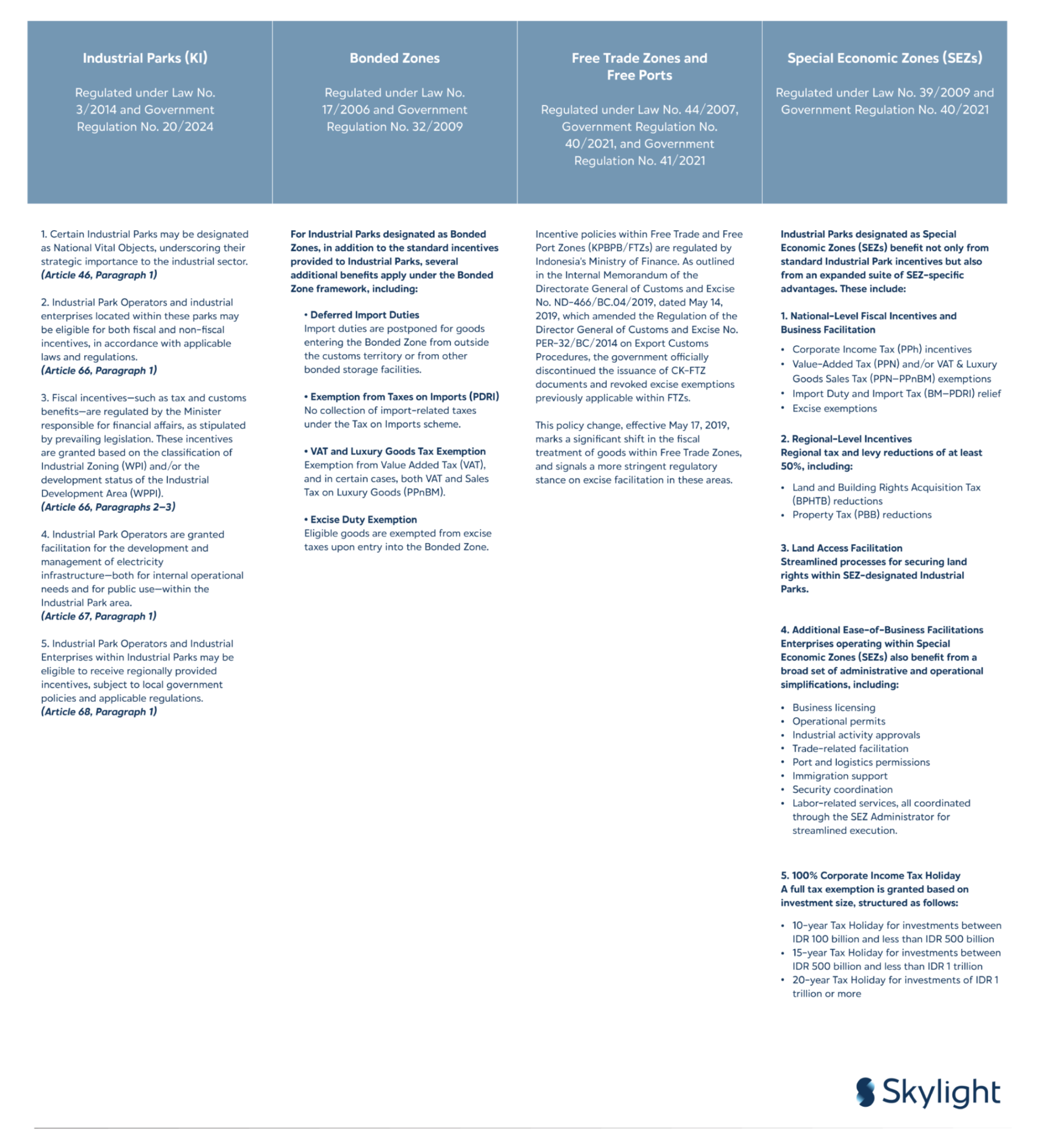
Strategic Realignment: Why Developers Are Increasingly Pursuing SEZ Designation
In response to the growing availability of robust fiscal incentives, streamlined regulatory processes, and investor-oriented facilitation within Special Economic Zones (SEZs), a clear strategic shift is emerging among new and prospective Industrial Park developers in Indonesia. SEZs offer a significantly more favorable policy environment compared to conventional Industrial Parks—ranging from tax holidays and customs relief to land rights facilitation, immigration support, and localized licensing services.
This competitive advantage is becoming a decisive factor for developers as they formulate their long-term investment and operational strategies. With the global race for capital, technology, and talent becoming increasingly intense, developers are recognizing that SEZ status does more than enhance profitability—it increases the overall value proposition of their estates to both domestic and foreign investors.
Moreover, aligning with the SEZ framework allows developers to position their projects as integrated, investment-ready ecosystems that meet international standards for ease of doing business. This not only improves tenant acquisition but also strengthens partnerships with government agencies, accelerates project timelines, and unlocks broader economic multipliers such as job creation, export growth, and regional development.
As a result, the trend toward seeking SEZ designation is not merely opportunistic—it reflects a fundamental realignment in how Industrial Parks are conceptualized and executed in Indonesia’s evolving investment landscape.
Final Thought: Think Like a National Asset, Not Just an Industrial Park Developer
The most successful Special Economic Zone (SEZ) proposals position themselves not merely as commercial real estate projects, but as national strategic infrastructure platforms that deliver broad-based economic impact. These initiatives go beyond the provision of industrial land—they are designed to catalyze regional development, foster innovation ecosystems, and attract globally competitive investments.
Investors looking to convert their industrial park into a SEZ should therefore adopt a long-term, nation-building mindset. This includes aligning the project with Indonesia’s national development priorities, proactively engaging with relevant policymakers and regulators, and structuring the zone as an integrated economic cluster that can drive inclusive growth.
Ultimately, the goal should be to create a transformational zone—one that enhances Indonesia’s position in global value chains and sets a benchmark for investment competitiveness in the region.
Source
Skylight Analytics Hub