Executive Brief: From Neighbors to Supply-Chain Partners – Integrating Local MSMEs Into Industrial Park Growth
Executive Summary
Industrial parks depend on more than land, utilities, and tenants. They rely on an ecosystem of service providers, operational support businesses, and suppliers to keep tenant operations running. Local micro, small, and medium enterprises (MSMEs) could fill far more of these roles. Most, however, are not yet ready to meet the standards industrial tenants require.
The opportunity is large. MSMEs make up 99 percent of players in Indonesia’s manufacturing sector, employ 97 percent of the workforce, and contributed approximately 59.64 percent of national GDP in 2024 — the most recent figure from the Ministry of MSMEs. Industrial policy still centers on the large and medium enterprises that make up the remaining 1 percent. The manufacturing sector expanded by 5.20 percent year-on-year in 2025, outpacing the broader economy, yet only a small share of MSMEs have joined global value chains or the supply chains of large industrial estates.
The barrier is not only capital. MSMEs also struggle with legal formalization, product standards, quality consistency, production capacity, delivery reliability, and visibility into what tenants actually need. Closing these gaps takes structured upgrading, not one-off donations.
Core thesis: Industrial parks create more durable value when they deliberately develop local MSMEs into reliable operational and supply-chain partners. This requires structured community development that combines capability building, coordination, and practical financing support. Donation-based CSR alone will not get there.
When done well, tenants gain faster, more flexible local supply. Parks gain a stronger investment proposition and a firmer social license to operate. Surrounding communities gain stable, higher-value economic activity.
Key Takeaways
- Local MSMEs are a competitive asset for industrial parks, not just a community obligation. A capable local supplier base improves tenant operations, shortens lead times, and makes the park more attractive to investors.
- The fastest wins lie in workforce-support and operational-support services. Catering, transport, cleaning, uniforms, housing, and maintenance can be localized quickly. Production-linked supply roles need deeper, longer-term upgrading.
- Most MSMEs are not yet tenant-ready. Legality, quality standards, scalable capacity, and delivery discipline are the gatekeepers to industrial procurement.
- Working capital is the decisive constraint. Without supply chain finance, mentoring and shared facilities rarely translate into lasting supplier commitment.
- CSR must evolve into structured community development. The winning model builds commercially usable local partners through training, formalization, business matching, and finance, rather than through grants.
1. Why MSMEs Matter to Industrial Parks
MSMEs do not need to be tenants to create value inside an industrial estate. They support the estate’s daily operations and the people who work there.
The commercial case is clear:
- Supply chain resilience. Local MSME suppliers reduce dependence on imported inputs. This cuts exposure to global supply disruptions and exchange rate swings.
- Higher-quality partners. Business-to-business (B2B) MSMEs outperform business-to-consumer (B2C) MSMEs. They are 30 percent more likely to introduce process innovations and 60 percent more likely to hold international quality certifications, which makes them more reliable partners for large tenants.
- Operational flexibility. Large enterprises already rely on MSMEs for specialized, non-core activities across the value chain, from raw material supply to logistics, maintenance, and last-mile distribution.
- Park competitiveness. A strong local supplier network improves the tenant experience, supports retention, and helps parks stand out to prospective investors.
- Social license to operate. Visible local economic benefits strengthen relationships with surrounding communities and local governments.
Who benefits, and how
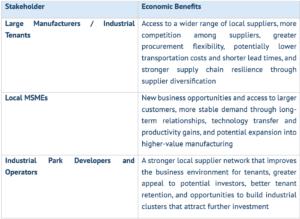
The MSME Landscape at a glance
Indonesia’s MSME base is deep and widely dispersed, but it is overwhelmingly micro-scale and oriented toward daily consumption.
MSME Classification (PP No. 7/2021 and 2025 Projection)
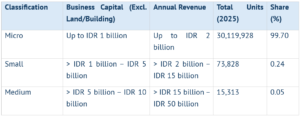
By sector, trade and retail account for 14.44 million units, accommodation and culinary for 6.41 million, and the processing industry for only 4.17 million. The implication is direct: the pool of production-ready MSMEs is thin, while the pool of service-oriented MSMEs is large. Industrial parks should build their integration strategy around that reality.
2. Not All MSME Integration Is the Same
Treating MSME integration as a single category overstates how quickly local businesses can join industrial supply chains. There are three distinct levels, and each comes with different barriers, timelines, and support needs.
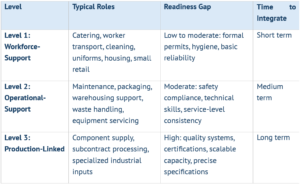
Why the distinction matters: If a tenant’s needs are limited to workforce support services, local MSMEs can integrate fairly quickly with modest guidance. Once requirements move into operational or production-linked roles, MSMEs need sustained, structured support from tenants and park operators. Parks should match each upgrading program to the level of integration they are targeting.
3. What Prevents MSMEs From Serving Industrial Tenants
MSMEs face systemic barriers, including limited human capital, outdated technology, low digital literacy, and difficulty standardizing quality and scaling output. To serve industrial tenants, they must become “industrial-park ready.”
What tenant-readiness requires
- Legality and safety. Formal business permits, Household Industry Product Licenses (PIRT), SNI labels, and relevant halal certifications.
- Quality and standardization. Safe, durable packaging with full tracking information, such as production codes, expiration dates, and net weight, that meets modern retail and industrial standards.
- Production capacity. A proven ability to scale operations and maintain consistent stock that matches high-volume demand.
- Technology and operational discipline. Facilities that meet strict hygiene and safety standards, which often requires new equipment and some automation.
- Commercial reliability. Consistent delivery, disciplined pricing, and the administrative capacity to handle contracts, invoicing, and payment terms.
Meeting these criteria requires a shift in mindset. MSMEs must move from short-term, transactional selling toward long-term, high-volume supply relationships. That shift rarely happens without active involvement from industrial estates and their tenants.
The capital constraint
Working capital is the single largest roadblock. Joining an industrial supply chain demands heavy upfront investment in people, facilities, and systems to meet strict quality, volume, and administrative requirements. Every step of upgrading costs money: formalization, equipment upgrades, inventory, and bridging the gap while waiting for corporate payment.
- Supply chain finance (SCF) is decisive. SCF from banks, suppliers, and large buyers is the most significant factor in securing MSME commitment to industrial supply chains. It allows MSMEs to fund operations while they wait for payment from large buyers.
- Non-financial support is necessary but not sufficient. Mentorship and shared facilities help. On their own, though, they do little to strengthen supply chain commitment if the underlying working capital problem remains unsolved.
The coordination gap
Many MSMEs simply do not know what tenants need. Without clear demand signals, they cannot make informed investments.
- Business matching and reverse exhibitions. Industrial estates should host “reverse trade fairs,” where large tenants present their specific needs for parts, processing technologies, and quality levels. This gives MSMEs, especially medium-sized enterprises, a clear view of real market demand and a basis for sound capital investment.
4. What Other Countries Get Right
Each benchmark offers a distinct, transferable lesson.
| Country | What Works | Lesson for Indonesia |
| Japan: Deep Ecosystem Integration | In the automotive sector, MSMEs achieve double the productivity of peers in other advanced economies, thanks to vertical integration and Keiretsu networks. Manufacturers such as Toyota build deep links with tier-2 and tier-3 suppliers, transferring know-how in demand planning, cost reduction, and management, often alongside cross-shareholding. | Anchor tenants should invest in long-term supplier development, not just transactional procurement. |
| Thailand: Targeted Finance and Investment Policy | Thailand offers SMEs larger credit guarantees than Indonesia (up to THB 40 million) and uses merit-based incentives that reward contributions to R&D and competitiveness. It has also ranked well above Indonesia on ease of doing business, especially in contract enforcement and business start-up. | Larger, better-targeted finance and a simpler business environment speed up SME investment. |
| Vietnam: Intensive Factory-Level Intervention | Vietnam prioritizes key supporting industries, including electronic components, precision engineering, and industrial packaging. Selected MSMEs receive three to six months of hands-on, on-site consulting to implement production-improvement methods widely used in Japanese and global manufacturing systems, including Lean, 5S, Kaizen, and Total Productive Maintenance (TPM), so they can meet the output control standards of foreign-invested enterprises. | Focused, on-site technical support produces measurable upgrading in a short time. |
| United Kingdom: Accessible Procurement and Collaboration | The UK raised construction MSME productivity by simplifying procurement, speeding up payment, and using demonstrator projects to showcase modern methods. This encouraged microenterprises to form consortia and win larger contracts once reserved for big firms. | Simpler procurement and faster payment let small firms compete together for larger contracts. |
5. Strategic Priorities for Industrial Parks and Tenants
Corporate social responsibility should shift from traditional philanthropy to structured community development. That means a deliberate program that strengthens the park’s local operating environment and prepares MSMEs for commercial integration. The toolbox goes well beyond CSR budgets. It includes tenant supplier-development programs, park-level facilitation, vocational partnerships, business matching, and financial intermediation.
- Segment MSME opportunities by integration level.
Map tenant demand across workforce-support, operational-support, and production-linked roles. Start with Level 1 services for quick, visible wins. Build a pipeline of Level 2 and Level 3 suppliers over time.
- Build industrial-park-ready MSMEs through targeted training and formalization.
Work with regional trade and industry offices to train MSMEs on pricing strategy, packaging quality, and the legal and technical standards tenants require. Help them formalize by securing PIRT, SNI, and halal certifications.
- Develop the future workforce and entrepreneurs through teaching factories.
Fund retail and industrial laboratories, known as teaching factories, inside local vocational schools (SMK). This builds the exact technical skills tenants need and prepares the next generation of local suppliers and entrepreneurs.
- Make tenant demand visible and give MSMEs a formal place in the park.
Host reverse exhibitions and regular business-matching sessions. Set aside dedicated retail and operational spaces, or offer rental mechanisms, so local MSMEs can operate formally within the estate as direct supporting facilities for the workforce.
- Expand practical access to finance.
Act as an intermediary between MSMEs and preferential financing schemes that offer lower interest rates and higher capital ceilings than standard micro-loans. Encourage anchor tenants and partner banks to provide supply chain finance, invoice financing, and staged procurement contracts that reduce MSMEs’ working capital burden
Skylight’s Opinion
Indonesia holds two complementary advantages: a vast, widely distributed MSME base and a diverse network of industrial zones. Connected deliberately, they can become mutually reinforcing engines of growth.
The starting point is realism. Each industry’s requirements must be matched against what local MSMEs can actually deliver. Where tenant needs are limited to workforce support services, local MSMEs can integrate quickly. Where needs extend into operational or production-linked roles, tenants and park operators must provide sustained, structured guidance.
That guidance should take the form of structured community development, not donations. Training, financial literacy, help with legal formalization, teaching factories for existing MSMEs, and vocational school partnerships for future entrepreneurs are the tools that build lasting capability.
Industrial parks that take this approach will gain more resilient operations, a stronger investor proposition, and deeper community trust. Local MSMEs will gain stable customers and a path toward higher-value work. The result is a partnership that grows the park, its tenants, and the surrounding region together.
Latest Update
- Indonesia Establishes Regional Investment Desks to Resolve Project Bottlenecks
- Indonesia’s Ministry of Investment and Downstreaming/BKPM has begun extending its regional investment-desk network with offices in Medan, Semarang, Makassar and Balikpapan. The four new desks form part of a wider mechanism intended to facilitate IDR100 trillion ($5.48 Billion USD) in investment realization. Rather than focusing solely on attracting new announcements, the offices are tasked with accompanying existing projects through licensing, land preparation, construction and commercial operations, particularly where difficulties involve several public agencies.
- BKPM developed the model through earlier desks in Batam and Bali. The regional offices bring national and provincial authorities into closer contact with local administrations, technical ministries, industrial-estate operators and special economic zones. Their scope includes inconsistencies in spatial plans, land acquisition, technical permits and infrastructure connections, as well as nontechnical obstacles such as illegal levies. Officials intend to review progress in resolving investor complaints every two weeks. The desks facilitate coordination; the legal authority to issue relevant approvals remains with the responsible agencies.
- The emphasis on project execution reflects the gap between an investment commitment and a functioning factory. Manufacturers may obtain initial approvals through Indonesia’s Online Single Submission system yet encounter subsequent issues relating to land-use conformity, local government clearance, utility availability or access roads. These problems frequently cross administrative boundaries and cannot be resolved by an investor’s contact with a single licensing office. For industrial estates, the ability to coordinate site readiness, technical permits and public infrastructure can be just as important as the initial tax and investment incentives.
- PLN and GGGI Sign Carbon-Purchase Agreement with Norway for Clean-Power Projects
- Indonesia and Norway have moved their bilateral carbon-market cooperation into a commercial implementation framework through a Mitigation Outcome Purchase Agreement (MOPA) signed by state electricity company PLN and the Global Green Growth Institute (GGGI) that acts as trustee of the Norwegian Article 6 Climate Action Fund. The programme is designed to purchase verified emission reductions from Indonesian power-sector projects, with a potential volume of up to 12 million tonnes of carbon dioxide equivalent by 2038.
- In its initial phase, the programme focuses on floating solar photovoltaic installations combined with battery energy storage systems. Floating solar can use water surfaces for electricity generation, while batteries help shift some output to periods when demand is higher and solar production is lower. This combination is relevant to PLN’s challenge of incorporating variable renewable energy into an electricity system that must maintain stable supply to households and industrial customers. The programme uses generation-based incentives tied to independently verified reductions in emissions, rather than rewarding the installation of equipment alone.
- Carbon transactions under Article 6.2 require more than the construction of renewable-energy facilities. Project developers must measure electricity generation and the associated emissions displacement, obtain the relevant authorization, meet verification standards and apply accounting procedures that prevent the same reduction from being counted by two countries. These requirements connect project engineering and operation with a new set of financial and regulatory responsibilities. GGGI’s transaction facility is intended to provide institutional support for this process.
- The transaction creates a possible supplementary revenue source for PLN-linked renewable projects and provides a model for international buyers to support emissions reduction in Indonesia. The decisive next steps are selecting eligible projects, bringing the associated solar and storage systems into service and delivering verified mitigation outcomes. Successful implementation could improve the commercial viability of future clean-energy investments while strengthening Indonesia’s role in cross-border carbon markets.
- BYD Targets 80-90% Utilization at New Subang Electric-Vehicle Plant
- Chinese electric-vehicle manufacturer BYD is seeking to raise utilization at its production facility in Subang, West Java, to 80–90% of installed capacity during 2026. PT BYD Motor Indonesia presented the goal during a media visit to the factory, which was inaugurated in September and has a stated annual production capacity of up to 150,000 vehicles. The company is increasing output in stages as it develops local distribution and responds to a growing market for battery-electric and other electrified cars. If production growth is sustained, Subang could become an important node in Indonesia’s EV ecosystem and increase competitive pressure on manufacturers that have historically dominated the country’s passenger-car industry.
- Subang represents a shift from selling imported EVs into Indonesia to establishing a domestic manufacturing base. At full nominal capacity, the facility would be capable of producing roughly 10,000–12,000 vehicles a month. BYD representatives described current market demand at around 6,000–7,000 units per month, providing a useful reference for the difference between market absorption and potential factory output. Capacity utilization is also influenced by the model mix, production scheduling, supplier deliveries and the pace at which the dealer network can reach customers outside major metropolitan areas.
- The plant is becoming an important local employer. BYD reported approximately 6,000 workers at the site, of whom around 90% are Indonesian nationals. Automotive production requires operators and technicians with skills in manufacturing quality, maintenance, electrical systems and increasingly battery-related processes. Training and the development of supporting services will therefore shape the plant’s economic contribution beyond direct assembly employment.
- Indonesia’s EV policy aims to move progressively from imported finished vehicles to domestic assembly, battery production and local component procurement. This context is especially important as local-content requirements rise and as domestic battery and materials investments begin supplying manufacturers. BYD’s scale may create opportunities for parts makers, industrial logistics providers, packaging businesses and equipment-maintenance firms; the degree of local procurement will determine how widely those opportunities spread through the national supplier base.
- Danantara and Telkom Expand PaDi UMKM into National Padisera Marketplace
- Danantara Indonesia and state telecommunications company Telkom are developing Padisera, a national digital marketplace intended to expand the commercial reach of Indonesian micro, small and medium-sized enterprises (MSMEs). The platform builds on Telkom’s existing PaDi UMKM procurement system and aims to extend a predominantly business-to-business model into direct sales to consumers. PaDi UMKM was established in 2020 to digitalize purchasing, particularly among state-owned enterprises. According to Danantara and Telkom, its business-to-business network has grown to more than 180,000 sellers and 115,000 buyers, generating gross merchandise value exceeding IDR27 trillion ($1.48 Billion USD). Rather than constructing a retail platform entirely from the beginning, the project seeks to use a procurement network as the starting point for a broader domestic commerce ecosystem.
- The shift from corporate procurement to retail sales changes the operating requirements of the platform. Business purchasers often buy through established procurement procedures and can place comparatively large orders, whereas consumer-facing commerce requires product discovery, reliable payments, smaller-order delivery, returns handling, customer support and effective merchant competition. MSMEs also need appropriate packaging, consistent product quality and inventory systems to serve unfamiliar retail customers. Platform access can reduce the difficulty of finding buyers, but a successful transaction still depends on fulfilment and trust.
- Danantara’s involvement places the initiative within its wider effort to use state-owned assets and technology capabilities to support economic development. Telkom contributes experience in digital infrastructure, platform operation and enterprise relationships; the companies also emphasize that the new platform is built by Indonesian technology personnel. Their cooperation combines investment-policy objectives with a commercial digital service, including an intention to strengthen links between small producers, institutional purchasers and households. Its pilot phase will test whether the existing seller and buyer network can generate repeat retail transactions at commercial scale. Over time, merchant activation, fulfilment quality and customer retention will indicate whether the initiative offers MSMEs a sustainable sales channel rather than simply another online registration portal.
- Kia Launches Locally Assembled Carens EV in Indonesia’s Family-Car Segment
- Kia Sales Indonesia has launched the all-new Carens EV, a battery-electric multi-purpose vehicle (MPV) offered in three-row, six- and seven-seat configurations. Four variants are priced at approximately IDR379 million to IDR432 million ($20,757 to $23,660 USD) on the road in Jakarta. The vehicle is assembled at Hyundai Motor Manufacturing Indonesia’s Cikarang plant in West Java, making it Kia’s first locally manufactured model in the country and placing it in the competitive mass-market family-vehicle segment.
- Two battery and powertrain configurations are offered. The Air Standard Range uses a 42kWh nickel-manganese-cobalt battery, with an electric motor rated at 99kW and a claimed driving range of up to 404km under the Modified Indian Driving Cycle (MIDC). The Earth Long Range has a 51.4kWh battery, 126kW motor and a claimed range of up to 490km. The model supports DC fast charging of up to 100kW, with the manufacturer quoting a 10–80% charge time of approximately 39 minutes under suitable conditions. These features are intended to make an EV practical for daily family travel as well as longer trips.
- The local manufacturing arrangement draws on Hyundai Motor Group’s existing production and battery investments in Indonesia. Local reporting places the model’s domestic-component level, or TKDN, at approximately 80%, supported by vehicle assembly in Cikarang and batteries associated with the HLI Green Power and HEI supply chain. The MPV format has particular significance in Indonesia, where multi-passenger family vehicles have long occupied a central position in the automotive market. The new Carens EV combines that familiar body style with electric propulsion, offering a route to electrification for households that may not consider a small city EV or a higher-priced sport-utility vehicle. Kia is also using after-sales packages, including vehicle and battery warranties, to address concerns about long-term ownership.
- The launch demonstrates how Indonesia’s EV market is broadening from early-adopter models toward familiar high-volume vehicle categories. Sales performance will depend on affordability, charging access, service coverage and competing offers from Chinese and Korean automakers. The use of a shared manufacturing and battery ecosystem also illustrates how local production can be organized across different brands while supporting Indonesia’s objective of deeper automotive localization.
- Fujikikai Opens Packaging-Machine Assembly and Engineering Facility in West Java
- Japanese automatic-packaging equipment manufacturer Fujikikai has established a machinery adjustment and assembly facility in the Greenland International Industrial Center (GIIC) industrial estate in Bekasi, West Java. Operated by PT Fuji Packaging Engineering Indonesia (FPEI), the site combines a factory and office in a two-storey building with approximately 1,200 square meters of floor area. Its main functions include machinery assembly, configuration for customer production lines, engineering work and after-sales maintenance.
- Fujikikai has supplied packaging machinery to food, beverage and other manufacturers through its overseas sales and service network. In Indonesia, PT Fuji Packaging Machines Indonesia (FPMI) previously concentrated on sales activities. The expansion does not replace Fujikikai’s main manufacturing operations in Japan: finished machinery and core production expertise remain centered there, while Indonesian engineers and technicians handle local adjustment, customization and customer support.
- Packaging machines often require changes after delivery because the dimensions, materials, speed and handling properties of products differ between customers. Food manufacturers may use different films, tray sizes, sealing requirements or production-line layouts, while a change in packaging material can require mechanical and control-system adjustments. Equipment downtime directly affects factory throughput and product quality. Dependence on engineers traveling from Japan can therefore create delays when customers need to modify equipment, commission a line or resolve maintenance issues. An Indonesian technical base places these services closer to the installed machinery.
- By placing engineers and assembly capacity near customers, Fujikikai can shorten service response times and build relationships throughout the life of an installation. The model relies not only on machinery sales but also on commissioning, maintenance, spare parts and operational support. The investment illustrates a practical form of manufacturing localization: transferring service-intensive work and selected assembly tasks closer to the market while retaining high-value production at the parent company’s established base. As Indonesian manufacturers automate and upgrade packaging lines, technical support facilities such as FPEI could become increasingly important. The next phase will be the growth of its local engineering workforce, service capacity and ability to support more customer production sites.
- Daito Kentaku Enters Indonesian Property Development with Residential Language-School Project
- Japanese property developer Daito Kentaku has begun a tenant-led commercial-property development business in Indonesia, starting with a residential Japanese-language school near Jakarta. The company acquired an existing commercial building at the end of October and began preparing the premises in November for a planned spring 2027 opening. Daito Kentaku intends to carry out property acquisition, refurbishment, leasing and building management through local companies, with the school as its initial long-term tenant.
- The project involves a development company and a property-management company established in Jakarta in August. The Japanese-language school will be operated by Indonesia Research Institute Japan, which already has experience in local Japanese-language education through SOKEN SCHOOL. Education is only one component of the business concept. The company and its partners are considering pathways through which graduates who wish to work in Japan can enter construction-related jobs with Daito Kentaku and its cooperating contractors or care services operated by group company Care Partner. The longer-term concept also includes Indonesian workers who acquire experience in Japan and later return home to work for local group operations or related businesses. This ‘circulating human-resources’ approach links Japanese labor demand with training and potential career development in Indonesia.
- The choice of Indonesia is connected to both its large young population and Japan’s requirements for trained workers in construction and social-care services. Overseas recruitment, however, requires suitable language skills, job preparation, employment support and ongoing worker protection. A residential school can combine education with accommodation and a structured programme before trainees begin employment. From the real-estate perspective, facilities tied to an education operator may offer repeatable models for building ownership and management as the partner network expands. Daito Kentaku plans to expand the school facilities to three buildings by fiscal 2027, then explore additional land acquisition, school development and wider rental-property businesses. The first project therefore serves two purposes: creating a physical base for language and workforce training while testing an Indonesian commercial-property operating model that could eventually extend to housing and comprehensive rental management.
End of Document
REFERENCES
- Skylight Analytics Hub
- https://kadin.id/data-dan-statistik/umkm-indonesia/
- https://moit.gov.vn/en/minister-s-newsletter/active-news/moit-samsung-cooperation-enhances-local-suppliers-role-in-global-value-chains.html
- https://openjicareport.jica.go.jp/pdf/12334389.pdf
- https://peraturan.bpk.go.id/Details/342969/permenko-perekonomian-no-1-tahun-2026
- https://research.binus.ac.id/smeei/2026/03/02/klasifikasi-umkm-di-indonesia-berdasarkan-uu/
- https://www.alfamidiku.com/medias/uploads/AR2025.pdf
- https://www.bi.go.id/en/publikasi/kajian/Documents/RP-MON-05-2024.pdf
- https://www.jica.go.jp/english/overseas/thailand/activities/coop02.html
- https://www.mckinsey.com/mgi/our-research/a-microscope-on-small-businesses-spotting-opportunities-to-boost-productivity
- https://www.ojk.go.id/id/regulasi/Pages/POJK-19-Tahun-2025-Kemudahan-Akses-Pembiayaan-Kepada-UMKM.aspx
- https://bkpm.go.id/id/info/siaran-pers/wamen-todotua-desk-investasi-regional-targetkan-realisasi-rp100-triliun
- https://www.antaranews.com/berita/5842415/bkpm-bidik-realisasi-investasi-rp100-triliun-lewat-desk-investasi
- https://ekonomi.bisnis.com/read/20261111/9/2020326/desk-investasi-upaya-baru-atasi-masalah-lama-dunia-usaha
- https://www.kemenlh.go.id/news/detail/kabar-baik-untuk-transisi-energi-indonesia-kerja-sama-pasar-karbon-dengan-norwegia-berlanjut-di-cop31-turkiye
- https://gggi.org/indonesia-accelerates-energy-transition-with-landmark-carbon-market-agreement-at-cop31/
- https://www.thejakartapost.com/business/2026/11/12/indonesia-norway-strike-carbon-credit-deal-at-cop31
- https://www.antaranews.com/berita/5844503/byd-optimalkan-utilisasi-pabrik-subang-hingga-90-persen-pada-2026
- https://www.antaranews.com/berita/5844751/byd-perkuat-penyerapan-tenaga-kerja-lokal-di-subang
- https://www.jetro.go.jp/biznews/2026/10/8db40c5d6a9171f3.html
- https://www.nna.jp/news/2987107
- https://www.danantaraindonesia.co.id/media-center/press-releases/danantara-telkom-padisera-msmes
- https://www.danantaraindonesia.co.id/id/media-center/press-releases/danantara-telkom-padisera-msmes
- https://www.nna.jp/news/2987121
- https://www.kia.com/id/id/showroom/carens-ev/specification.html
- https://www.cnnindonesia.com/otomotif/20261111140458-603-1425887/kia-carens-ev-rakitan-cikarang-meluncur-harga-mulai-rp379-juta
- https://www.cnnindonesia.com/otomotif/20261111165345-603-1425985/baru-meluncur-ini-spesifikasi-kia-carens-ev
- https://www.gridoto.com/read/224430097/harga-kia-carens-ev-di-indonesia-mobil-listrik-dengan-tkdn-80-persen?page=all
- https://www.nna.jp/news/2987718
- https://www.fujikikai-inc.co.jp/news/20261105-118756147.html
- https://plantdb.jp/article/e0ee4cc6-2b7d-4272-a74d-15e1157019a9
- https://kikai-news.net/2026/11/11/%E3%83%95%E3%82%B8%E3%82%AD%E3%82%AB%E3%82%A4%E3%80%81%E3%82%A4%E3%83%B3%E3%83%89%E3%83%8D%E3%82%B7%E3%82%A2%E3%81%AB%E6%A9%9F%E6%A2%B0%E8%AA%BF%E6%95%B4%E7%B5%84%E3%81%BF%E7%AB%8B%E3%81%A6%E5%B7%A5/
- https://www.nna.jp/news/2987605
- https://www.mapion.co.jp/news/release/000001678.000035668-all/
- https://www.jakartashimbun.com/free/detail/74342.html
- https://voix.jp/biz/news-analysis/182118/
- https://www.nna.jp/news/2986508