EXECUTIVE BRIEF: Changing Players in Industrial Real Estate Development: The Entry of Institutional Capital and a New Model for Industrial Development
Executive Summary
Industrial real estate, particularly logistics facilities, Ready-Built Factories (RBFs), and cold storage facilities, is increasingly shifting toward a model in which the users of facilities and the owners of real estate are separate entities. As cash flow and risk can now be assessed based on factors such as rent, occupancy, lease duration, and tenant credit, these facilities are no longer viewed solely as assets attached to corporate operations, but increasingly as investable real estate assets for institutional capital.
At the same time, the role of institutional capital is also changing. In India, long-term capital from investors such as CPP Investments holds stabilized industrial and logistics assets through IndoSpace Core, allowing developers to recover invested capital and reinvest it. In Vietnam, BW Industrial, and in the GCC, GLIDE, show how private equity and institutional investors are moving beyond the acquisition of completed assets and participating directly in development through partnerships with local developers and greenfield projects. Similar trends are also emerging in cold storage, where institutional capital is developing and acquiring specialized infrastructure backed by long-term master leases and anchor tenants.
Attracting institutional capital requires predictable industrial demand, measurable cash flow, a certain degree of standardization and reusability, and a strong development platform capable of managing land acquisition, permitting, infrastructure, tenant acquisition, and operations. Demand can be generated not only by large manufacturers, but also by ports, metropolitan areas, universities, and research institutions, around which suppliers, startups, R&D functions, and logistics activities may cluster.
The priority for industrial estate should be to first create industrial agglomeration and sustained facility demand, and then identify specific functions—such as logistics, RBFs, cold storage, energy, and environmental infrastructure—that can generate stable cash flow and be structured as investment assets. Going forward, industrial development may increasingly require developers not only to develop land, but also to build platform-type businesses that combine industrial demand, infrastructure, tenants, research functions, and capital.
Key Takeways
- Institutional capital is beginning to change not only the ownership of industrial real estate, but also who develops it. In addition to long-term investors that hold completed assets, private equity and institutional investors are increasingly participating directly in development platforms and greenfield projects.
- Capital recycling can accelerate the flow of capital into industrial development. By transferring stabilized assets to long-term investors, developers can recover invested capital and reinvest it in new development projects.
- The foundation for turning real estate into an investment asset is not the property itself, but sustained industrial demand. Industrial clusters anchored by manufacturers, ports, metropolitan areas, or research institutions generate facility demand, and only when that demand can be converted into stable cash flow can institutional capital be introduced.
- Industrial estates may be able to combine different sources of capital for different internal functions. Logistics, RBFs, cold storage, energy, and environmental infrastructure can be structured as separate assets, allowing real estate funds, infrastructure funds, private equity, pension capital, and other investors to participate according to the characteristics of each asset.
- While institutional capital can accelerate development, it may also reinforce the concentration of capital in investment grade locations and assets. Areas with weak demand or insufficient infrastructure may struggle to attract capital, potentially widening the gap between successful industrial clusters and other.
Why Industrial Real Estate Has Become an Investment Asset
Warehouses and factories were traditionally viewed primarily as facilities attached to corporate operations, meaning that the user and owner of the property were often the same entity. Today, however, models that separate the user of a facility from the owner of the real estate are becoming more common.
In logistics, regional demand can be assessed based on factors such as population, e-commerce activity, ports, highways, and manufacturing clusters. Buildings can also be standardized to a certain extent, increasing the possibility that a facility can be re-leased to another logistics company if the existing tenant leaves.
In manufacturing, Ready-Built Factories allow manufacturers to lease factory buildings and install their own production equipment rather than committing large amounts of capital to land and buildings. Manufacturers can continue investing in production equipment while reducing upfront CapEx and long-term capital commitments to real estate.
As a result of the new model, developers and investors can evaluate the cash flow and risk based on factors such as rent, occupancy rate, NOI (Net Operating Income), lease duration, cap rate, tenant credit, and hold or manage these facilities as independent real estate assets. According to CBRE’s 2026 Asia Pacific Investor Intentions Survey, Industrial & Logistics ranked as the second-most preferred real estate sector after Office. Investment in real estate by institutional investors—including private equity, real estate funds, insurance companies, pension funds, and sovereign wealth funds—also increased in 2025, with the trend expected to continue in 2026. This growth is happened due to the result of the new model facilities such as logistics assets, RBFs, and cold storage are evolving from corporate use facilities into cash-flow assets that institutional investors can underwrite.
Different Models of Institutional Capital Participation in Industrial Real Estate
1. Institutional Investment in Ready-Built Factories — BW Industrial
Vietnam’s market for rental industrial estate, particularly Ready-Built Factories, is expanding amid global supply-chain diversification, manufacturing relocation from China, and continued high levels of FDI.
RBF become a unique selling point because it can cut the operation timeline by 18-24 months than going traditionally to secure long-term industrial land. RBFs have evolved from relatively low-cost factory space into institutional-grade industrial assets capable of supporting more advanced manufacturing. The share of RBF supply provided by institutional developers rose from approximately 25% in 2018 to around 41% in 2023 and is projected to reach approximately 46% by 2027. The demand has also increased by 54% of newly licensed manufacturing projects reportedly selected RBFs in the Q3 of 2025. Major sources of demand include precision machinery, electronic components, high-tech textiles, pharmaceuticals, medical devices, and supporting industries.
BW Industrial was established in 2018 by global private equity firm Warburg Pincus and Vietnamese industrial and infrastructure developer Becamex. In January 2026, BW Industrial established a US$120 million strategic partnership with a global institutional investor. The partnership includes three development projects totaling approximately 270,000 sq m as seed assets, while BW itself serves as asset and development manager, responsible for sourcing, development, operations, and investment management. Large manufacturers such as Samsung, Foxconn, and Goertek have attracted hundreds of satellite companies, creating demand for RBFs, warehouses, and logistics facilities.
By combining the land, permitting, infrastructure development capabilities, and industrial networks of local developers with the capital, investment management, and asset management capabilities of private equity and institutional investors, a development platform can be created that integrates development, leasing, and operation of industrial facilities.
Implications for Indonesia: In regions where manufacturing and supplier clusters are already established, RBFs could be developed not merely as rental factories, but as industrial assets supported by recurring leasing demand. This could create opportunities to introduce institutional capital from the development stage.
2. Long-Term Institutional Investment — IndoSpace x CPP Investments
In 2017, CPP Investments and IndoSpace established IndoSpace Core. CPP Investments currently owns 93% of IndoSpace Core. In November 2025, IndoSpace Core acquired six industrial and logistics parks across major manufacturing and logistics markets in India for INR 30 billion. The six assets cover a combined 380 acres and approximately 9 million sq ft of leasable area and consist of completed income-generating assets. Following the transaction, IndoSpace Core’s portfolio expanded to approximately 22 million sq ft.
However CPP investments is not limited to investing in stabilized core assets, but also in IndoSpace Logistics Parks III (ILP III), one of IndoSpace’s development funds, and in 2023 committed US$205 million as an anchor investor to a new development vehicle, ILP IV. ILP IV targets US$600 million in equity commitments and plans to develop 25–30 million sq ft of new industrial and logistics assets across major Indian cities.
Within this structure, core assets and development assets play different roles. Core assets can generate relatively predictable rental cash flow backed by long leases and stable tenant demand. Development assets, by contrast, carry higher risks related to land acquisition, construction, and leasing, but also offer exposure to the creation of new assets and future growth in asset value.
Once assets developed by the development fund reach stable occupancy and rental income, they can potentially be acquired by a long-term vehicle such as IndoSpace Core. The developer can then recover the capital invested in those assets and reinvest it in the next round of land acquisition and new development. This structure is also well aligned with the characteristics of pension capital.
However, IndoSpace should not be viewed simply as an inflation-hedging investment. CPP Investments also sees long-term investment opportunities in India’s manufacturing expansion, urbanization, e-commerce growth, and sustained demand for high-quality modern industrial real estate. The significance of this case is pension capital is used to secure stable investment returns through core assets while also funding the creation of future growth assets through development funds, with the two linked through capital recycling.
Implications for Indonesia: In locations such as Greater Jakarta, major ports, and industrial corridors where long-term logistics and manufacturing demand can be relatively well forecast, combining stabilized core assets with new developments may create opportunities to attract long-term institutional capital from pension funds, insurance companies, sovereign wealth funds, and similar investors. However, this requires locations and industrial ecosystems where future tenant demand, rental cash flow, and asset value can be explained and supported over the long term.
3. Institutional Investors as Developers — Blackstone x Lunate (GLIDE)
In October 2025, Blackstone and Abu Dhabi-based investment manager Lunate established the Gulf Logistics Infrastructure Development Enterprise (GLIDE) to develop, acquire, and operate logistics assets across the GCC.
GLIDE aims to build a portfolio of US$5 billion in Grade A logistics assets, with greenfield development serving as a major part of its investment strategy in addition to acquisitions of existing assets. It also plans to engage in sale-and-leaseback transactions with regional companies. Blackstone has identified a combination of rising logistics demand driven by e-commerce, manufacturing, and economic growth, together with a shortage of international-standard Grade A logistics facilities, as a significant investment opportunity in the GCC.
In this case, institutional capital is not simply acquiring completed assets from developers, but forming its own development platform and becoming directly involved in the development, acquisition, and operation of logistics facilities.
Implications for Indonesia: In regions where logistics and manufacturing demand exceeds the supply of international-standard facilities, institutional capital could become not only an acquirer of existing assets but also a development player that supplies new industrial real estate.
4. Sector-Specific Infrastructure Investment — Cold Chain
JLL forecasts that cumulative investment in cold storage across Asia Pacific will exceed US$2 billion by 2030. Investment reached US$948 million in 2021 before temporarily slowing. However, the market is expected to mature further, supported by stable demand from the food and pharmaceutical sectors and higher rental levels than conventional logistics facilities.
CapitaLand Investment and PGIM Real Estate established a private fund in South Korea and acquired two cold storage facilities represent approximately KRW 127.1 billion in funds under management with long-term leases backed by long-term master leases with food wholesaler Foodist. Meanwhile, in 2025, Brookfield and the investment arm of Hong Kong-based Uni-China Group established a joint venture to develop a greenfield cold storage facility in Tsing Yi, Hong Kong, serving the food and pharmaceutical sectors. Uni-China’s logistics business committed to occupying the entire facility upon completion, allowing institutional capital to finance the development with tenant demand secured in advance.
This suggests that industrial real estate investment may increasingly expand beyond conventional warehouses and factories into specialized facilities tailored to the infrastructure needs of individual industries.
Implications for Indonesia: This trend could create new opportunities for industrial estate development in Indonesia, such as food-processing clusters require cold storage, logistics, and packaging facilities, while pharmaceutical clusters may generate demand for specialized temperature-controlled storage and logistics infrastructure. Different institutional investors may increasingly participate in individual industry clusters according to their specific infrastructure requirements, rather than relying on a single developer to finance and own an entire industrial estate.
How to Make Industrial Development Investable
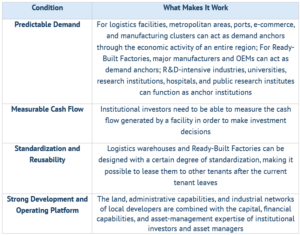
Benefits and Risks
Stakeholder | Benefits | Risks |
Investors | • Stable long-term income supported by lease agreements. • Portfolio diversification through exposure to industrial demand beyond traditional office and retail assets. • Investment opportunities linked to long-term manufacturing and logistics growth. | • Vacancy and tenant credit risks. • Declining asset values due to rising interest rates and changes in cap rates. • Lower rents and occupancy caused by oversupply. • Limited reusability and obsolescence of specialized facilities. |
| Developers | • Recovery of development capital through the sale of stabilized assets. • Faster reinvestment and business expansion through capital recycling. • Sharing of development costs and risks through partnerships with institutional investors. | • Loss of future recurring rental income following asset sales. • Failure to sell assets to long-term investors due to insufficient occupancy or unstable cash flow. • Disruption of capital recycling when invested capital cannot be recovered. • Dependence on external investors’ investment strategies and financing conditions. |
| Tenants | • Lower upfront CapEx for land and buildings. • Faster commencement of operations by reducing construction and permitting requirements. • Greater ability to allocate capital to production equipment and core business activities. • Flexibility for expansion, relocation, or downsizing. | • Ongoing rental obligations and potential rent increases upon lease renewal. |
Skylight Opinion
Indonesia could create the opportunity by viewing industrial estates may increasingly need to be viewed as industrial platforms that combine logistics, Ready-Built Factories, cold storage, energy, environmental infrastructure, R&D facilities, and data-related infrastructure, each with different demand drivers and revenue structures. The ability to introduce the appropriate capital provider for each asset may therefore become increasingly important.
For example, a food industrial cluster requires not only food-processing plants but also cold storage, logistics facilities, packaging facilities, water treatment, waste management, and energy infrastructure. Institutional capital is already acquiring and developing cold storage assets through greenfield development, while JLL forecasts that cumulative cold storage investment in Asia Pacific will exceed US$2 billion by 2030. This suggests that individual functions within an industrial cluster may be structured as independent investment assets.
Institutional capital does not replace industrial estates. However, by enabling facilities within industrial clusters to be structured as investment assets, developers may be able to evolve from conventional land developers into industrial platform operators that combine industrial demand, infrastructure, tenants, research functions, and capital.
Latest Update
- Chandra Asri’s CA-EDC Plant Reaches 80% Completion, Targeting 2027 Operations
- Chandra Asri Group, Indonesia’s largest integrated petrochemical company, reported that construction of its Chlor Alkali–Ethylene Dichloride (CA-EDC) facility in Cilegon, Banten, has reached about 80% completion as of September 2026. The project, developed through its subsidiary PT Chandra Asri Alkali, represents an investment of more than USD 800 million and is scheduled to begin operations in 2027. Construction has advanced from 72% in July, with work now focused on installing major production equipment such as process vessels, heat exchangers, pumps, compressors and absorption columns, while supporting logistics infrastructure including the jetty and product storage facilities is being built in parallel.
- Under Phase I the plant is designed to produce 400,000 tons of solid caustic soda per year (roughly 827,000 tons in liquid form) and 500,000 tons of Ethylene Dichloride (EDC) annually. Caustic soda is a key chemical used in water treatment, detergents, alumina refining and nickel processing, while EDC is a critical feedstock for PVC production. One of the main goals is to reduce Indonesia’s reliance on imported caustic soda. Chandra Asri estimates domestic production could generate import-substitution savings of up to IDR 4.9 trillion a year, with EDC exports potentially earning up to IDR 5 trillion in foreign exchange annually.
- The project has been designated a National Strategic Project. In March 2026 Danantara Indonesia and the Indonesia Investment Authority signed an agreement to jointly invest USD 200 million. Around 3,000 workers are expected during construction and about 250 permanent jobs once the plant is fully operational. Chandra Asri has already begun a feasibility study for a second phase that would require an additional investment of around USD 1 billion.
- VKTR Expands Rental-Based e-MaaS Model to Lower Barriers to Commercial EV Adoption
- PT VKTR Teknologi Mobilitas Tbk is expanding its Electric Mobility-as-a-Service (e-MaaS) business, offering electric buses, trucks and other commercial EVs through a rental model. Instead of buying vehicles outright, customers can make monthly payments and shift EV-related spending from capital expenditure to operating expenditure. This approach is designed to make fleet electrification more accessible for public-transport operators, logistics companies, industrial users and mining firms while reducing the financial risk of long-term asset ownership and rapid technology change.
- In the first half of 2026 VKTR delivered 30 additional 12-metre electric buses to a TransJakarta operator, bringing its cumulative supply to the system to 152 units. It also delivered LOKON Transporter vehicles to a logistics company in Malang and continued expanding into corporate, industrial and mining applications. The product range now includes 8-metre and 12-metre electric buses, the LOKON Transporter and several heavy-duty electric truck configurations. Sales in the same period reached about IDR 648 billion, up 56% year-on-year, with operating profit of roughly IDR 15 billion and net profit of about IDR 10 billion.
- In September 2026 Danantara Investment Management, VKTR and its parent company PT Bakrie & Brothers signed a non-binding term sheet to explore strategic investment in Indonesia’s commercial EV ecosystem. The collaboration specifically highlights Mobility-as-a-Service as a way to lower adoption barriers, widen access to financing and accelerate the shift of fleet operators to electric buses and trucks. Part of the proceeds from VKTR’s planned rights issue is expected to support the expansion of its EV leasing and MaaS subsidiary.
- MD Entertainment Partners with South Korea’s SBS for Content Localization and Co-Production
- PT MD Entertainment Tbk signed a Memorandum of Understanding with South Korean broadcaster SBS Co., Ltd. on 29 September in Jakarta. The agreement combines SBS’s content intellectual-property portfolio with MD Entertainment’s production and distribution capabilities in Indonesia. As an initial step the two companies plan to bring popular SBS programmes to Indonesian audiences through MDTV and to develop Indonesian-language remakes based on SBS’s existing library. The partnership is also expected to cover co-production, joint development of new intellectual property, content distribution, advertising, brand marketing and live entertainment.
- The MoU builds on an existing capital relationship. In 2025 SBS participated in MD Entertainment’s rights issue, investing approximately USD 20 million and acquiring around 413.8 million shares. The investment, described as the largest overseas investment in SBS’s history, made the Korean broadcaster a strategic shareholder. The latest agreement therefore moves the relationship from financial investment toward operational cooperation in content development, production and distribution.
- SBS has cited the growth potential of Southeast Asia’s content market and the potential synergies with MD Entertainment as key reasons for the partnership. The companies intend to explore opportunities not only in Indonesia but across Southeast Asia and other international markets, positioning Indonesia as a strategic hub. With a population of around 280 million and the continued expansion of digital media and OTT platforms, the market is increasingly attractive to international content companies. The cooperation is notable because it goes beyond the conventional export of Korean entertainment toward local adaptation, co-production and joint IP development.
- Indonesia Plans IDR 17 Trillion Integrated Livestock Ecosystem
- The Indonesian government is accelerating the development of an integrated livestock ecosystem with a planned budget of approximately IDR 17 trillion to strengthen domestic supplies of chicken, eggs and milk. The first phase will focus on five regions (Lampung, East Java, South Sulawesi, West Nusa Tenggara and Gorontalo) with completion targeted for 2027. Around IDR 2.2 trillion has already been allocated for these initial areas. Each cluster is designed to include feed mills, day-old-chick production facilities, poultry farms, egg production and dairy cattle operations.
- The government aims to cut supply-chain inefficiencies by locating feed production closer to livestock operations and establishing local DOC supply, thereby reducing logistics costs. Corn grown by farmers surrounding the clusters is expected to supply the local feed mills, creating a more stable market for agricultural output. On the demand side, the Free Nutritious Meals programme (Makan Bergizi Gratis) is expected to serve as a major offtaker for the chicken, eggs and milk produced by the new clusters, giving farmers and livestock businesses a more predictable market.
- One of the key development areas is Bone Regency in South Sulawesi, where an integrated livestock zone covering roughly 150 hectares is being prepared. The broader IDR 17 trillion figure represents funding being readied for the wider roll-out of integrated livestock ecosystems across multiple regions, not only the first five locations. The initiative seeks to build a vertically integrated food supply chain that links domestic agriculture, feed production, breeding, farming, processing and distribution with large-scale demand generated by the national nutrition programme.
- Whitesky Aviation Expands Partnerships to Build a Commercial eVTOL Ecosystem
- PT Whitesky Aviation, one of Indonesia’s leading helicopter operators, is expanding partnerships with companies in China, Japan and South Korea as it seeks to commercialise electric Vertical Take-Off and Landing (eVTOL) aircraft and Advanced Air Mobility. In September 2026 the company launched an Asian roadshow to engage not only aircraft manufacturers but also financing firms, battery and charging-technology developers and infrastructure providers. Its goal is to build a complete operating ecosystem covering aircraft, financing, maintenance, charging infrastructure, training and operational readiness rather than focusing solely on aircraft procurement.
- Whitesky has already signed a strategic agreement with Japan’s SkyDrive (August 2025) and placed a pre-order for up to 30 SKYDRIVE aircraft. The partners are exploring air-taxi operations from Whitesky’s Cengkareng Heliport next to Soekarno-Hatta International Airport as well as potential applications in the mining sector. In August 2026 Whitesky also signed a memorandum of understanding with China’s AutoFlight covering a potential order for 60 V2000EM Prosperity passenger eVTOL aircraft. The company’s long-term plan is to develop a fleet of up to 200 eVTOL aircraft by 2036, including 120 from China, 30 from Japan and 50 developed in Indonesia.
- Whitesky intends to use its existing helicopter operations as the foundation for the transition. Years of experience in flight safety, maintenance, ground support and customer mobility give the company a practical base from which to expand into eVTOL. Rather than viewing eVTOL as a direct replacement for helicopters, Whitesky sees the technology as an extension of its aviation capabilities that could open more scalable applications in short-distance urban transport, tourism and connectivity for industrial and remote areas.
- Indonesia Reports 2.67 Million Halal-Certified Industrial Businesses Ahead of October 2026 Mandate
- Indonesia’s Ministry of Industry reported that approximately 2.67 million industrial businesses had obtained halal certification by the end of June 2026. Around 5.49 million industrial products had been certified through roughly 2.76 million certificates. Food-related businesses accounted for the largest share at about 2.32 million, followed by 342,090 beverage businesses and 5,341 businesses in chemicals, pharmaceuticals and traditional medicines. Industry Minister Agus Gumiwang Kartasasmita announced the figures at the Industrial Festival x Halal Indo 2026 in Tangerang on 24 September.
- The acceleration comes ahead of a major expansion of mandatory halal requirements on 18 October 2026. The new phase will cover not only food and beverages but also slaughtered products, cosmetics, chemical and genetically engineered products, traditional medicines and health supplements, food ingredients and additives, as well as selected consumer goods including clothing, household products, religious equipment, stationery and certain medical devices. Requirements will also extend to micro and small enterprises and to foreign or imported products. Non-compliance may result in administrative measures ranging from written warnings and fines to certificate revocation or product withdrawal.
- In the State of the Global Islamic Economy Report 2025/26 Indonesia ranked fourth in the overall halal economy ecosystem, third in halal food and retained the top position in modest fashion. Halal-related exports to Organisation of Islamic Cooperation members reached USD 12.51 billion in 2024, while imports stood at USD 31.52 billion. The Ministry of Industry has introduced a Halal Industry Development Roadmap for 2025–2029 aimed at strengthening domestic production, reducing import dependence and improving access to international markets.
- Danantara and Thales Sign MoU on AI, Defence, and Cybersecurity
- Danantara Indonesia signed a Memorandum of Understanding with French defence and technology group Thales on 24 September to explore cooperation in four strategic areas: artificial intelligence, defence systems, digital technologies and cybersecurity. The agreement establishes an initial framework for potential investment projects aimed at strengthening local industrial capabilities, accelerating technology transfer and developing skilled employment. Specific projects remain subject to further evaluation and definitive agreements.
- Potential areas of cooperation include defence-technology manufacturing, maintenance and service facilities, airport security systems, applied AI use cases, cybersecurity operations centres and post-quantum technologies. The MoU also opens the possibility of collaboration with state-owned enterprises within the Danantara ecosystem, allowing more manufacturing, engineering, software development and cybersecurity operations to be conducted domestically. Thales has operated in Indonesia for nearly 50 years and already maintains extensive cooperation with PT Len Industri, part of DEFEND ID, including a joint venture and Centre of Excellence focused on air-surveillance radars, Command & Control systems and MRO services.
- The two companies are also cooperating on the production of 13 Ground Control Interception radar systems under a contract valued at approximately IDR 5.8 trillion, with final assembly conducted at PT Len’s facilities in Subang, West Java. By May 2026 the second of the 13 radar systems had entered operation. The latest MoU with Danantara therefore has the potential to expand an existing defence-industrial relationship into a broader strategic technology partnership covering AI, cybersecurity, post-quantum technologies, digital infrastructure and local defence manufacturing. The agreement remains at an exploratory stage, with no specific investment value or final project commitments announced so far.
End of Document
REFERENCES
- Skylight Analytics Hub
- https://www.cbre.com/insights/reports/2026-asia-pacific-investor-intentions-survey
- https://www.cushmanwakefield.com/en/vietnam/news/2025/11/vietnams-ready-built-factories-the-fast-lane-for-global-manufacturers
- https://assets.cushmanwakefield.com/-/media/cw/apac/vietnam/insights/20250219—leasing-white-paper-vf4-vcw-v2.pdf?rev=0b366b053eff4be8bc87c748a89edf71
- https://www.cushmanwakefield.com/en/vietnam/insights/hanoi-marketbeat/industrial-marketbeat
- https://www.cppinvestments.com/newsroom/cpp-investments-and-indospace-expand-joint-venture-with-us300-million-acquisition-of-six-logistics-parks
- https://www.cppinvestments.com/newsroom/cpp-investments-anchors-new-indospace-fund-with-us205-million-investment
- https://www.blackstone.com/news/press/blackstone-lunate-announce-strategic-partnership-to-invest-in-gcc-logistics
- https://www.jll.com/en-sea/newsroom/asia-pacific-cold-storage-investment-to-mature-despite-recent-headwinds
- https://www.capitaland.com/en/about-capitaland/newsroom/news-releases/international/2021/nov/CLI_establishes_2_private_funds_in_Japan_South_Korea_to_grow_FUM_by_688million.html
- https://uni-china.com/newsroom/brookfield-acquires-hong-kong-site-for-cold-storage-venture-with-uni-china
- https://investor.digitalrealty.com/news-releases/news-release-details/digital-realty-announces-final-close-325-billion-us-hyperscale
- https://www.cbre.com/insights/books/us-life-sciences-real-estate-investment-trends/investment-characteristics
- NNA ASIA: https://www.nna.jp/news/2972528
- Bisnis: https://market.bisnis.com/read/20260929/192/2008071/chandra-asri-tpia-ungkap-progres-pembangunan-pabrik-ca-edc-capai-80
- IDX: https://www.idxchannel.com/market-news/pabrik-ca-edc-milik-chandra-asri-tpia-masuk-tahap-pemasangan-peralatan-utama
- Chandra Asri: https://chandra-asri.com/en/news/ca-edc-facility-construction-reaches-72-completion
- Danantara Indonesia: https://www.danantaraindonesia.co.id/media-center/press-releases/reducing-import-dependency-danantara-and-ina-sign-investment-agreement-in-chandra-asri-groups-ca-edc-project
- Danantara: https://www.danantaraindonesia.co.id/media-center/press-releases/dim-vktr-ev-mobility-collaboration
- VKTR: https://vktr.id/news/vktr-sales-performance-grew-56-h1-2026-e-maas-positioned-enabler-ev-adoption
- NNA ASIA: https://www.nna.jp/news/2972556
- Bisnis: https://market.bisnis.com/read/20260902/192/2000659/danantara-siapkan-rp2-triliun-untuk-vktr-borong-bus-dan-truk-listrik
- Bisnis: https://market.bisnis.com/read/20261001/192/2008921/sinyal-ekspansi-vktr-di-balik-lonjakan-penjualan-semester-i2026
- Media Indonesia: https://mediaindonesia.com/hiburan/938922/md-entertainment-gandeng-sbs-dari-korea-siap-siap-makin-banyak-adaptasi-drakor
- IDX: https://www.idxchannel.com/market-news/film-perkuat-kolaborasi-dengan-sbs-korea-garap-pasar-indonesia/all
- Bisnis: https://market.bisnis.com/read/20260929/192/2008246/md-entertainment-film-gandeng-sbs-asal-korea-selatan-siapkan-tayangan-anyar
- NNA ASIA: https://www.nna.jp/news/2972602
- Bisnis: https://ekonomi.bisnis.com/read/20260927/12/2007538/kementan-bangun-ekosistem-peternakan-terintegrasi-siapkan-anggaran-rp17-triliun
- Kementerian Pertanian Republik Indonesia: https://pertanian.go.id/news/view/8182?utm
- NNA ASIA: https://www.nna.jp/news/2972073
- NNA ASIA: https://www.nna.jp/news/2971482
- SKYDRIVE: https://skydrive.co.jp/news/65296/
- AUTOFLIGHT: https://www.autoflight.com/en/news/duplicate-of-autoflight-showcases-advanced-air-mobility-during-games-o/
- detikfinance: https://finance.detik.com/berita-ekonomi-bisnis/d-8675457/ri-mulai-kembangkan-pesawat-listrik
- NNA ASIA: https://www.nna.jp/news/2970853
- ANTARA: https://en.antaranews.com/news/432795/ri-govt-steps-up-halal-certification-support-for-small-firms
- Danantara: https://www.danantaraindonesia.co.id/media-center/press-releases/thales-danantara-strategic-technology
- NNA ASIA: https://www.nna.jp/news/2970905
- ANTARA: https://www.antaranews.com/berita/5757988/danantara-thales-jajaki-investasi-bidang-ai-hingga-keamanan-siber