EXECUTIVE BRIEF: From Labor Export to Capability Circulation – Turning Overseas Work into Domestic Economic Value
Executive Summary
Indonesia is measuring the wrong thing. Migration policy tracks how many workers go abroad and how much money they send home. Neither number tells you what the economy keeps once those workers return. That is the question that should drive decisions now.
An estimated 3 to 4 million Indonesians work abroad at any given time — in Hong Kong, Taiwan, Malaysia, Japan, and Singapore. They can come home with four kinds of value: income, skills, work habits, and networks. The country captures each unevenly, and some barely at all.
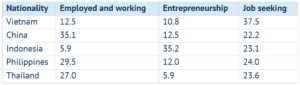
The evidence is blunt. In OTIT’s FY2020 survey of Indonesian technical intern trainees returning from Japan, only 5.9% were employed and working afterward — the lowest rate in the group. Just 39.0% worked in the same or a similar field as their training. And 35.2% started a business, the highest rate among comparable countries.
The strategic shift is from labor export, judged by placements and remittances, to capability circulation, judged by how much overseas experience converts into domestic productivity, stronger firms, and better-paid careers at home.
The decision splits two ways. Business can gain a workforce with operational discipline, quality habits, and supervisory potential — if firms build ways to assess and absorb it. Government must stop running migration as a standalone program and start treating it as workforce and industrial strategy. Both require the same move: design the full cycle, from pre-departure to post-return. Every cohort that drifts into unrelated work is capability the country paid to build and then let slip away.
Why This Matters Now
Returnees arrive in steady numbers — hundreds of thousands each year, many with formal-sector experience. At the same time, domestic industries in manufacturing, food processing, cold-chain logistics, facility maintenance, and quality control need exactly the disciplined, trained labor these workers can build. The match should be automatic. It is not.
The wage math seals the decision. In 2026, Jakarta’s minimum wage sat around IDR 5.73 million ($350 USD) per month, among the highest in the country, while many provinces held near IDR 3 million ($170.16 USD) or below. A factory or care worker in Taiwan or Japan can earn IDR 15–25 million ($850.78–1,417.97 USD) per month — several times the provincial floor. For a young worker in a regional town, going abroad is not a last resort. It is the rational choice.
So why does absorption stay weak when demand is real? The demand exists in principle, but the machinery to convert it into hiring is missing — no reliable way to verify overseas experience, match returnees to roles, or bridge wage expectations. The problem is not absence of need. It is failure of translation.
What Returnees Actually Bring Back — and the Risk That Comes With It
For employers, the case is workforce quality, not corporate responsibility. A returnee who has worked inside a well-run foreign operation can arrive with something local pipelines struggle to supply.
Technical skills — machinery operation, food-safety protocols, clinical care — are the visible layer. The more transferable value sits underneath, in behavior:
- Workplace discipline — punctuality, reliability, consistency built into routine.
- Quality and safety habits — instinctive attention to standards, hygiene, occupational safety.
- Service orientation — customer-handling norms from demanding markets.
- Production routines — familiarity with structured, accountable operations.
These habits lift productivity in ways that are hard to teach in a classroom. A caregiver back from Japan with internalized infection-control routines does not just fill a role — she raises the standard others work to.
But decision-makers must face one nuance directly: not every imported habit fits at home. A returnee used to strict labor protections may expect more than a domestic employer provides. The sharper risk is re-migration — wage expectations formed abroad can push a promising hire to leave again for the next overseas contract, wasting months of onboarding. Retention, not recruitment, becomes the binding constraint.
The point is not that some habits are good and others bad. Overseas experience produces raw capability. The question that determines the payoff is whether Indonesia has the institutions — firms, training bodies, certification systems — to translate it before it dissipates.
The Financial Gap That Undermines the Payoff
Remittances are treated as proof that migration works. The flows are real, but they hide an uncomfortable pattern that matters to banks, employers, and government alike: sending money home is not the same as building wealth.
Many workers remit a large share of income for years, then return with little saved. Earnings go to household support, consumption, and debt repayment — much of it contracted before departure. Placement fees, agency costs, and travel can run into the tens of millions of rupiah, and workers often spend their first year abroad simply clearing them. The national ledger reads as success. The individual comes home with inadequate savings despite years of hard labor.
That makes budgeting, remittance planning, debt management, and savings discipline, delivered before departure and before return. But it is necessary, not sufficient. It works only alongside lower upfront cost burdens and real post-return opportunities.
The outcome data exposes the deeper problem. Whether a returnee works or starts a business says nothing about whether their overseas skills are being used. For that, look at how closely post-return work matches the original training.
Post-return employment status by nationality (%)
Match Between Post-Return Work and Technical Internship Content by Nationality (%)
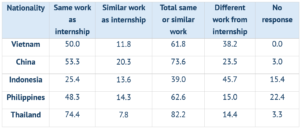
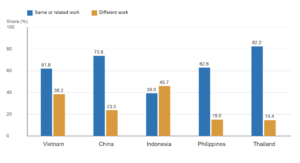
The pattern in one line: Indonesia leads on business formation but ranks lowest on staying in the trained field — 39.0%, against 82.2% for Thailand and 73.6% for China. Nearly half of returnees end up in unrelated work.
High business formation paired with the lowest formal-employment rate can reflect genuine initiative — or signal that formal jobs were hard to find. Both are true for different workers. Without financing, market access, and mentoring, many ventures stay low-productivity survival businesses. The decision point is clear: entrepreneurship pays off only when it is supported.
Where the Current Model Breaks
Indonesia has built the front half of the journey well. Vocational schools run overseas tracks, migrant centers manage information, and local governments offer one-stop services. Preparation and placement are comparatively strong.
The back half breaks — and that is where value leaks out:
- Little designed destination. Workers leave with no plan for where they will work when they return.
- Weak recognition of overseas skills. Firms have few ways to assess and certify competencies gained abroad, so three years of formal experience often counts for little.
- Few receiving platforms. Structured channels linking returnees to employers are scarce; matching happens by luck or not at all.
This is why strong demand and weak absorption coexist. The need is real; the connective machinery is missing. The result is measurable — 45.7% of returnees end up in work different from their overseas training. The fix is to treat the journey as one continuous cycle, with a response owed at each stage: employer-informed training before departure, skill records during overseas work, registration and certification at return, and employment links with industrial estates and local firms afterward.
What Business Should Do
The return sits in the multiplier. Returnees are natural candidates for a supervisory and trainer pipeline — line leaders and internal trainers who spread strong standards across a whole team. One well-placed returnee lifts the output of everyone around them.
The commercial logic is direct. A worker already fluent in formal production routines needs less onboarding, reaches full productivity faster, and is likelier to pass an audit or client inspection without remediation. In export-oriented sectors where a failed compliance check can cost a contract, that reliability carries real financial value.
Capturing it means solving an absorption problem:
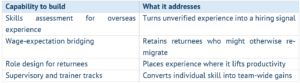
The objections are fair — and each is a design problem, not a dead end. Returnees may cost more, may re-migrate, may hold skills that do not match local processes, and may be hard to verify. Assessment handles verification, role design handles fit, advancement paths handle retention. The firms that solve these first get first access to a scarce, work-ready talent pool.
Industrial parks have the most to gain. They have long competed on land, power, water, and logistics. Increasingly, the ability to supply skilled labor will decide their competitiveness. An estate that coordinates with vocational schools, training bodies, and returnee channels becomes a talent platform — supplying disciplined, work-ready people, not just infrastructure. That is a differentiator for operators and a cost-and-risk reducer for tenants.
What Government Should Do
Government’s role must move from administrator of a migration program to architect of a workforce strategy. The central shift is integration: migration and industrial policy run on separate tracks today and should be one. When the state knows which sectors need which skills, it can steer pre-departure training toward capabilities that pay off both abroad and at home.
The reforms fall into three phases:
- Quick wins (0–12 months). Stand up a returnee registration system and database — who returns, with what experience, to where — paired with a pilot employer-matching scheme in one or two high-demand sectors such as food processing or caregiving.
- Medium-term reforms (1–3 years). Establish portable skill certification so firms can recognize competencies gained overseas — the connective tissue the model lacks. Embed mandatory financial education, before departure and before return, into existing channels.
- Structural agenda (3+ years). Integrate migration fully into industrial workforce planning, pulling training bodies, sending organizations, migrant centers, local governments, industrial estates, and employers into a single career pathway.
None of this works without a clear owner. A single body should hold the mandate — most logically the Ministry of Manpower in formal partnership with BP2MI and the Ministry of Industry, or a designated coordinating unit empowered to align them. The first boardroom question is “who is accountable?” — and the strategy needs an answer before it needs a budget. None of this requires sending fewer workers or spending dramatically more. It requires treating overseas employment as an investment the country intends to recover.
International References
Three international models point to specific actions. A caution applies to all: labor markets differ, so these are lessons to adapt, not templates to copy.
Philippines — institutionalized reintegration. Formal support for returning workers: entrepreneurship programs, loans, financial literacy, social reintegration. The lesson is that migration policy should not end at departure. The warning is the risk of an economy overly dependent on overseas labor. Action: adopt structured reintegration support — financing, mentoring, job matching — while keeping overseas employment as one channel, not the centerpiece.
Germany — Triple Win. A caregiver mobility model that benefits receiving country, sending country, and worker at once, with ethical recruitment, training, qualification recognition, and integration support built in. It runs from the receiving side; Indonesia sits on the sending side. Action: negotiate bilateral arrangements that lock in training, qualification recognition, and worker protection as conditions of supply.
Global Skill Partnership — co-investment in shared skills. Sending and receiving countries jointly fund training, with some graduates working abroad and others staying home — migration as human capital formation, not brain drain. This is the closest fit to capability circulation. Action: design training in food processing, mechanical maintenance, cold-chain logistics, quality control, and agro-fishery processing that serves both overseas placements and domestic industry.
Skylight’s View
The real question is not how many Indonesians work abroad. It is how much of that experience the country converts into domestic capability when they return. That conversion will not happen on its own. Business needs channels to absorb and use overseas experience. Government needs to connect migration to certification, reintegration, and industry demand.
Indonesia already has the talent. The strategic task now is to make sure the value comes home too.
Latest Update
- Dharma Polimetal Introduces BESS at GIIAS 2026, Expanding into EV Energy Ecosystem
- Indonesian automotive component manufacturer PT Dharma Polimetal Tbk (DRMA) introduced its All-in-One Battery Energy Storage System (BESS) at the Gaikindo Indonesia International Auto Show (GIIAS) 2026, marking another step in the company’s expansion beyond conventional automotive components into the broader electric vehicle and energy ecosystem. The newly introduced system is designed for various applications, including residential, commercial, industrial, solar energy, and electric vehicle-related power needs.
- The introduction of BESS is part of DRMA’s broader strategy to diversify its business portfolio in response to the transformation of the automotive industry. Traditionally focused on manufacturing automotive components, the company has expanded into electrification-related businesses, including battery systems, charging infrastructure, electric vehicle components, and energy solutions.
- DRMA’s BESS is positioned as an energy storage solution that can improve electricity reliability and support renewable energy utilization. The system can be connected with solar power generation and is designed to provide flexible energy storage solutions for various users, ranging from households and commercial facilities to industrial applications. In addition, the technology could support the development of EV charging infrastructure by improving power management capabilities.
- The development reflects the changing role of automotive suppliers as Indonesia moves toward electrification. As electric vehicle adoption accelerates, component manufacturers are increasingly required to expand beyond traditional vehicle parts and participate in new areas such as batteries, energy management systems, charging infrastructure, and other supporting technologies. DRMA’s move represents an example of how local automotive suppliers are adapting to the emerging EV value chain.
- Indonesia’s transition toward electric mobility is creating opportunities not only for vehicle manufacturers but also for companies involved in supporting infrastructure and energy systems. By combining automotive manufacturing capabilities with energy storage technology, DRMA aims to strengthen its position within Indonesia’s growing EV ecosystem and contribute to the development of a more integrated electric mobility industry.
- Indonesia Plans Rare Earth Permanent Magnet Production Facility to Strengthen Critical Mineral Downstreaming
- Indonesia is preparing to develop a permanent magnet production facility using rare earth elements (REE) as part of its broader strategy to strengthen downstream processing of strategic minerals. The project is being promoted by Danantara, Indonesia’s state investment agency, with the aim of developing domestic capabilities in advanced mineral processing and high-value manufacturing. The facility is expected to begin operations around 2028 and will support industries such as electric vehicles (EVs), renewable energy, and strategic sectors including defense.
- The development is part of Indonesia’s wider effort to move beyond raw mineral exports and build integrated industrial value chains. While Indonesia has already become a major global player in nickel processing, the government is seeking to expand downstream capabilities into other critical minerals, including rare earth elements, by developing domestic processing, refining, and manufacturing industries.
- Prior to the development of permanent magnet production, Indonesia is also strengthening its foundation in rare earth processing through the establishment of research and industrial facilities. A rare earth research and production facility is being developed in Bangka Belitung, particularly in the Tanjung Ular area of West Bangka, through cooperation between PT Timah and PT Perusahaan Mineral Nasional (Perminas). The facility is expected to support research, processing capabilities, and the development of future rare earth downstream industries.
- Rare earth elements are essential materials for various advanced technologies, including EV traction motors, wind turbines, electronic devices, and defense-related equipment. In particular, neodymium-based permanent magnets are a key component in electric vehicle motors, making rare earth processing an important part of future EV supply chains.
- Indonesia has identified significant potential in rare earth resources, particularly as by-products from tin mining activities in areas such as Bangka Belitung. However, the country has historically lacked domestic capabilities in rare earth separation, refining, and advanced manufacturing. Through the development of facilities managed by state-related entities such as Perminas, the government aims to establish a more integrated rare earth ecosystem from resource processing to high-value products.
- The development of a permanent magnet industry represents another step in Indonesia’s industrial transformation strategy. By expanding from mineral extraction into advanced manufacturing, Indonesia aims to capture greater economic value from its natural resources and strengthen its position in emerging industries such as EVs, renewable energy, and high-technology manufacturing.
- For investors, the development highlights Indonesia’s ambition to become not only a supplier of critical minerals but also a participant in global technology supply chains. The success of this strategy will depend on the country’s ability to develop processing technology, attract strategic partners, and build a competitive ecosystem covering the entire rare earth value chain.
- BAIC Plans Local Assembly of Compact EV in Indonesia by January 2027
- Chinese automaker BAIC (Beijing Automotive Industry Holding Co.) is preparing to begin local assembly of a compact electric vehicle (EV) model in Indonesia by January 2027, strengthening its localization strategy in one of Southeast Asia’s largest automotive markets. The company aims to expand its EV presence by combining competitive pricing with increased local production capabilities.
- BAIC has been developing its Indonesian operations through cooperation with local partners, including JIO Group. The company previously began local assembly of its BJ40 PLUS model at a production facility in Purwakarta, West Java, marking its first locally assembled vehicle in Indonesia. BAIC has continued to expand its localization plans as it seeks to improve cost competitiveness and strengthen its position in the Indonesian market.
- The planned EV assembly reflects the increasing competition in Indonesia’s electric vehicle sector. Chinese manufacturers such as BAIC, BYD, Geely, and other EV players are accelerating localization efforts by establishing production bases, partnering with local companies, and developing domestic supply chains. Local assembly enables manufacturers to benefit from Indonesia’s EV policies while reducing dependence on imported vehicles.
- BAIC is also expanding its New Energy Vehicle (NEV) portfolio in Indonesia, introducing battery electric vehicles alongside conventional and hybrid models. The company aims to develop a broader product lineup, including SUVs, MPVs, and other EV models, while strengthening its dealership and after-sales service networks.
- Indonesia has become a strategic market for EV manufacturers due to its large consumer base, government support for electrification, and potential role as a regional production hub. For Chinese automakers, local assembly provides an opportunity to compete more effectively through lower costs and improved market adaptation.
- The expansion of BAIC highlights the continued localization trend among Chinese automotive companies in Indonesia. As competition intensifies, success in the Indonesian EV market will increasingly depend not only on vehicle technology and pricing but also on the ability to build local production capacity, supply chains, and after-sales ecosystems.
- Meiwa Invests in Santomo’s Biomass Business in Indonesia
- Meiwa Corporation, a Japanese trading company engaged in resource, environmental, automotive, and chemical-related businesses, has invested in PT Santomo Biomass Indonesia (SBI), a subsidiary of Santomo Group, to strengthen its involvement in Indonesia’s renewable energy sector. SBI specializes in sourcing and supplying biomass resources from Indonesia, including wood pellets, palm kernel shells (PKS), and other biomass materials for sustainable energy applications.
- The investment comes amid growing demand for renewable energy solutions and efforts to reduce dependence on fossil fuels. Indonesia has abundant biomass resources generated from its agricultural and forestry industries, such as palm oil residues, rice husks, and wood waste. Utilizing these resources as alternative fuels could contribute to reducing greenhouse gas emissions while creating additional value from previously underutilized materials.
- Santomo Biomass Indonesia is involved in the procurement, processing, and trading of various biomass products, including solid biomass fuels. The company aims to establish a stable biomass supply chain by connecting Indonesia’s resource potential with increasing demand for low-carbon energy in domestic and international markets. In addition to solid biomass, Santomo Group is also exploring broader renewable energy opportunities, including the utilization of waste-derived resources and sustainable fuel development.
- This investment highlights the growing importance of Indonesia as a supplier of renewable energy resources. While Indonesia has traditionally relied on natural resources such as coal and palm oil, the country is increasingly seeking to create higher-value industries through resource utilization and downstream development. Biomass offers an opportunity to transform agricultural and forestry residues into valuable energy resources while supporting decarbonization efforts.
- For Japan and other countries seeking to establish sustainable energy supply chains, Indonesia’s biomass sector provides new investment opportunities. Through cooperation between Japanese companies and Indonesian businesses, the development of biomass supply networks could contribute not only to emissions reduction but also to the creation of new industries utilizing Indonesia’s abundant natural resources.
- Hokkokugin Group, Mitani Sangyo, and Suzuki Invest in Indonesian Mobility Startup
- Hokkokugin Group (the holding company of Hokuriku Bank) and Mitani Sangyo have invested in movus technologies, an Indonesian mobility service startup, through a jointly established venture fund. Suzuki Motor Corporation has also invested in movus through its corporate venture capital fund, Suzuki Global Ventures, highlighting growing interest among Japanese companies in Indonesia’s evolving mobility ecosystem.
- Movus provides an eco-car subscription service targeting ride-hailing drivers in Indonesia. By combining IoT devices with a proprietary credit assessment system using smartphone-based data, the company enables users to access vehicles through monthly payments while eventually obtaining ownership. This model aims to address financing barriers for drivers and small-scale operators who may face difficulties accessing conventional vehicle loans.
- The investment reflects the broader transformation of the automotive industry from traditional vehicle ownership toward mobility services. In Indonesia, the expansion of ride-hailing platforms, digital financial services, and fleet-based transportation is creating new business opportunities beyond vehicle manufacturing. Companies are increasingly seeking to participate in the wider mobility value chain, including vehicle leasing, financing, fleet management, and digital services.
- For Suzuki, the investment represents an effort to strengthen its connection with Indonesian customers through new mobility models. Since entering Indonesia in 1970, Suzuki has positioned the country as a key ASEAN market and has developed a strong local presence. Through movus, Suzuki aims to expand access to vehicles and reach new customer segments, particularly among ride-hailing drivers who require flexible ownership solutions.
- For Hokkokugin Group and Mitani Sangyo, the investment demonstrates the expanding role of Japanese financial institutions and diversified companies in supporting overseas business development. As Indonesia’s automotive industry moves toward electrification and digitalization, opportunities are emerging not only in vehicle manufacturing but also in supporting industries such as financing, subscription services, charging infrastructure, and fleet operations.
- This development highlights that Indonesia’s automotive transformation extends beyond EV production itself. As vehicles become increasingly connected with digital platforms and service models, the future mobility ecosystem will involve a wider range of industries, including automakers, technology companies, financial institutions, and service providers.
- Bekasi Starts Construction of Waste-to-Energy Plant with Chinese Participation
- Indonesia has started construction of a new waste-to-energy plant in Bekasi City, West Java. The project is located in Ciketing Udik, Bantar Gebang, an area closely linked to Greater Jakarta’s waste management system. The investment value is estimated at around IDR 3 trillion ($170 million), with a planned processing capacity of up to 1,500 tons of waste per day, or around 500,000 tons annually. The facility is expected to begin operations in mid-2028 and is positioned as a project that can reduce pressure on existing landfill facilities, generate electricity for tens of thousands of households, and create around 1,000 jobs once completed.
- Bekasi plays an important role in handling waste from the Jakarta metropolitan area, but existing landfill capacity has already become a serious concern. The new waste-to-energy project is expected to ease the burden on nearby landfill facilities, including Sumur Batu, while supporting a more sustainable urban waste management system. However, the success of the project will depend not only on the construction of the plant itself, but also on upstream waste management, including household and commercial waste separation, collection systems, and a stable supply of suitable waste.
- The project company is Bekasi Environment Nusantara, with China’s Wangneng Environment selected as the operating partner. Danantara Indonesia is coordinating the project through PT Danantara Investment Management and PT Daya Energi Bersih Nusantara, known as Denera. Earlier this year, Danantara selected Wangneng Environment for the Bekasi project and Zhejiang Weiming Environment Protection for the Denpasar Raya project in Bali, showing the strong presence of Chinese companies in Danantara-led waste-to-energy projects.
- The Bekasi project follows the groundbreaking of the Denpasar waste-to-energy plant in Bali in July. The Bali project is also a large-scale facility, with a planned capacity of around 1,500 tons of waste per day and more than 500,000 tons annually. In the same month, construction also began on the Legok Nangka waste-to-energy project in West Java, a Japanese-led PPP project. Legok Nangka is designed to process up to 2,131 tons of waste per day and generate around 40 MW of electricity. Taken together, the Bali, Bekasi, and Legok Nangka projects show that Indonesia’s waste-to-energy policy is moving from the planning stage into actual investment and construction.
- The Prabowo administration is promoting waste-to-energy development as part of a broader national strategy to address urban waste, improve sanitation, generate cleaner electricity, and create jobs. Chinese companies are gaining visibility in Danantara-led projects such as Bekasi and Denpasar, while Japanese companies are participating through PPP-based projects such as Legok Nangka, where technology, project structuring, and public-private coordination are important. Going forward, the key issues will be waste separation, power purchase arrangements, tipping fees, and coordination among local governments. Waste-to-energy is likely to become an important area of Indonesia’s urban infrastructure and environmental investment market.
- Indonesia Officially Launches 100 GWp Solar Power Development Program
- President Prabowo Subianto officially launched Indonesia’s 100 GWp solar power development program on August 25 in Gilimanuk, Jembrana Regency, Bali. The government aims to develop 100 GWp of solar power capacity within three years. As the first stage, 14 solar power projects across six provinces were launched or broken ground, with a combined capacity of 5.3 GWp.
- The initial projects are located across West Java, Central Java, East Java, Bali, the Bangka Belitung Islands, and the Riau Islands. Key projects include Saguling, Purwakarta, Jatiluhur, Cirata, and Jatigede in West Java, as well as Karangkates, Madura, Pasuruan, and Banyuwangi in East Java, and Gilimanuk in Bali. The program also includes plans to expand the Cirata floating solar power plant to 1,250 MWp.
- The total investment required for the 100 GWp program is estimated at around Rp1,140 trillion, equivalent to approximately USD $62–73 billion. Energy and Mineral Resources Minister Bahlil Lahadalia said the program could reduce government subsidy costs by around Rp73.9 trillion annually and potentially create approximately 5.52 million jobs.
- The government views the program as part of a broader strategy to strengthen Indonesia’s energy independence and reduce dependence on fossil fuels. President Prabowo has also called for the accelerated retirement of diesel power plants. In August, he said the government plans to build 30 GW of solar capacity in 2026 while retiring 13 GW of diesel-based generation.
- Private independent power producers (IPPs) are expected to play an important role in the next stage of development. The government plans to tender seven projects, including Purwakarta, Jatiluhur, Cirata, Jatigede, Madura, Gilimanuk, and Buleleng. If competitive bids cannot be secured, the government may proceed with the projects through Danantara.
- The scale of the 100 GWp program will require significant investment not only in solar generation but also in solar panels, battery storage, transmission infrastructure, and grid connections. The launch of the first 14 projects with 5.3 GWp indicates that Indonesia’s ambitious solar power target is now moving from the policy and planning stage toward actual project development and investment.
- Japanese STEAM Education Expands to Indonesia, Supporting Future-Oriented Learning Development
- Japanese educational institution Azeri Academy (Azery Gakuen) is expanding its original STEAM childcare education method to Indonesia. The initiative was selected for the Japanese Ministry of Education, Culture, Sports, Science and Technology’s (MEXT) “EDU-Port Japan” project, which supports the overseas expansion of Japanese-style education. Through cooperation with Indonesian educational institutions, model schools, and teacher training programs, Azeri Academy aims to develop a sustainable education model adapted to local conditions.
- STEAM education integrates Science, Technology, Engineering, Arts, and Mathematics to encourage creative thinking and problem-solving skills. While STEAM education is generally targeted at elementary school students and older, Azeri Academy has redesigned the approach for early childhood education by connecting daily play activities with exploration and discovery.
- Rather than focusing on memorizing knowledge or providing predetermined answers, the STEAM childcare method emphasizes encouraging children to ask questions, experiment, and develop their own solutions. Through activities such as scientific experiments, cooking experiences, art projects, and outdoor exploration, children learn through observation, trial and error, and reflection. The approach aims to develop non-cognitive skills such as curiosity, independence, collaboration, persistence, and self-regulation.
- Azeri Academy has previously expanded its STEAM childcare initiatives overseas through cooperation with educational institutions in Vietnam. Since signing a memorandum of understanding with a university in Da Nang in 2022, the organization has conducted practical classes and childcare training programs. In Indonesia, the SakuraNesia Foundation is supporting cooperation between Azeri Academy and local educational institutions.
- The organization has already introduced its educational approach through discussions with Indonesian education officials, visits to the Indonesia University of Education (UPI), and presentations at AI and STEAM education-related events. The possibility of implementing STEAM childcare at UPI’s affiliated kindergarten is currently being discussed, with a memorandum of understanding expected to be finalized in the future.
- The expansion reflects growing interest in education models that emphasize creativity and adaptability in response to rapid technological changes, including the spread of artificial intelligence. As AI changes the nature of work and knowledge acquisition, education systems are increasingly focusing on developing skills such as critical thinking, problem-solving, and the ability to learn independently.
- For Indonesia, cooperation in STEAM education could contribute to strengthening human capital development by introducing new approaches to early childhood education and teacher training. The initiative also demonstrates opportunities for Japanese education providers to expand overseas by adapting their expertise to local educational environments rather than simply transferring existing models.
End of Document
REFERENCES
- Skylight Analytics Hub
- https://en.antaranews.com/news/415544/indonesia-targets-up-to-80000-in-smk-go-global-program
- https://www.antaranews.com/berita/5637845/indonesia-targetkan-40000-pekerja-migran-melalui-smk-go-global
- https://bantuan.kemnaker.go.id/support/solutions/articles/43000586006-apa-dasar-pelaksanaan-ssw-pbs-di-indonesia-
- https://www.mhlw.go.jp/stf/newpage_68794.html
- https://www.mhlw.go.jp/stf/seisakunitsuite/bunya/koyou_roudou/jinzaikaihatsu/global_cooperation/index_00029.html
- https://www.oecd.org/en/publications/recruiting-immigrant-workers-japan-2024_0e5a10e3-en/full-report/component-8.html
- https://www.otit.go.jp/upload/docs/211109-101.pdf
- https://www.otit.go.jp/upload/docs/260410_ENG.pdf
- https://www.ilo.org/sites/default/files/wcmsp5/groups/public/%40asia/%40ro-bangkok/%40sro-bangkok/documents/publication/wcms_733917.pdf
- https://www.ilo.org/publications/effective-return-and-reintegration-migrant-workers-special-focus-asean?utm_
- https://www.ilo.org/sites/default/files/wcmsp5/groups/public/%40ed_protect/%40protrav/%40migrant/documents/publication/wcms_882374.pdf
- https://en.antaranews.com/news/391377/ri-govt-reaffirms-commitment-to-cut-unemployment-via-smk-go-global
- https://www.oecd.org/en/publications/employment-and-skills-strategies-in-indonesia_dc9f0c7c-en/full-report/fostering-local-approaches-to-skills-in-indonesia_afcff4d8.html?utm_
- https://documents1.worldbank.org/curated/en/099012625065011104/pdf/P177415-878f121b-d70f-460b-9813-533520ac88d1.pdf
- https://www.cgdev.org/sites/default/files/cgd-and-development-global-skill-partnerships.pdf
- https://smk.kemendikdasmen.go.id/terbitan/keputusan-menteri-pendidikan-dasar-dan-menengahrepublik-indonesianomor-64-tahun-2026-tentang-penyelenggaraan-program-kelas-kebekerjaan-luar-negeri-pada-sekolah-menengah-kejuruan?utm_
- https://satudata.bp2mi.go.id/dataset_detail/proporsi-pekerja-migran-indonesia-yang-bekerja-pada-pemberi-kerja-berbadan-hukum
- https://www.otit.go.jp/upload/docs/cb2cf8c0fe0c02e9a7f22d058ea46d52117f61c2.pdf?utm_
- https://balinkbayan.gov.ph/national-services/national-gov-services/reintegration-prog?utm_
- https://triple-win-programm.de/en/about-triple-win/?utm_
- https://www.giz.de/en/newsroom/stories/triple-win-nurses-germany?utm_
- https://www.ilo.org/projects-and-partnerships/projects/supporting-socio-economic-reintegration-sri-lankan-migrant-workers?utm_
- https://owwa.gov.ph/reintegration/
- https://www.bps.go.id/id/pressrelease/2026/05/05/2574/tingkat-pengangguran-terbuka–tpt–sebesar-4-68-persen–rata-rata-upah-buruh-sebesar-3-29-juta-rupiah-.html
- https://www.kabarbursa.com/ekonomi-hijau/dharma-polimetal-drma-perkenalkan-bess-di-giias-2026-bisnis-baru-di-ekosistem-ev?utm_
- https://industri.kontan.co.id/news/perluas-portofolio-dharma-polimetal-drma-battery-energy-storage-system?utm_
- https://www.antaranews.com/berita/4466038/dharma-polimetal-incar-peluang-industri-kendaraan-listrik-di-2025?utm_
- https://www.nna.jp/news/2958020
- https://www.antaranews.com/berita/5691284/indonesia-akan-bangun-pabrik-magnet-permanen-dari-ltj?utm_
- https://www.suara.com/bisnis/2026/08/13/151239/danantara-bangun-pabrik-magnet-permanen-untuk-komponen-ev-hingga-senjata-canggih?utm_
- https://periskop.id/industri/20260812/indonesia-targetkan-pabrik-magnet-permanen-ltj-beroperasi-pada-2028?utm_
- https://investortrust.id/business/103028/pekan-depan-pt-timah-perminas-groundbreaking-proyek-logam-tanah-jarang?utm_
- https://www.nna.jp/news/2956583
- https://kumparan.com/kumparanoto/baic-t1-mulai-produksi-lokal-tahun-depan-target-tkdn-60-persen-27lNLNZDUy9?utm
- https://www.baicglobal.com/news/newsRelease/detail/263?utm_
- https://www.nna.jp/news/2958102
- https://ssl4.eir-parts.net/doc/8103/tdnet/2875463/00.pdf
- https://santomobiomass.com/business/?utm_
- https://ashu-aseanstatistics.com/news/301377-66471810130
- https://www.wisebk.com/asean_news/383084/
- https://www.suzuki.co.jp/release/d/2026/0515a/
- https://www.nna.jp/news/2957489
- https://ashu-aseanstatistics.com/news/307577-46400810130
- https://www.danantaraindonesia.co.id/id/media-center/press-releases/danantara-indonesia-announces-selected-partners-for-waste-to-energy-plants-in-bekasi-and-denpasar
- https://www.danantaraindonesia.co.id/id/media-center/press-releases/bekasi-waste-to-energy-construction?utm_
- https://esdm.go.id/en/media-center/news-archives/pengolahan-sampah-menjadi-energi-listrik-legok-nangka-dibangun-2131-ton-sampah-diolah-per-hari?utm_
- https://en.antaranews.com/news/421904/danantara-breaks-ground-on-bali-waste-to-energy-plant
- https://www.nna.jp/news/2960850
- https://ashu-aseanstatistics.com/news/303277-76488818230
- https://indonesiabusinesspost.com/7214/energy-and-resources/indonesia-opens-tenders-for-7-solar-power-plants-to-independent-power-companies
- https://rri.co.id/en/national/2681668/indonesia-launches-100-gwp-solar-power-plant-construction-program
- https://en.antaranews.com/news/428464/indonesia-sets-three-year-target-for-100-gw-solar-power-capacity
- https://www.nna.jp/news/2960394
- https://www.jakarta-nippo.com/13061/
- https://azalee.or.jp/news/