Executive Brief: Indonesia’s Halal Certification: Barrier or Opportunity for Investors?
Executive Summary
Indonesia’s halal certification regime is often framed as a compliance hurdle. That framing misses the point. Certification is fast becoming a market-access requirement—the price of entry into the world’s largest Muslim consumer market, not an optional standard or a discretionary cost.
The government is moving through a phased mandatory rollout: food and beverages since October 2024, cosmetics and consumer goods by October 2026, and select pharmaceuticals and medical devices by 2029. Each phase widens the set of products that cannot legally reach Indonesian shelves without certification.
For investors, this changes the calculus. The relevant question is no longer whether compliance adds cost—it does—but whether that cost is justified by access to a market of roughly 240 million Muslim consumers. The evidence suggests firms have already answered: more than 4,100 halal certificates have been issued to foreign businesses, with Chinese companies leading by a wide margin. They are treating certification as a cost of entry, not a reason to stay out.
The bottom line: halal certification should be read as a strategic investment decision. Early movers gain a durable advantage; latecomers face the same requirement with less time and less differentiation.
Key Takeaways
- Certification is a gate, not a hurdle. For a growing list of sectors, no certificate means no legal market access.
- The clock is set. Cosmetics and consumer goods must comply by October 2026; pharmaceuticals follow by 2029.
- Foreign firms are already in. Over 4,100 certificates issued to overseas businesses—China first, then South Korea, Malaysia, India, and Thailand—signal that the market treats compliance as routine, not prohibitive.
- Scale is the differentiator. Indonesia pairs the largest Muslim consumer base in ASEAN with the region’s broadest mandatory regime. That combination is commercially more consequential than any voluntary system.
- Compliance can become a moat. Once certified, firms hold an advantage over competitors still navigating the process—particularly in regulated categories.
- Ecosystem gaps remain the real risk. Indonesia trails Malaysia in halal industrial parks and logistics, so location strategy still matters.
What is Changing and Why It Matters Now
Indonesia has shifted from a voluntary, religiously administered system under the Indonesian Ulema Council (MUI) to a mandatory, state-led framework under the Halal Product Assurance Organizing Agency (BPJPH). That shift gives certification legal weight, clearer standards, and stronger international credibility—but it also raises the compliance threshold for anyone selling into the market.
The rollout is deliberately phased, giving businesses time to adapt products, suppliers, and documentation:
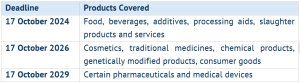
The 2026 deadline is the pressing one. Cosmetics and consumer goods companies that have not started now face a tightening window. For non-food industries in particular, forward compliance planning is no longer optional—it is a condition of continued market presence.
Why it matters: enforcement is accelerating alongside stricter labeling and publication rules. The direction of policy is clear, and the cost of waiting rises with each phase.
Indonesia vs. ASEAN Regional Context
Halal certification looks different across the region, and those differences reveal Indonesia’s distinct position.
- Malaysia (JAKIM) — The recognized global benchmark. Certification is largely voluntary but internationally trusted, making Malaysia primarily a halal production and export hub rather than a large consumer market. Its ecosystem—industrial parks, logistics, export clusters—is the region’s most mature.
- Thailand (CICOT) — Voluntary certification used as an export competitiveness tool, backed by a strong food-processing industry and government support.
- Vietnam — An early-stage, export-oriented manufacturing base using halal certification to attract investment and reach Muslim-majority markets, despite a small domestic Muslim population.
- Singapore (MUIS) — Voluntary but highly trusted, focused on domestic consumer confidence rather than export volume.
Here is the insight that matters: peers use halal mainly as an export lever. Indonesia is the outlier because it combines the largest Muslim consumer base in ASEAN (around 240 million) with a progressively mandatory, state-led regime. That makes its system potentially more burdensome than voluntary models—but far more commercially consequential. In Indonesia, certification is not about winning export contracts elsewhere; it is about accessing the demand that already exists at home.
Investor Opportunities
Access to the world’s largest Muslim consumer market. With roughly 240 million Muslims, Indonesia offers scale that few markets can match. As certification becomes mandatory across food, beverages, cosmetics, pharmaceuticals, and consumer goods, it turns into a prerequisite for reaching that demand. For many businesses, the market opportunity alone justifies the investment required.
First-mover advantage in regulated sectors. Each phase of the rollout resets the competitive field. Firms that certify ahead of a deadline can capture shelf space and consumer trust while competitors are still preparing documentation and audits. In categories facing the 2026 and 2029 deadlines, moving early is a genuine strategic edge.
Certification as a competitive moat. Once obtained, certification is not easily replicated overnight—it requires verified supply chains, audits, and internal compliance systems. Firms that build this capability early create a barrier for later entrants and strengthen relationships with retailers and distributors who prioritize compliant products.
A credible, increasingly connected framework. BPJPH’s state-backed system has improved transparency and legitimacy, and expanding Mutual Recognition Arrangements are linking Indonesia to international halal networks. This can ease certain compliance steps for foreign firms over time—though any benefit from broader global harmonization should be treated as upside, not a guarantee.
Key Risks and Constraints
Compliance costs and resource demands. Documentation, audits, and internal compliance systems all carry cost. For foreign firms, supplier verification, international audits, and regulatory coordination add further expense. These burdens fall unevenly—larger multinationals absorb them more easily than SMEs, which may find market entry harder.
Supply chain traceability. Halal integrity must hold across raw materials, additives, processing, storage, transport, and distribution. For companies running complex international supply chains, maintaining that integrity across many suppliers and jurisdictions is a real operational challenge.
Evolving requirements. The phased framework keeps expanding, and rules on labeling and publication continue to tighten. Businesses must monitor developments and adjust to shifting timelines—a planning challenge in itself.
Ecosystem maturity versus Malaysia. This is the constraint investors most often underweight. Indonesia’s market size is unmatched, but its halal infrastructure lags. Malaysia has invested heavily in halal industrial parks, specialized logistics, and export-oriented clusters. Market size alone should not drive location decisions; supply chain infrastructure, export connectivity, and support services matter too. For some strategies, a Malaysia-Indonesia split—produce in one, sell into the other—may make more sense than concentrating everything in a single market.
Skylight’s Opinion
For investors, Indonesia’s halal regime is best understood as a structural feature of market entry, not a discretionary certification issue. The critical question is not whether compliance adds cost—it does—but whether that cost is justified by access to Indonesia’s scale, its clear regulatory trajectory, and the long-term growth of its halal economy.
The behavior of foreign firms already answers much of the question. More than 4,100 have obtained certification rather than exit the market, treating it as the price of participation in a market too large to ignore.
The strategic reading is straightforward: what looks like a barrier today is becoming a competitive advantage tomorrow. Firms that certify early, build compliant supply chains, and factor regional ecosystem gaps into their location strategy will be best positioned as enforcement deepens. Those that wait will face the same requirements with less time, weaker differentiation, and a harder path to the shelf.
Latest Update
- Indonesia Becomes Southeast Asia’s First Official Partner Country at INNOPROM 2026
- INNOPROM is an international industrial trade fair held in Yekaterinburg, Russia, July 6–9, 2026. Indonesia became the first Southeast Asian country to serve as Official Partner Country, following the UAE (2024) and Saudi Arabia (2025), and used the event to introduce its New National Industrialization Strategy.
- Four main cooperation themes were put forward: technology transfer and partnerships, direct investment in ready-to-operate industrial areas, downstream supply chain development for critical minerals (nickel, bauxite, copper, cobalt, and lithium), and agri-food processing collaboration.
- Seven industrial cooperation agreements were concluded, including a foundational MoU between the Indonesian and Russian Ministries of Industry, five private sector technical and commercial agreements, and an MoU between the Indonesian Industrial Estate Association (HKI) and Russia’s Industry Association. These build on two earlier MoUs in shipbuilding and chrysotile asbestos studies signed in December 2025.
- Bilateral trade between Indonesia and Russia reached USD 4.8 billion in 2025, with Indonesian exports to Russia rising 7.5%. The I-EAEU CEPA, signed in December 2025, grants preferential treatment to 90.5% of tariff lines, broadening Indonesia’s access to Eurasian markets.
- VinFast Partners with Chinese Firms to Develop EV Battery Recycling in Indonesia
- Vietnamese EV manufacturer VinFast has partnered with CATL and Gotion High-Tech to develop an EV battery recycling system in Indonesia. The partnership aims to establish a circular battery value chain by collecting and recycling end-of-life EV batteries while recovering critical minerals such as lithium and nickel.
- Under the collaboration, the Chinese companies will provide battery recycling technologies and expertise, while VinFast seeks to build its long-term capabilities in battery lifecycle management and sustainable resource utilization. The initiative supports Indonesia’s efforts to strengthen its domestic EV ecosystem.
- The partnership comes as Indonesia rapidly expands its battery manufacturing capacity. A battery plant being developed by CATL and Indonesia Battery Corporation (IBC) in West Java is scheduled to begin operations by the end of 2026, with an initial production capacity of 6.9 GWh—equivalent to batteries for approximately 130,000 electric vehicles annually. The facility is planned to expand to 15 GWh in the future, significantly increasing the volume of batteries that will eventually require recycling.
- The project highlights the growing importance of battery recycling as Indonesia develops a comprehensive EV supply chain. By integrating battery production with end-of-life recycling, the country aims to strengthen resource security, improve sustainability, and reinforce its position as a regional EV manufacturing hub.
- Indonesia Accelerates Batam as a Global Maritime and Investment Gateway
- During a July 7 meeting with the Batam Development Authority (BP Batam), President Prabowo Subianto placed Batam at the center of Indonesia’s next phase of economic transformation, more than a free trade zone, emphasized that the island should serve as a national model for downstream industrialization, investment acceleration, regulatory reform, and logistics efficiency—backed by world-class infrastructure and faster public services.
- A key priority is upgrading Batam’s port system, including a new international port integrated with industrial estates, advanced manufacturing, a hyperscale data center, and global shipping networks. The goal is to strengthen Batam’s role in regional supply chains by cutting logistics costs, improving export competitiveness, and cementing its position as one of Southeast Asia’s most strategic production and distribution hubs.
- Realized investment reached IDR 69.3 trillion (USD 4.2 billion) in 2025. In Q1 2026, investment hit IDR 17.48 trillion (USD 1.07 billion), a 102.85% year-on-year increase. Capital continues to concentrate in high-value sectors, including electronics and machinery, digital infrastructure, energy, and industrial estates.
- Batam sits just off Singapore and anchors the Batam-Bintan-Karimun (BBK) industrial corridor, a natural gateway for cross-border trade and investment. Singapore remained Indonesia’s largest foreign investor in 2025, contributing around 30.9% of total FDI, with much of that capital concentrated in the BBK corridor across property, logistics, clean energy, and the digital economy.
- Further investment is expected in AI data centers, electronics, and the EV supply chain, aligning Batam with the future-oriented industries reshaping Indonesia’s investment landscape.
- Indonesia Launches D-8 Halal Expo to Advance US$500 Billion Intra-Bloc Trade Goal
- The Indonesian government has launched the inaugural D-8 Halal Expo Indonesia (HEI) 2026 in Jakarta, bringing together businesses, investors, and policymakers from Developing Eight (D-8) member countries to promote halal products, investment, and economic cooperation through exhibitions and business matching.
- Deputy Foreign Minister Anis Matta stated that D-8 members aim to increase intra-bloc trade to US$500 billion by 2030, up from the current level of approximately US$150–160 billion. He emphasized that the halal economy will serve as a key driver of regional economic integration and sustainable growth.
- The expo showcases a wide range of halal industries, including food and beverages, pharmaceuticals, cosmetics, fashion, and Islamic finance. Business matching sessions and investment forums are also being held to strengthen the global halal supply chain and expand investment among D-8 member states.
- The government also highlighted halal-certified gelatin produced from fish processing by-products, such as fish skin and bones, as a priority sector. By converting underutilized marine resources into high-value halal ingredients for the food, pharmaceutical, and cosmetics industries, Indonesia aims to strengthen the halal raw materials supply chain and enhance the competitiveness of the global halal industry.
- Indonesia Breaks Ground on Bali Waste-to-Energy Plant as First Phase of Nationwide Rollout
- Danantara Indonesia, the country’s sovereign wealth fund, has broken ground on a waste-to-energy (WtE) plant in Denpasar, Bali, marking the first project under the government’s nationwide waste-to-energy development program. The initiative aims to address Bali’s long-standing waste management challenges while expanding renewable energy generation.
- Bali, Indonesia’s leading tourism destination, has struggled for years with growing volumes of municipal waste and marine plastic pollution, raising environmental concerns and affecting the island’s tourism industry. The new WtE facility is expected to play a key role in reducing landfill dependence and improving waste management.
- The project is led by Danantara Indonesia, with China’s Zhejiang Weiming Environment Protection Co., Ltd. participating as the investor, developer, and operator. Wangneng Environment Co., Ltd. has also been selected as a technology and operational partner. With a total investment of approximately IDR 3 trillion (US$171.4 million), the facility is expected to process 1,500 tonnes of municipal waste per day (more than 500,000 tonnes annually) and generate enough electricity to supply approximately 100,000 households.
- The Indonesian government intends to use the Bali project as a model for similar facilities across the country. The nationwide rollout is expected to strengthen waste management, support the country’s renewable energy transition, and promote a circular economy.
- ESR and Mitsubishi Corporation Subsidiary Expand Logistics Partnership in West Java
- ESR, one of the Asia-Pacific region’s largest real asset managers, and PT MC Urban Development Indonesia (MCUDI), the Indonesian real estate development subsidiary of Mitsubishi Corporation, have expanded their strategic partnership to jointly develop two Grade A logistics and industrial facilities in Karawang and Cikarang, West Java. The two projects have a combined expected asset value of more than US$80 million, with completion scheduled for Q3 2027.
- The Karawang Logistics and Industrial Hub will be developed within Suryacipta Industrial Estate on a 100,000 sqm site, providing approximately 63,000 sqm of leasable space. Meanwhile, the Cikarang Logistics and Industrial Hub, located in Jababeka Industrial Estate, will occupy a 68,000 sqm site with more than 48,000 sqm of leasable area, targeting multinational manufacturers, logistics providers, and e-commerce companies.
- The projects represent the second phase of ESR and MCUDI’s collaboration in Indonesia, following the successful completion and leasing of Karawang Logistics Park 1 and Cikarang Logistics Parks 1 and 2. Both facilities will incorporate Japanese-quality specifications, including seismic-resistant structures, advanced fire protection systems, LED lighting, skylights, and infrastructure for future solar panel installation.
- The investment reflects growing demand for modern logistics infrastructure in West Java, Indonesia’s largest manufacturing base. By expanding high-quality logistics facilities in major industrial estates, ESR and MCUDI aim to strengthen supply chain efficiency and support the continued growth of manufacturing, logistics, and e-commerce industries in the region.
- TESS Holdings Completes EFB Pellet Demonstration Plant in North Sumatra
- TESS Holdings Co., Ltd. has completed an EFB (Empty Fruit Bunch) pellet demonstration plant through its Indonesian subsidiary, PT PTEC Research and Development, in Sei Mangkei Industrial Estate, North Sumatra. The facility officially held its completion ceremony on 3 July 2026 and has an annual production capacity of approximately 10,000 tons.
- The plant converts Empty Fruit Bunches (EFB)—an agricultural residue generated during palm oil production—into biomass fuel pellets. The pellets will be supplied to customers in both Indonesia and Japan, with the project demonstrating the entire value chain from production to commercial distribution.
- TESS positions resource-circulating biomass fuel as one of the core businesses under its TX2030 Medium-Term Management Plan. Through this demonstration facility, the company will continue R&D toward large-scale commercialization, targeting a production capacity of 100,000 tons of EFB pellets per year during the plan period.
- The project supports Indonesia’s downstreaming strategy by converting palm oil residues into value-added biomass fuel instead of treating them as waste. It also strengthens the country’s biomass industry while contributing to circular economy initiatives and carbon neutrality efforts.
- JOGMEC, JAPEX, and Indonesian Partner to Assess Hydrocarbon Potential in North Sumatra Basin
- Japan Organization for Metals and Energy Security (JOGMEC), Japan Petroleum Exploration Co., Ltd. (JAPEX), and Universitas Padjadjaran (UNPAD) have launched a joint project to assess the oil and natural gas exploration potential of the North Sumatra Basin. The study will evaluate both onshore and offshore areas through geological and geophysical surveys in cooperation with the Indonesian government.
- The North Sumatra Basin is one of Indonesia’s most established hydrocarbon-producing regions and continues to attract exploration interest following recent gas discoveries. The project will analyze existing geological and geophysical data while conducting additional surveys to identify prospective exploration targets.
- The assessment is being carried out under JOGMEC’s overseas geological and geophysical survey program, which supports resource potential evaluations through collaboration with foreign governments, national oil companies, and research institutions. The initiative is intended to facilitate future upstream investment opportunities for Japanese companies.
- The project reflects Japan’s continued interest in strengthening energy cooperation with Indonesia and securing long-term energy resources. If promising prospects are identified, the study could lead to future oil and gas exploration and development projects involving Japanese companies in Indonesia.
End of Document
REFERENCES
- Skylight Analytics Hub
- https://bpjph.halal.go.id/en/detail/ab-1?utm_
- https://bpjph.halal.go.id/en/detail/bpjph-cosmetic-products-must-have-halal-certification-by-october-2026?utm_
- https://www.jetro.go.jp/biz/areareports/2025/627ac4d8be401ad5.html
- https://www.jetro.go.jp/world/reports/2024/02/44c73f4c6a3f52c3.html
- https://www.jetro.go.jp/ext_images/_Reports/02/2024/44c73f4c6a3f52c3/202403.pdf
- https://www.jetro.go.jp/ext_images/agriportal/online/2024/d7f59900e17818b9/SIHALAL_manual_SHLN-Newest_jp.pdf
- https://www.jetro.go.jp/agriportal/online/d7f59900e17818b9.html
- https://th-biz.com/oneasia-202511/
- https://squareup.com/jp/ja/townsquare/tips-for-halal-business
- https://www.jetro.go.jp/ext_images/agriportal/online/2024/d7f59900e17818b9/JETRO_Halal_Seminar_jp.pdf
- https://www.pewresearch.org/short-reads/2017/08/09/muslims-and-islam-key-findings-in-the-u-s-and-around-the-world/
- https://cmsbl.halal.go.id/uploads/Law_33_2014_on_Halal_Product_Assurance_8c328febdf.pdf
- https://bpjph.halal.go.id/en/detail/good-news-registration-for-foreign-halal-certificate-opens-on-the-sihalal-menu?utm_
- https://jhba.jp/halal/certification/
- https://www.maff.go.jp/j/kokusai/kokkyo/food_value_chain/document/attach/pdf/study-24.pdf
- https://kbli.co.id/resources/halal-certification?utm_
- https://productregistrationindonesia.com/id/indonesia-halal-certification-2/?utm_
- https://jhba.jp/magazine/vol-1182-
- https://en.antaranews.com/news/421813/indonesia-unveils-sbin-to-attract-eurasian-investment-at-innoprom-2026
- https://ekonomi.tvrinews.com/berita/ts5r6uu-indonesia-tampilkan-produk-manufaktur-unggulan-di-innoprom-2026
- https://wartaekonomi.co.id/read621569/bidik-pasar-eurasia-indonesia-kantongi-tujuh-mou-industri-di-innoprom-2026?page=2
- https://rri.co.id/ekonomi/bisnis/2557456/industri-kimia-indonesia-bidik-pasar-eurasia-lewat-innoprom-2026#google_vignette
- https://news.metal.com/hadith…/newscontent/103992119-lithium-battery-vietnamese-automaker-vinfast-establishes-partnerships-with-gotion-high-tech-and-catl?utm_
- https://www.reuters.com/world/china/indonesia-china-lithium-battery-plant-operational-by-end-2026-official-says-2025-06-29/?utm_
- https://www.nna.jp/news/2944276
- https://jambi.antaranews.com/berita/660907/prabowo-arahkan-batam-jadi-gerbang-maritim-dan-investasi-global?utm_
- https://www.jetro.go.jp/biz/areareports/2026/87e6d29ff6d89fab.html?utm_
- https://www.thejakartapost.com/business/2026/07/08/prabowo-touts-batam-as-indonesias-next-global-maritime-investment-gateway
- https://en.antaranews.com/news/421916/indonesia-unveils-first-d-8-halal-expo-eyes-500b-trade-goal?utm_
- https://www.nna.jp/news/2944273
- https://en.vietnamplus.vn/indonesias-bali-starts-work-on-first-waste-to-energy-plant-to-tackle-waste-boost-green-transition-post348017.vnp?utm_
- https://technode.global/2026/07/10/danantara-initiates-indonesias-waste-to-energy-plant-in-bali/?utm_
- https://www.dealstreetasia.com/stories/danantara-waste-to-energy-plant-488411?utm_
- https://www.nna.jp/news/2944257
- https://www.reuters.com/business/energy/indonesia-wealth-fund-danantara-starts-construction-first-waste-to-energy-2026-07-08/?utm_
- https://www.nna.jp/news/2944282
- https://ashu-aseanstatistics.com/news/303037-75485819530
- https://www.wisebk.com/asean_news/378415/
- https://en.antaranews.com/amp/news/421689/esr-and-mcudi-expand-indonesia-logistics-partnership?utm_
- https://www.esr.com/news/mcudi-partnership-indonesia/?utm_
- https://mcud-id.com/projects/logistics-warehouse/cikarang-logistics-park3.html
- https://ashu-aseanstatistics.com/news/305337-35453815530
- https://ssl4.eir-parts.net/doc/5074/tdnet/2847983/00.pdf
- https://www.logi-today.com/974239?utm_
- https://www.nna.jp/news/2943766
- https://www.japex.co.jp/en/news/detail/20260708_01/?utm_
- https://www.jogmec.go.jp/english/news/release/release_00450.html?utm_