EXECUTIVE BRIEF: Weakening Rupiah Leaves Indonesia’s Middle Class More VulnerableStrategic Snapshot
The weakening Indonesian Rupiah is often viewed primarily through financial-market indicators such as exchange rates, capital flows, and monetary policy. For investors and business leaders, however, the more important risk may be unfolding in the real economy.
As the Rupiah approaches the IDR 18,000 per US Dollar level, sustained currency weakness could place increasing pressure on household purchasing power, domestic consumption, corporate performance, and investment momentum. This matters because Indonesia remains a consumption-led economy, with household spending contributing approximately 54% of GDP.
The key question is therefore not only whether the Rupiah will weaken further, but whether Indonesia’s middle class—and especially its near-middle-class households—can continue supporting economic growth amid rising living costs and more cautious spending behavior.
Why Rupiah Weakness Matters Beyond FX Markets
A weaker Rupiah can support export competitiveness in selected sectors. However, for a large domestic-demand economy, the downside risks are significant. Currency depreciation raises the cost of imported goods, overseas services, and domestically produced goods that rely on imported inputs.
The effect is not always immediate. It often moves gradually through supply chains before appearing in consumer prices. Yet over time, sustained Rupiah weakness can affect a wide range of household expenditures, including digital and connected living, imported essentials and global lifestyle spending.
Even goods manufactured in Indonesia may remain exposed to foreign exchange movements because many producers depend on imported machinery, industrial components, chemicals, packaging materials, and raw materials. As companies face higher input costs, they may absorb part of the pressure temporarily, but prolonged currency weakness increases the likelihood that these costs are passed on to consumers.
For global investors, this transmission mechanism is critical. Rupiah depreciation is not only an FX issue; it can become a domestic-demand issue, a margin issue, and ultimately an investment-confidence issue.
Pressure on Household Purchasing Power
When imported costs rise, households experience the impact through higher prices and reduced real purchasing power. Middle-income consumers are especially important because they form the core of Indonesia’s domestic consumption engine.
As living costs increase, households typically begin to reprioritize spending. Essential categories such as food,housing, healthcare, education, and transportation become the main focus. Discretionary categories are more vulnerable to slower growth, including:

Major financial commitments may also be delayed. Consumers may postpone property purchases, vehicle upgrades, education-related spending, and other long-term decisions as they seek to protect savings and reduce financial risk.
At the household level, these adjustments may appear manageable. Across millions of consumers, however, the cumulative effect can be material. In an economy where household consumption accounts for approximately 54% of GDP, even a gradual shift toward defensive spending can weaken broader economic momentum.
Changing Consumption Patterns and Sector Exposure
The impact of weaker purchasing power will not be evenly distributed across sectors. Businesses with exposure to essential goods and lower-price consumer segments may prove more resilient. Companies dependent on discretionary spending, imported goods, or premium-positioned products may face greater pressure.
Price sensitivity is likely to become more important. Consumers may trade down to cheaper brands, delay purchases, reduce frequency of consumption, or seek better value.
Businesses that can adjust pricing, product mix, and distribution models quickly may be better positioned than those relying on premium demand or imported cost structures.
From Consumer Caution to Business and Investment Risk
For Indonesia, changing consumption behavior is not only a household issue. It directly affects corporate earnings, business confidence, and investment decisions.
As demand softens, companies may face slower revenue growth at the same time that input costs rise. This is especially challenging for firms with high exposure to imported raw materials, foreign-currency liabilities, or imported inventory.
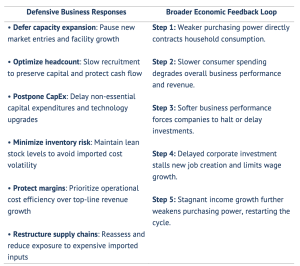
Over time, what begins as a currency issue can develop into a broader demand-and- investment challenge. For global investors, this feedback loop is central to assessing Indonesia’s near-term growth resilience and therisk-reward profile of market exposure.
The Near-Middle-Class Vulnerability
The most important area of concern may not be the established middle class, but the millions of households that have only recently moved into middle-income status. These near-middle-class households are more economically fragile. They often have:
- Limited savings buffers
- Higher sensitivity to inflation
- Mortgage, vehicle, or consumer debt obligations
- Less flexibility to absorb rising living costs
- Greater exposure to job and income volatility
Unlike higher-income households, they have fewer financial reserves to manage prolonged price increases. As a result, they may be among the first consumers to reduce discretionary spending, delay major purchases, or cutback on services linked to lifestyle improvement and upward mobility.
This matters for Indonesia’s long-term growth story. Middle-class expansion has been an important driver of domestic demand, consumer-sector growth, and investor interest. If currency weakness and inflation pressures slow that expansion, the impact could extend beyond short-term consumption and affect the country’s broader economic trajectory.
The risk is not an immediate collapse in consumption. The more realistic concern is a gradual weakening ofthe consumer base that has historically underpinned Indonesia’s economic resilience.
Social Stability and Confidence Considerations
The implications of prolonged economic pressure extend beyond household budgets and corporate earnings. As living costs rise and purchasing power weakens, households may become more concerned about economic security, job stability, and future mobility.
While social challenges cannot be attributed solely to exchange-rate movements, sustained financial pressure combined with slower job creation and weaker income growth can increase social vulnerability. This is especially relevant in urban areas, where cost-of-living pressures are more visible and household expectations for upward mobility are often higher.
For investors, social stability is closely linked to institutional confidence, policy credibility, and the operating environment. A prolonged squeeze on households could create broader concerns around consumer sentiment,public trust, and policy response.
For policymakers, protecting purchasing power is therefore not only an economic objective. It is also important for maintaining confidence, resilience, and social stability during periods of external and domestic pressure.
Key Indicators Investors Should Watch
Investors and business leaders should monitor whether Rupiah weakness remains contained within financial markets or begins to transmit more deeply into the real economy. Important indicators include:
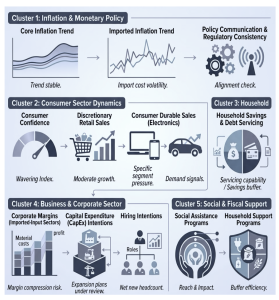
*)These indicators can help assess whether the pressure is temporary and manageable or whether it is becoming a more persistent constraint on Indonesia’s domestic growth engine.
Implications for Businesses and Investors
Businesses should prepare for a more cautious consumer environment, especially in discretionary and non-essential categories. Investors should pay close attention to margin exposure, pricing power, demand resilience, and currency sensitivity across sectors. Key actions include:
- Preparing for more price-sensitive consumers and softer discretionary
- Focusing on value-driven products and services as affordability becomes a more important purchasing factor.
- Improving operational efficiency and cost management to offset rising input costs and currency volatility.
- Strengthening supply-chain resilience, including localization where feasible, to reduce dependence on imported inputs.
- Reviewing foreign-currency exposure across costs, debt, inventory, and
- Monitoring shifting demand patterns to identify resilient segments and potential market-share opportunities.
- Preserving strategic flexibility in hiring, inventory, capital expenditure, and expansion planning.
Businesses that adapt early to changing consumer behavior may be able to protect margins and gain share,even in a more difficult macro environment.
Skylight’s Perspective
The weakening Rupiah should not be viewed solely as a currency-market event. Its broader significance lies in the chain reaction it can create across the economy. A prolonged period of currency weakness can raise imported costs, compress household purchasing power, change consumption behavior, pressure corporate margins, delay investment decisions, slow job creation, and weaken economic momentum. These risks are especially important in Indonesia because household consumption accounts for approximately 54% of GDP.
For global investors, the central issue is whether Indonesia can maintain the strength of its domestic-demand engine while navigating currency pressure. The country’s long-term investment case remains closely tied to the resilience of its consumers, the credibility of its institutions, and the ability of businesses and policymakers to preserve confidence.
Ultimately, Indonesia’s challenge is not simply managing a weaker Rupiah. It is ensuring that income growth, economic opportunity, and public confidence continue to outpace rising living costs. The long-term strength of the economy will depend not only on the value of the Rupiah, but also on the resilience of its institutions, businesses, and people.
Latest Update
- Linknet Deploys AI-Based CCTV in the EJIP Industrial Park
- Linknet is expanding its strategic partnership with This collaboration on telecommunications infrastructure management has now been enhanced through the adoption of AI-based IoT technology.
- Previously, Linknet had been operating in the area as a provider of dedicated internet services tosupport tenants’ connectivity With the signing of the latest addendum, these services havenow been expanded to include AI- powered CCTV solutions.
- The installation of this smart surveillance camera system is intended to maximize security in the area while boosting operational There are three main functions of the IoT solution implemented at EJIP:
- Perimeter Security: Closely monitors the perimeter of the EJIP area to prevent potential security
- Traffic Management: The system can detect illegal parking and monitor the speed of vehicles passing through the industrial park.
- Water Level Detection: An environmental risk mitigation feature that monitors water levels as an early warning system.
- The technological upgrade is not merely seen as a facility upgrade, but a strategic investment to ensure maximum security and operational efficiency for all tenants.
- Indonesia Establishes New State Holding to Oversee its Industrial Park Business Unit
- Indonesia has established Kawasan Industri Indonesia, a new holding company tasked with consolidating the management of state-owned industrial park and enhancing the country’s attractiveness to investors.
- The initiative forms part of a broader government effort to streamline industrial park governance, addressing longstanding concerns over fragmented management and limited strategic integration.
- Historically, industrial park operations were managed alongside unrelated business activities, creating inefficiencies and underscoring the need for a dedicated entity focused exclusively on industrial park development and management.
- The new holding company will assume oversight of all industrial park owned by SOEs enabling a more coordinated, professional, and integrated management approach.
- Prior to this restructuring, SOE industrial park were managed under the Danareksa ecosystem. In 2024, Danareksa also announced plans to modernize its industrial park portfolio and diversifyrevenue streams beyond traditional land sales.
- Under the latest restructuring led by Danantara, Danareksa will refocus on its core asset management mandate, while industrial park operations will be transferred to the newly established holding company.
- The legal and corporate restructuring process is expected to be completed by 2026, with Kawasan Industri Indonesia targeted to commence full operations in 2027.
- Batang Industropolis (KITB) Explores Investments in Solar Power Plants and WaterTechnology from Hungary
- KITB is actively exploring investment partnerships in the green energy and water utility technology sectors through the Indonesia–Hungary Investment and Business Forum held in The forum brought together KITB management, Hungarian business leaders, and government representatives to identify opportunities for strategic collaboration.
- One of the key initiatives under discussion is a partnership with Merlion Teck Ltd to develop a utility-scale solar power plant within the industrial park. The proposed project envisions a capacity of 100–200 MW across a 200- hectare site, supporting KITB’s transition toward a more sustainable industrial ecosystem.
- The solar power project is planned under a long-term Power Purchase Agreement (PPA)framework, ensuring a stable supply of renewable energy for industrial tenants while supportingIndonesia’s broader decarbonization objectives.
- Beyond renewable energy, KITB is also exploring cooperation with Iconic Energy Kft, particularly in the areas of circular economy implementation, resource efficiency, and zero-waste industrial operations.
- The initiative is further complemented by a partnership with the Hungarian Water Partnership (HWP)to advance clean water treatment technologies and water quality monitoring systems within the industrial park.
- Through the potential implementation of an integrated water management pilot project, KITB aimsto enhance utility reliability, improve environmental performance, and strengthen its positioning as a sustainable and future- ready industrial park.
- KOMEHYO Bets on Indonesia’s Growing Appetite for Branded Resale
- KOMEHYO Holdings plans to establish a local subsidiary in Indonesia by October 2026 to expand its reach in Southeast Asia’s luxury resale The company chose Indonesia for its strong demand and long-term growth prospects, positioning the country as a future strategic hub for secondhand luxury goods.
- Tentatively named PT KOMEHYO INDONESIA, the new Jakarta-based entity will handle the procurement, resale, and distribution of luxury items, including handbags, watches, jewelry, and precious The subsidiary will operate with IDR 20 billion in capital as a wholly owned venture led by Toru Imai, signaling wider Japanese corporate confidence in Indonesia’s expanding upper-income segments and the rising appeal of branded resale.
- Indonesia’s Largest Refrigerator Factory Officially Opens in Suryacipta
- Midea Electronics Indonesia has officially inaugurated the largest refrigerator manufacturing facility in Located within the Suryacipta City of Industry, the factory occupies more than 150,000 square meters and is designed with an annual production capacity exceeding 2 million units.
- The facility manufactures a broad range of refrigeration products, including side-by-side refrigerators, double-door and single-door refrigerators, as well as chest Notably, it is the first and only factory in Indonesia capable of producing both side-by-side refrigerators and chest freezers within a single integrated production complex.
- With a production capacity of over 2 million units annually, the factory is positioned to serve bothIndonesia’s growing domestic market and export demand across Southeast The investment is also expected to generate thousands of employment opportunities, further supporting local economic development and strengthening Indonesia’s position as a regional manufacturing hub for consumer electronics.
- Inpex Acquires Barong Offshore Exploration Block in East Java
- Japanese energy company INPEX has secured participation in the Barong offshore exploration block located off the coast of East Java and South Sulawesi, Indonesia, as part of Indonesia’s Second Petroleum Bidding Round The block was awarded to a consortium consisting of INPEX and BP Exploration Indonesia.
- Under the Production Sharing Contract (PSC), INPEX will serve as the operator with a 51%participating interest, while BP will hold the remaining 49%. The PSC signing took place during the Indonesian Petroleum Association (IPA) Convention Exhibition 2026.
- The Barong block is considered a promising gas exploration area with estimated gas potential of approximately 9 trillion cubic feet (tcf). The area is strategically located in eastern offshore Java, where several oil and gas discoveries have already been identified and where medium- to long-term domestic energy demand is expected to remain stable.
- For INPEX, the acquisition aligns with its broader strategy to strengthen its upstream natural gas and LNG business in Southeast Asia, particularly in Indonesia, which remains one of the company’score operational regions. The project also complements INPEX’s existing Indonesian LNG portfolio, including the Abadi LNG Project in the Masela Block. This development reflects continued Japanese participation in Indonesia’s upstream energy sector amid the country’s efforts to enhance energy security and attract foreign investment into oil and gas exploration.
- Fujifilm and Siloam Hospitals Partner to Advance Healthcare Services
- Fuji film Indonesia and Siloam Hospitals Group signed a memorandum of understanding to build a comprehensive healthcare ecosystem integrating artificial intelligence, medical education, and clinical capacity The collaboration focuses on improving healthcare services, developing medical professionals, and addressing public health challenges. Siloam will deploy Fujifilm’s AI-powered solutions to streamline screening, enhance diagnostic accuracy, and support faster, data-driven decisions. The partnership also includes a new Endoscopy Training Center to teach advanced gastrointestinal procedures—such as EUS, ERCP, and colonoscopies—while facilitating academic collaboration with Universitas Pelita Harapan and knowledge exchanges with Japanese institutions.
- To address pressing public health needs, the organizations will combat tuberculosis by rolling out AI-equipped portable X-ray systems, expanding early detection and screening access in underserved communities. This strategic alliance aims to accelerate the adoption of advanced medical technologies, strengthen the domestic healthcare workforce, and improve patient access to high-quality care across Indonesia.
- KAO Partners with Recyclers to Turn Used Diapers into Fuels
- Kao Indonesia has launched a circular economy pilot project with Kertabumi Recycling Center inSouth Tangerang to transform used disposable diapers into high-quality diesel fuel. The initiative tackles growing waste management challenges by using pyrolysis to process the cleaned, dried, and separated plastic components of the diapers. This highly efficient treatment takes three to five hours and yields about five liters of fuel from just five kilograms of waste material. The resulting fuel currently powers facility generators, equipment, and vehicles, and it boasts a cetanenumber of 64.1, which delivers better engine ignition performance than conventional diesel.
- To secure a steady supply of materials, the partners created an incentive- based collection model with two local community health centers, rewarding residents with 500 grams of Kao detergent in exchange for 50 cleaned diapers of any brand. This grassroots approach successfully collected approximately 4,800 diapers by April 2026 and builds upon a continuous sustainability partnership with Kertabumi that began in 2020. Because Indonesia records more than four million births annually, diaper waste remains a pressing environmental issue, prompting Kao to plan broader collection expansions using its established waste recovery network.
- A US$10 Million Electronics Factory is Being Built in Millenium Industrial Park
- PT Berkat Elektrik Sejati Tangguh (PT BEST) has commenced the development of a new airconditioner and washing machine manufacturing facility within the Millennium Industrial Park, a 1,600-hectare industrial park in The project, valued at approximately US$10 million, officially broke ground on May 25 2026.
- The first phase of development will occupy around 5 hectares and will focus on the productionof air conditioners and washing machines through an integrated manufacturing system designed to enhance operational efficiency and product quality.
- The investment is fully funded through domestic direct investment, reflecting growing confidence among local manufacturers amid rising domestic demand and the continued expansion of Indonesia’s manufacturing sector.
- The new facility forms part of PT BEST’s long-term strategy to strengthen national manufacturing capabilities, expand local production capacity, and contribute to the development of a more resilient and competitive industrial base in Indonesia.
End of Document
REFERENCES
- Skylight Analytics Hub
- https://ugm.ac.id/en/news/weakening-rupiah-leaves-indonesias-middle-class-more-vulnerable/
- https://jakartaglobe.id/business/rupiah-weakness-has-become-excessive-indonesian- economist-warns
- https://www.kompas.id/artikel/en-nilai-rupiah-melemah-bagaimana-dampaknya-pada- perekonomian
- https://en.tempo.co/read/2097530/rupiah-weakens-how-it-affects-indonesian- households#google_vignette
- https://inet.detik.com/business/d-8492302/linknet-garap-cctv-berbasis-ai-di-kawasan-industri- ejip
- https://jakartaglobe.id/business/indonesia-establishes-new-state-holding-to-oversee-industrial- parks
- https://investor.id/macroeconomy/440448/pemerintah-resmi-bentuk-holding-kawasan-industri- beroperasi-mulai-2027#goog_rewarded
- https://money.kompas.com/read/2026/05/27/084000526/kek-industropolis-batang-jajaki- investasi-plts-hingga-teknologi-air-dari
- https://komehyohds.com/ir/upload_file/tdnrelease/2780_20260514532655_P01_.pdf
- https://www.cnnindonesia.com/ekonomi/20260521194113-625-1360961/fujifilm-dan-siloam- teken-mou-untuk-majukan-layanan-medis-indonesia
- https://disway.id/read/949129/pabrik-kulkas-terbesar-di-indonesia-resmi-dibuka-buka-peluang- ribuan-lapangan-kerja
- https://www.inpex.com/news/2026/20260520.htmlhttps://www.inpex.com/news/2026/20260521.html
- https://www.nna.jp/news/2918320
- https://www.inews.id/multimedia/photo/investasi-pabrik-elektronik-senilai-10-juta-dolar-as- dibangun-di-tangerang